


10 Tips for Parenting a Child with Demand Avoidance

What if a request that seems small to you feels overwhelming to your child? Getting dressed, leaving the house or starting homework can turn into a stressful negotiation, leaving you unsure whether to hold a boundary or ease the pressure. If you’re searching for the top 10 tips for a child with demand avoidence for parents, you’re likely looking for practical ideas that don’t rely on rewards, consequences or ever-firmer instructions.
Demand avoidance may be connected with anxiety, a need for autonomy, sensory overwhelm or other experiences. It doesn’t have one explanation for every child. In the UK, PDA is often discussed as a profile rather than a standalone diagnosis. Whatever is behind your child’s response, it can help to look beyond apparent refusal and consider what is making a demand feel difficult. This guide offers ten ways to adjust your language, make routines more manageable and protect your connection with your child. It also explains when wider concerns may be worth discussing with a clinician, without assuming that demand avoidance alone points to ADHD or another diagnosis.
Table of Contents
Demand avoidance in children: start by understanding what may be underneath
Repeated refusals can make ordinary routines exhausting. Getting dressed, eating breakfast or leaving the house may become a tense negotiation, and it’s understandable to feel unsure what to try next. Begin with observation, not blame. Demand avoidance describes a pattern in which a child finds it difficult to meet requests or expectations. It isn’t, by itself, a diagnosis or proof that they’re deliberately being difficult.
Different factors may be behind a child’s response. Anxiety, uncertainty about what will happen, sensory strain, tiredness or other pressures can all play a part. The same child may respond differently from one situation to another. Pathological Demand Avoidance (PDA) is discussed as a profile associated with autism, but noticing avoidance doesn’t establish that a child has this profile or any particular diagnosis. The overview of Pathological Demand Avoidance (PDA) offers further context.
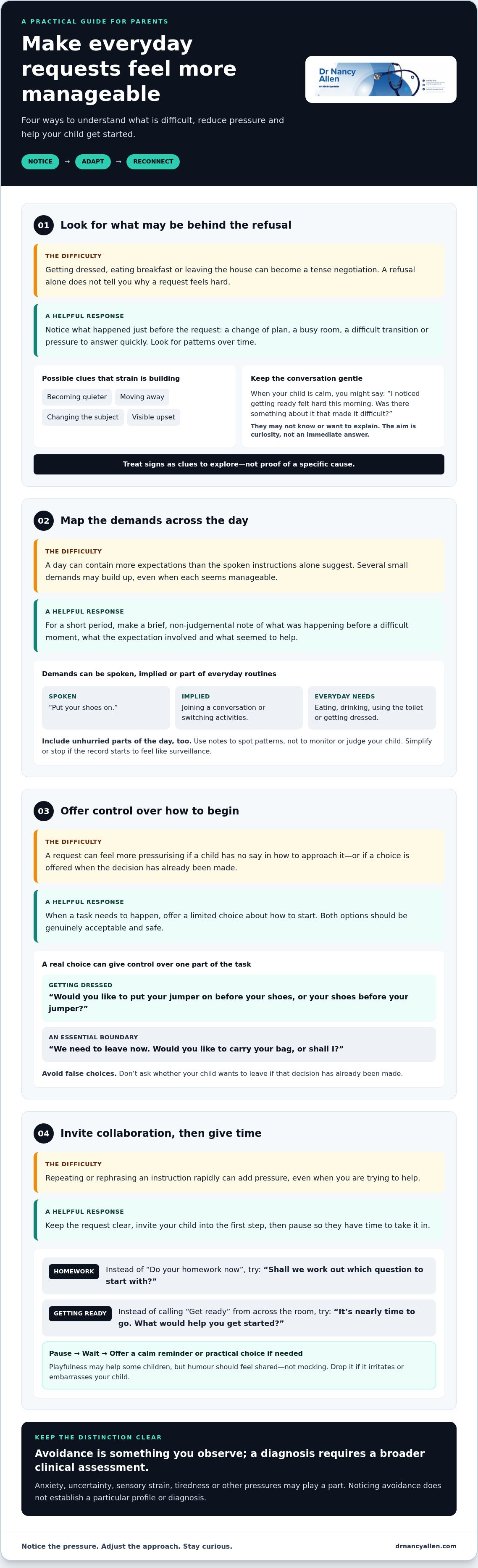
“Avoidance is something you observe; a diagnosis requires a broader clinical assessment.” Keeping that distinction in mind can help you stay curious and respond to your child’s needs, rather than settling too quickly on a label. It’s a useful starting point for the top 10 tips for a child with demand avoidence for parents.
Tip 1: Look for the need or stress behind the refusal
Notice what happened just before a request and how your child responded. Was there a sudden change of plan, a busy room, a difficult transition or pressure to answer quickly? Look for patterns over time, including particular situations, people or times of day, and signs that strain is building. These might include becoming quieter, moving away, changing the subject or getting visibly upset. Treat them as clues to explore, not proof of a specific cause.
When your child is calm, try gentle curiosity rather than asking them to defend themselves. You might say, “I noticed getting ready felt hard this morning. Was there something about it that made it difficult?” They may not know or want to explain, and that’s all right. The aim is to understand the moment, not to get an immediate answer or agreement.
Tip 2: Map demands across the whole day
Some expectations are spoken aloud, such as “Put your shoes on”. Others are implied: joining a conversation, switching activities when a programme ends or following a familiar routine. Transitions and bodily needs, including eating, drinking, using the toilet or getting dressed, can also involve demands. Several small expectations may build up, even if each seems manageable on its own.
For a short period, make a simple, non-judgemental note of what was happening before difficult moments, what the expectation involved and what seemed to help. Include unhurried parts of the day, too. Keep the record brief and use it to spot patterns, not to monitor or judge your child. If it starts to feel like surveillance, simplify it or stop. The purpose is to notice where pressure might be building and what could make daily expectations easier to approach.
Tips 3 and 4: Make requests feel less pressurised
Changing how you make a request may help your child hear it, consider it and respond. These are adjustments to try, not scripts that work every time. A phrase that feels relaxed to one child may feel pressurising to another, so notice your child’s response and adapt. Keep your meaning honest: a calm tone doesn’t mean disguising a request or pretending something is optional when it isn’t.
Low-pressure communication is clear, respectful and adaptable. It gives your child room to process and, where possible, influence how they begin, without removing necessary expectations.
Tip 3: Offer a choice of how, not whether, to begin
When a task needs to happen, offer a limited choice about how to start, but only if both options are genuinely acceptable and safe. For example, “Would you like to put your jumper on before your shoes, or your shoes before your jumper?” lets your child choose the order without suggesting that getting ready is optional.
For an essential boundary, be straightforward: “We need to leave now. Would you like to carry your bag, or shall I?” Avoid false choices, such as asking whether your child wants to leave when the decision has already been made. A choice should give them real control over one part of the situation, not make them responsible for an adult decision.
Tip 4: Turn instructions into collaborative invitations
An abrupt “Do your homework now” might become, “Shall we work out which question to start with?” Instead of repeating “Get ready” from across the room, go over and say, “It’s nearly time to go. What would help you get started?” These approaches keep the request clear while inviting your child into the first step. Adapt the wording to their age and preferences.
Then pause. Repeating or rephrasing the request rapidly can add pressure, even when you’re trying to help. Give your child time to take in what you’ve said. If they don’t respond, wait before offering a calm reminder or practical choice. Playfulness can help some children. For example, you could ask whether the socks or shoes are ready to leave first. But humour should feel shared, never mocking. If it irritates or embarrasses your child, drop it.
Neither approach is a trick, and your child may still find a request difficult. Treat each attempt as information: did the choice feel genuine, was the invitation clear, and did your child have enough time to respond? As you try the top 10 tips for a child with demand avoidence for parents, notice which communication changes feel respectful and useful for your family.
If demand avoidance sits alongside broader concerns about attention, impulsivity or activity levels, a child ADHD assessment may be one route to clinical discussion. Avoidance alone doesn’t establish ADHD, but a wider assessment may help bring clarity to concerns about your child’s development.
Tips 5 and 6: Balance autonomy with essential boundaries
Reducing pressure doesn’t mean removing every expectation or allowing unsafe behaviour. Decide which expectations are essential, where your child can have flexibility and what can wait. This helps protect safety without treating every preference or routine as equally urgent. Your child’s capacity can change with stress, context and available support, so the balance may need to shift from one day to the next.
Tip 5: Separate safety boundaries from flexible preferences
Keep essential limits clear, calm and proportionate. Holding a hand near traffic or stopping an unsafe action is different from insisting that a child puts their coat on before their shoes. Explain the reason in words your child can understand, then focus on maintaining the boundary safely. You can be flexible about timing or method, but don’t make an unsafe action seem acceptable.
Essential: Needs linked to immediate safety or health, such as staying close near traffic or taking necessary steps when unwell. Keep the limit in place; offer flexibility only where it remains safe.
Negotiable: Expectations where more than one safe option works, such as the order of getting dressed, which suitable coat to wear or when to complete a routine task.
Deferrable: Tasks that can reasonably wait or be dropped today, such as a non-urgent chore or an optional activity when your child’s capacity is low.
Tip 6: Choose which demands matter today
At the start of a demanding day, sort expectations into those that must happen now, those that can be negotiated and those that can wait. This isn’t about giving up on routines; it’s a way to avoid using your child’s limited energy on every preference at once. Revisit the priorities during illness, disrupted sleep, change or other stressful periods, when usual expectations may feel harder to manage.
Expectations can multiply when adults aren’t aligned. One person may expect homework before screen time, while another assumes the child can have a break first. A brief conversation between caregivers can help agree what is essential today, what can flex and who will explain any change. Keep the plan manageable, and don’t add extra tasks simply because one demand has gone smoothly.
Prioritising is a practical judgement, not a test of consistency. A boundary can stay firm while the surrounding routine changes. Review what matters, consider your child’s current capacity and adjust expectations without blame when circumstances shift.
Tips 7 and 8: Reduce escalation and reconnect after difficult moments
When a child is becoming distressed, the immediate aim isn’t to win an argument or complete the task at any cost. A rising voice, tense posture, pacing, retreating, going quiet or struggling to respond may suggest they need less input or more time. These signs don’t tell you exactly what your child is experiencing, but they can be a cue to pause and focus on safety and recovery.
Tip 7: Pause the demand when distress is rising
Try a simple sequence. First, stop adding questions and instructions. Next, check for immediate safety, including whether your child or anyone nearby is at risk. Then reduce noise, other people or demands where you can, and give your child space and time to settle. A quiet “I’m here. We can pause” may be easier to take in than several explanations or repeated requests.
Distress can look different from one child to another. Some children may shout or move away; others may become still, quiet or seem unable to answer. A shutdown or intense reaction shouldn’t automatically be treated as deliberate misbehaviour, but it doesn’t reveal a single cause either. Stay nearby if that is reassuring and safe, and avoid crowding or touching your child unless needed to prevent immediate harm. If there’s immediate danger, call 999. For urgent medical help that isn’t an emergency, call NHS 111.
Tip 8: Repair connection after the moment has passed
Wait until your child is calmer before revisiting what happened. They may need time before they can talk, and there’s no need to demand an apology or explanation straight away. Brief reassurance, such as “We had a hard moment. I’m glad we’re together again,” can show that the relationship is still secure without pretending the incident didn’t matter.
Later, use open, non-blaming questions to learn what might help next time: “Was there a part that felt especially hard?” or “Would you like to tell me, draw it or leave it for now?” Listen without correcting their account. You could gently share your own observation: “I noticed it got harder when we were rushing.” The purpose is to understand and plan, not to interrogate or prove who was right.
Repair can also include calmly addressing any harm or practical consequences once your child is ready, while keeping the conversation proportionate. If talking is difficult, agree on a simple signal or another way to show they need a pause. For a related step-by-step resource, explore the ADHD meltdown action plan. These approaches can help families protect safety and reconnect after difficult moments.
Tips 9 and 10: Build consistent support around your child
Support is easier to sustain when the adults around your child share a few clear priorities. Consistency doesn’t mean using identical words or expecting every day to go smoothly. It means reducing surprises where possible, sharing useful observations respectfully and recognising that parents have limits, too. Choose changes you can maintain rather than creating a long plan that adds pressure to family life.
Tip 9: Share a simple, consistent approach with school
If demand-related distress affects your child at school, consider speaking with relevant staff, such as their class teacher or SENCO. Agree on a small number of practical adjustments to try, then review whether they help. For example, staff might give advance notice of a transition or identify a quieter way for your child to begin a task. Keep the plan focused and workable.
Share neutral observations rather than conclusions or blame: “The change from break to class seemed difficult on these days” is more useful than “They refuse to cooperate”. Note what happened beforehand, what your child did and what appeared to help. Ask your child, in an age-appropriate way, what they’re comfortable with adults knowing. Share only information relevant to supporting them, and avoid discussing sensitive details more widely than needed.
Where ADHD is already part of the picture, a guide for teachers supporting children with ADHD may offer useful ideas for school conversations. Aim for a shared understanding of your child’s needs, not a single explanation for every difficult moment.
Tip 10: Seek support when concerns affect daily life
If distress or avoidance persists and affects family routines, learning, friendships or your child’s wellbeing, it may help to discuss your concerns with an appropriate health professional. Take a brief record of recurring situations, changes you’ve noticed and what seems to ease or increase pressure. This gives the conversation a practical starting point without requiring you to arrive with a diagnosis.
Demand avoidance alone doesn’t establish ADHD, autism or another diagnosis. Supporting your child’s day-to-day needs and assessing possible co-occurring needs are different questions. If you have broader concerns about attention, impulsivity or activity levels as well as avoidance, a child ADHD assessment with Dr Nancy Allen may be one option for clinical discussion. The assessment can explore whether ADHD may be relevant; it doesn’t assess or treat demand avoidance itself.
Include your own capacity in the plan. Choose one or two changes to focus on, share responsibilities where possible and revisit the approach when circumstances change. The top 10 tips for a child with demand avoidence for parents are starting points, not standards you must meet perfectly. If broader ADHD concerns are on your mind, you can consider whether discussing a child ADHD assessment with Dr Nancy Allen feels like a helpful next step.
Choose one manageable next step
You don’t need to change everything at once. Pick one adjustment that feels realistic for your family, try it consistently for a little while and notice what your child’s response may be telling you. Progress can begin with understanding one difficult moment, rather than achieving a perfect routine.
Use the top 10 tips for a child with demand avoidence for parents as a starting point, and remember that practical support and clinical assessment answer different questions. Demand avoidance alone doesn’t establish ADHD. If you have broader concerns about attention, impulsivity or activity levels, a clinical discussion may help you consider what support is appropriate.
Dr Nancy Allen offers ADHD assessments for children and adults, with online consultations available UK-wide. An ADHD assessment usually takes around 75 minutes, and diagnosis can be done in as little as 72 hours. Online ADHD assessments are often available within 72 hours, subject to availability. If exploring this option feels right for your family, explore child ADHD assessment and personalised support.
Small, thoughtful steps count. With patience and the right support, you can keep learning what helps your child feel safer, understood and more able to manage everyday life.
Frequently Asked Questions
Is demand avoidance the same as PDA?
No. Demand avoidance describes behaviour a parent may notice, while PDA is a term some people use for a particular profile; terminology and professional understanding vary. A label isn’t needed to make everyday support more responsive. For example, you can tell school that transitions are difficult and explain what seems to help, without presenting PDA as a confirmed diagnosis. If concerns persist or affect daily life, discuss them with an appropriate health professional.
Can a child have demand avoidance without autism or ADHD?
Yes. Avoiding requests doesn’t, on its own, establish autism, ADHD or another diagnosis. A child might resist a particular expectation because they’re uncertain about what comes next, feel anxious, are experiencing sensory strain or are affected by circumstances such as tiredness. Notice whether avoidance happens across settings or around specific tasks, but don’t use a checklist to diagnose your child. Seek professional advice if wider concerns continue.
Should I use rewards and consequences with a child who avoids demands?
There’s no single approach that suits every child. A reward chart may motivate one child but feel like added pressure to another; a consequence can sometimes intensify conflict or shame. Notice what happens after you introduce a strategy, including whether your child becomes more anxious or disengaged. Keep safety limits clear, recognise effort without making affection conditional, and pause any approach that repeatedly worsens distress.
How can I make everyday requests easier for my child?
Try changing one part of a routine at a time, such as preparing school items the night before or giving your child a quiet moment before asking them to move on. The top 10 tips for a child with demand avoidence for parents offer ideas, but no wording works for everyone. Observe whether the task, timing or setting is the difficulty, and seek professional advice if everyday activities remain hard to manage.
What should I do when my child becomes distressed by a demand?
Keep your words brief and check that everyone is safe. If it’s safe to do so, reduce noise or other demands and avoid asking your child to explain themselves straight away. For instance, “We’re safe. I’ll give you some space” may be enough. Once the moment has passed, you can ask whether they’d prefer to talk, draw or leave it for later. If there’s immediate danger, call 999; for urgent medical help, contact NHS 111.
When should I seek professional support for my child’s demand avoidance?
Consider seeking advice if distress or avoidance is ongoing, affects your child’s wellbeing, or makes home or school life difficult. Before an appointment, jot down a few examples: what was expected, what happened and how it affected your child. Demand avoidance alone doesn’t establish ADHD; an assessment considers broader clinical information. If ADHD is one of your wider concerns, a child ADHD assessment may be an option to discuss with Dr Nancy Allen.



Comments