


ADHD and Sleep: Expert Tips for a Better Night’s Rest

Updated: 2 days ago
What if better sleep doesn’t begin with a perfect bedtime routine? If winding down feels difficult or a consistent schedule is hard to maintain, advice to simply “go to bed earlier” can feel frustrating. The relationship between ADHD and sleep can work both ways: ADHD-related patterns may make rest harder, while poor sleep can affect attention and day-to-day wellbeing.
You’re not failing because a routine hasn’t been easy to keep. Finding an approach that works often means understanding what gets in the way, whether that’s an active mind at bedtime, changing schedules, medication or another possible sleep concern. One pattern alone can’t tell you what’s causing the problem, and this article isn’t a substitute for a clinical assessment.
Here, you’ll explore how ADHD and sleep difficulties may interact, try manageable strategies that can flex around real life, and learn when persistent problems are worth discussing with a clinician. Dr Nancy Allen draws on more than 25 years of clinical experience in ADHD assessment and personalised planning. An assessment can explore sleep concerns alongside wider ADHD symptoms, while persistent sleep difficulties may need separate clinical advice.
Table of Contents
ADHD and sleep: why struggling to rest deserves attention
Repeatedly lying awake, waking through the night or starting the day exhausted can wear you down. Poor rest may affect more than your energy: ordinary tasks can take more effort when sleep is unpredictable. If you’re wondering whether ADHD and sleep are connected for you, noticing the difficulty is a useful first step, not a reason to blame yourself or reach a diagnosis on your own.
ADHD-related sleep difficulties are sleep experiences that may occur alongside ADHD; they are not, by themselves, a separate diagnosis. Sleep problems have several possible influences, including stress, changes in routine, health concerns, medication and other sleep conditions. A sleep pattern alone can’t establish ADHD or explain what is causing poor rest.
For a related perspective on how anxiety can affect rest, watch this video:
What does ADHD and sleep mean in everyday life?
Sleep concerns might mean finding it hard to wind down, going to bed at different times, waking during the night or getting up without feeling restored. Some people describe thoughts that keep racing when they want to settle; others find evening activities or losing track of time push bedtime later than planned. These are examples, not a checklist everyone with ADHD will recognise.
Experiences differ between individuals and can change over time. A late bedtime, restless night or tired morning may be worth observing, but none is proof of ADHD. A general overview of Attention-deficit hyperactivity disorder (ADHD) can offer background, but understanding an individual’s sleep requires more than matching one experience to a description.
Why is it worth paying attention to ongoing sleep problems?
When rest is poor, concentration may feel less steady, patience can run thin and everyday routines may take more effort. That can be discouraging, especially if you’re already working hard to stay organised or manage competing demands. These effects are real, but they don’t identify their cause. Tiredness can follow disrupted sleep for many reasons, so it’s better treated as something to understand than as evidence of ADHD.
Keep a simple note of what you notice: roughly when you go to bed and wake, whether you wake overnight, and how rested you feel in the morning. You don’t need a perfect sleep diary. A few observations can help you spot patterns and explain what’s been happening if you discuss it with a clinician.
This guide focuses on practical changes that can fit around real-life barriers, rather than a flawless routine. If sleep disruption persists, affects your days or worsens, clinical advice can help explore possible contributing factors. An ADHD assessment considers a wider history of symptoms and their impact. It is not a sleep test and cannot, on its own, diagnose or treat a sleep disorder.
Recognise your sleep pattern without assuming ADHD is the only cause
Noticing what happens around sleep can make a conversation with a clinician more specific. It needn’t become another demanding routine. The aim is to describe what you experience and whether it changes over time, not to decide for yourself that ADHD or a particular sleep condition is responsible.
What details can help you describe a sleep problem?
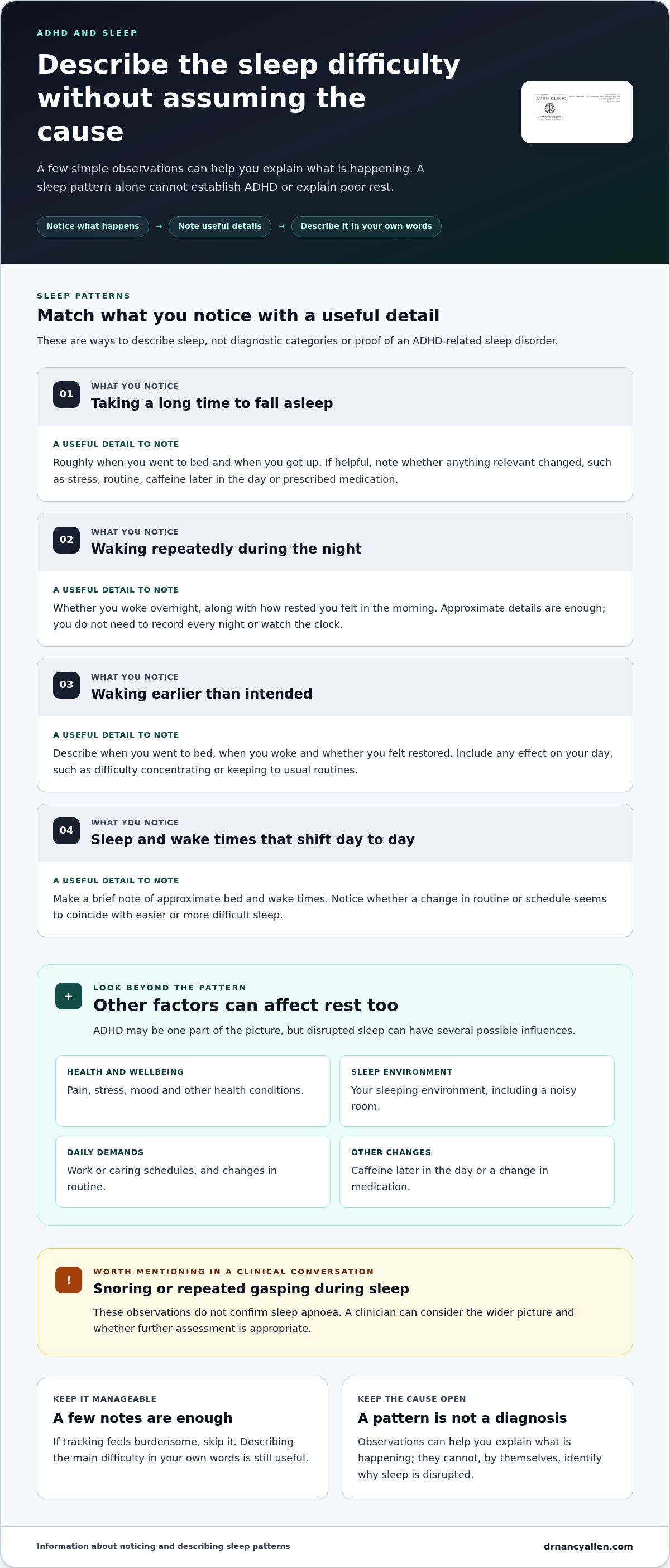
Start with the part of sleep that feels most difficult. You might take a long time to fall asleep, wake repeatedly, wake earlier than intended, or find your sleep and wake times shifting from day to day. These are useful descriptions, not diagnostic categories or proof of an ADHD-related sleep disorder. You can read more about why the ADHD brain struggles to switch off for a deeper explanation of one possible connection.
If it helps, make a quick note in your phone or on paper. Approximate details are enough:
Roughly when you went to bed and when you got up.
Whether you woke during the night, and how rested you felt in the morning.
Any changes that might be relevant, such as stress, a different routine, caffeine later in the day, or prescribed medication.
You don’t need to record every night or watch the clock. A few brief observations can help you spot whether a change tends to coincide with better or more difficult sleep. Note the effect on daytime life too, such as whether tiredness makes concentrating, managing your mood or keeping to usual routines harder. If tracking feels burdensome, skip it. Describing the main difficulty in your own words is still useful.
Could another factor be affecting your sleep?
Yes. Pain, stress, mood, your sleeping environment and other health conditions can all play a part. For instance, when physical discomfort or tension interferes with rest, integrative providers such as Dr. Philip Boamah | Natural Medicine & Physical Therapy highlight how addressing musculoskeletal health and overall wellbeing can support better rest. Work or caring schedules, a noisy room, or a change in medication may also be relevant. ADHD may be one part of the picture, but it shouldn’t be assumed to explain every disrupted night.
Notice symptoms that may be useful to mention in a clinical conversation. For example, tell a clinician if someone has noticed loud snoring or repeated gasping during sleep. These observations don’t confirm sleep apnoea, just as a later-than-planned bedtime doesn’t establish a delayed sleep phase. A clinician can consider the wider picture and whether further assessment is appropriate.
Bring your notes, if you have them, alongside questions about how sleep affects your day. If you’re also exploring whether ADHD symptoms fit a broader pattern, personalised ADHD assessment and treatment planning can help consider that wider history. An ADHD assessment isn’t a sleep test, but it can support a fuller discussion of your concerns and next steps.
Which ADHD-friendly sleep strategies are worth trying first?
Sleep advice can sound simple until remembering, starting and repeating a new habit become the hardest parts. Rather than attempting a complete bedtime overhaul, choose one small experiment that addresses the obstacle you notice most. With ADHD and sleep, a strategy is a tool to test, not a rule you’ve failed if it doesn’t suit you.
The options below address different barriers. Pick the one that seems most relevant, then make the first step easy to see and repeat. If a fixed routine is unrealistic, aim for a flexible anchor instead.
These are starting points, not guarantees. Keep the option that feels manageable and seems helpful; adapt or set aside the rest. If you’re taking prescribed medication, don’t change its timing or dose without discussing it with your prescriber.
How can you make a wind-down routine easier to begin?
Make it brief, visible and forgiving. Choose one repeatable cue, such as dimming the lights or putting tomorrow’s essentials by the door. A note on the bathroom mirror or an alert can help if remembering is the sticking point. You don’t need an elaborate sequence. If an evening goes off plan, simply restart at the next opportunity.
What if bedtime procrastination keeps you awake?
A late bedtime isn’t always a deliberate choice. Sometimes time slips by; sometimes staying up is a way to reclaim personal time after a day shaped by other demands. If that feels familiar, consider a gentle transition alarm and a small, protected period for an enjoyable activity before bed. The aim is to make room for downtime without letting it take over the night. Explore revenge bedtime procrastination causes and solutions for more on this pattern.
Test one change for a few nights, then consider whether it was easy enough to repeat and whether anything felt different. Adjust the cue or choose another strategy; this is information, not a pass-or-fail test. If you’re also exploring wider ADHD symptoms, personalised ADHD assessment and treatment planning can help place those concerns in context. It isn’t a sleep assessment or a promise that sleep will improve.
Build a realistic ADHD-friendly sleep plan for your week
A useful plan should fit around your actual life, not an ideal week with no interruptions. If shift changes, caring duties or variable energy make a fixed routine unrealistic, build around a small action you can adapt. Change one element at a time so you can notice what seems helpful, rather than trying several new habits and feeling unsure which made a difference.
Use this short sequence as a starting point:
Choose one goal. Pick the part of sleep that causes the most difficulty, such as winding down or getting up at a manageable time.
Add a cue. Link the action to something you already do, or use a visible reminder to make it easier to remember.
Prepare your surroundings. Make one practical adjustment, such as placing essentials where you’ll find them or reducing a distraction.
Review what happened. Notice whether the action fitted your week and whether your sleep or daytime energy felt different.
Adjust gently. Keep, change or drop the action. Then decide whether to try another single adjustment.
How can you choose a sleep goal that’s small enough to keep?
Ask which point feels most disruptive: winding down, bedtime, waking or interruptions during the night. Turn it into one observable action you can repeat on most days, such as setting out tomorrow’s clothes before bed or using the same gentle reminder to start getting ready. A goal should allow for imperfect days. A routine is a support, not a test of willpower.
Make the plan flexible from the outset. If you work shifts, link your cue to the end of a shift rather than a particular clock time. If caring responsibilities interrupt evenings, choose an action that can be resumed later or simplified on demanding days. On low-energy days, the smallest version still counts. The aim is a routine that can bend without disappearing altogether.
How should you review whether a strategy is helping?
After giving your change a reasonable trial, consider three things: whether it was manageable, whether it seemed to affect your sleep observations, and how your energy or daily routine felt. Detailed records aren’t essential. If a strategy adds pressure without helping, adapt it or let it go. Persistent or worsening sleep difficulties deserve clinical discussion, not self-blame.
Sleep concerns can be considered alongside wider symptoms, but an ADHD assessment isn’t a sleep test and can’t establish the cause of disrupted rest on its own. If you’re seeking clarity about broader patterns, explore an adult ADHD assessment as one route to understanding your symptoms and discussing personalised next steps.
Dr Nancy Allen has more than 25 years of clinical experience in ADHD assessment and personalised planning. If you’re ready to explore whether an assessment may help you understand wider ADHD concerns, find out about adult ADHD assessment.
When should you seek clinical advice about ADHD and sleep?
Consider speaking with a clinician if sleep disruption continues, has a marked effect on your daytime life, or is getting worse. You don’t need to wait until you’ve tried every routine or strategy. Ongoing tiredness can make work, study, relationships and everyday tasks harder, and it’s reasonable to ask for help understanding what may be contributing.
Sleep difficulties can sit alongside ADHD, but they can also have other causes. A discussion can help decide whether sleep concerns and possible ADHD symptoms need to be considered together or separately. If you take prescribed medication and have questions about its effect on sleep, speak with the clinician who prescribes it. Don’t change the dose or stop taking it on your own.
What should you raise in a clinical conversation?
It may help to describe the sleep pattern in plain terms: what tends to happen, how long it’s been going on, and how it affects your days. Mention anything you’ve tried and whether it made a difference, even if you only tested it briefly. You don’t need a complete diary or a perfect account to start the conversation.
Changes to prescribed medicines or other relevant health changes.
Concerns about mood, concentration, energy or feeling safe.
Whether symptoms vary with stress, routine or your working pattern.
Ask whether your sleep concerns may need separate consideration from ADHD symptoms. If someone has noticed loud snoring, repeated gasping or another unusual change during sleep, include that too. These details don’t confirm a particular sleep condition, but they can help a clinician understand what you’re experiencing and consider appropriate next steps.
How can ADHD assessment add context to sleep difficulties?
An ADHD assessment explores a wider history, including symptoms and their impact across different parts of life. This may help clarify whether ADHD-related needs warrant further discussion, but an assessment is not a sleep test and cannot establish every sleep diagnosis or explain every cause of disrupted rest.
For some people, sleep concerns come up as part of a broader effort to understand attention, organisation or daily functioning. Dr Nancy Allen brings more than 25 years of clinical experience to personalised ADHD assessment and treatment planning. Her approach can help place possible ADHD symptoms in context and consider individual next steps, without assuming that a diagnosis or plan will resolve sleep problems.
If wider ADHD symptoms are also on your mind, you can find out about online ADHD consultations with Dr Nancy Allen. A clear conversation about your history and concerns can be a considered first step towards understanding what support may be appropriate.
Take the next step at your own pace
You don’t need to solve every sleep difficulty before asking for help. If concerns about ADHD and sleep are part of a wider pattern affecting your daily life, a thoughtful conversation can help you consider what you’d like to understand next. Bring your questions, uncertainties and the parts that feel hardest to explain; there’s no need to have everything worked out in advance.
An ADHD assessment explores symptoms and their impact as part of a broader picture. It isn’t a sleep test, and no assessment or treatment plan can promise to resolve sleep problems. Its value is in helping you understand your ADHD-related needs and consider appropriate next steps in a personalised way.
Dr Nancy Allen offers secure online consultations across the UK, drawing on more than 25 years of clinical experience in ADHD assessment and personalised treatment planning. If you’re ready to explore whether this support fits your wider concerns, Explore personalised ADHD assessment and support.
A manageable next step is enough. You deserve to have your concerns heard and considered with care.
Frequently Asked Questions
Can ADHD cause insomnia?
ADHD can be associated with difficulty falling asleep, but insomnia shouldn’t automatically be attributed to ADHD. An active mind, changes in routine, stress, medication and other health factors may all contribute. A late night now and then doesn’t necessarily mean you have insomnia. If you regularly struggle to sleep despite having the opportunity to rest, discuss the pattern with a clinician, who can consider possible causes and appropriate next steps. In addition, addressing broader lifestyle and nutritional factors with specialised services such as Enas Wellness can offer practical support for those managing insomnia.
Is delayed sleep phase linked to ADHD?
Yes, research has linked ADHD with a tendency towards later sleep and wake times for some people. This may mean feeling alert late at night and finding an early start difficult, even when you’re trying to keep a conventional schedule. It doesn’t happen to everyone with ADHD, and a late preference alone can’t confirm a circadian rhythm condition. Describe how your sleep timing affects work, study or other commitments to a clinician.
Can poor sleep make ADHD symptoms feel worse?
Yes. Inadequate or disrupted rest can make attention, emotional regulation and impulse control more difficult, which may intensify challenges that are already present. For example, after a poor night, it might take more effort to follow a conversation or pause before responding. This doesn’t show that sleep is the only cause, or confirm ADHD. Consider whether difficulties are longstanding and present in different settings, rather than judging from one tired day.
Can ADHD medication affect sleep?
ADHD medication can affect sleep for some people, although effects vary with the medicine and the individual. If you notice a change after starting treatment or adjusting a prescribed dose, note when it happens and how it affects your nights. Share this with the prescriber, who can advise on your specific treatment. Don’t stop taking medication or change its dose or timing without their guidance.
Could sleep apnoea be mistaken for ADHD?
Sleep apnoea can cause disrupted rest and daytime difficulties, including problems with concentration, which may overlap with some ADHD-related experiences. Signs such as witnessed pauses in breathing, loud snoring or repeated gasping are worth mentioning to a clinician, but they don’t establish a diagnosis. ADHD assessment considers a wider history of symptoms, while suspected sleep apnoea needs appropriate clinical consideration in its own right.
Do adults with ADHD need less sleep?
No. Having ADHD doesn’t mean an adult inherently needs less sleep. People differ in how much rest suits them, but regularly sleeping too little shouldn’t be treated as an inevitable feature of ADHD or a sign that you’re coping well. If you feel persistently unrefreshed or struggle to stay alert during the day, consider what may be affecting your sleep and discuss ongoing concerns with a clinician.



Comments