


ADHD and Tics in Children: Signs and Next Steps

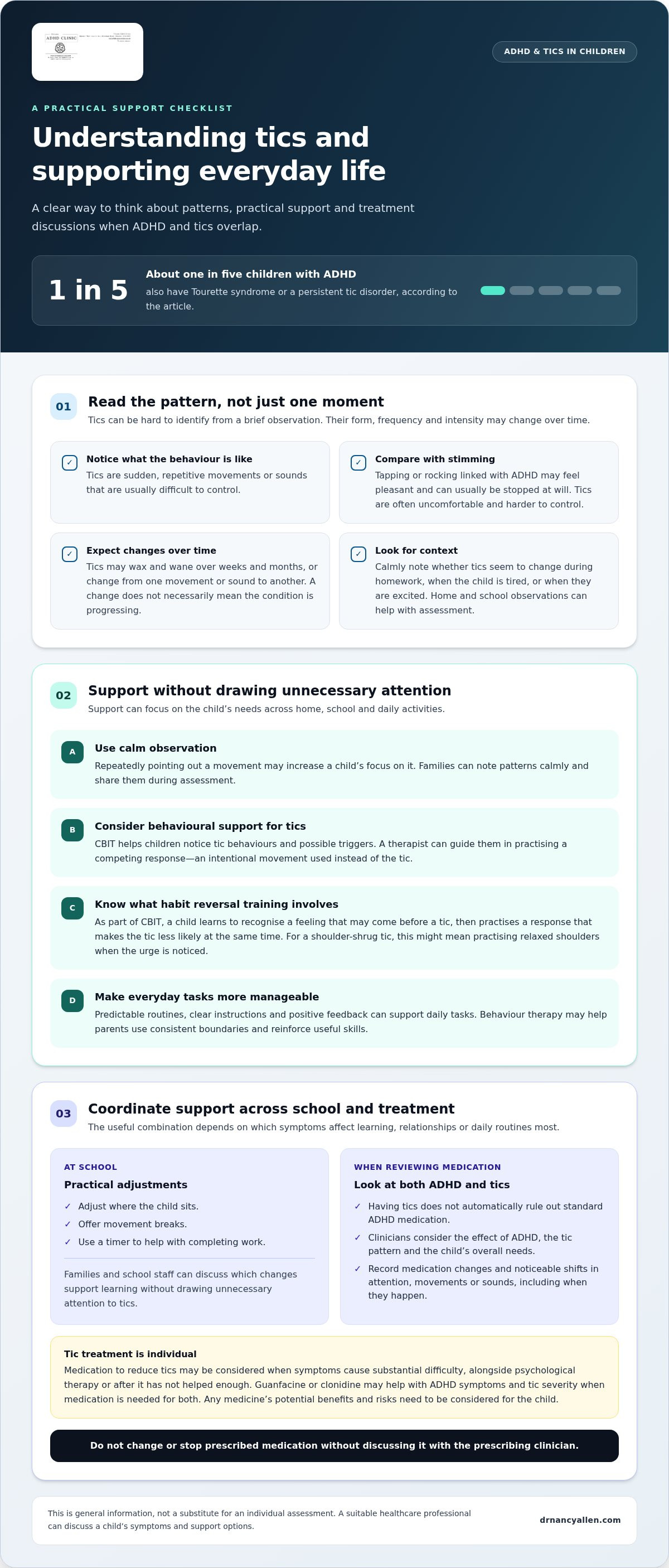
ADHD and tics in children can occur together: about one in five children with ADHD also have Tourette syndrome or a persistent tic disorder. ADHD doesn’t cause tics, but children with ADHD are more likely to experience them. Tics are sudden, repetitive movements or sounds that are usually difficult to control.
Noticing a new movement or sound can be unsettling, especially when it’s unclear whether it’s a tic, fidgeting or another behaviour. The distinction matters, but symptoms can change over time and may not be easy to identify from a brief observation.
This article explains how ADHD and tics can overlap, how to distinguish tics from other behaviours, and how tic symptoms may change as a child grows. It also outlines what an assessment may involve and how support or treatment might be considered, without assuming that every tic needs treatment.
Table of Contents
ADHD and Tics: What’s the Connection?
ADHD and tics in children can occur together, but ADHD doesn’t cause tics. Around half of young people with Tourette syndrome also have ADHD. This overlap can make it harder to work out which behaviours relate to attention, impulse control or tic symptoms.
Consider what the movement feels like and how it happens. ADHD-related stimming, such as tapping or rocking, may feel pleasant and can usually be stopped at will. Tics are often uncomfortable and harder to control. Tics can also occur alongside obsessive compulsive disorder, so assessment considers the child’s wider experiences.
For an overview of tic signs and treatment, watch this video:
When ADHD and tics both affect daily activities, behavioural treatment may be considered. Comprehensive behavioural intervention for tics, or CBIT, helps children notice tic behaviours and identify possible triggers. A therapist can guide them in practising a competing response, an intentional movement used instead of the tic.
Habit reversal training is a core part of CBIT. The child learns to recognise the feeling that may come before a tic, then practises a response that makes the tic less likely to happen at the same time. For example, a child with a shoulder-shrug tic might practise keeping their shoulders relaxed when they notice the urge. A trained therapist teaches and adapts the approach.
CBIT also helps families understand how attention can affect tics. Repeatedly pointing out a movement may increase a child’s focus on it. Instead, parents can calmly note patterns, such as whether tics change during homework, when the child is tired, or when they are excited, and share those observations during assessment.
ADHD symptoms can affect behaviour without a child choosing to be disruptive. Inattention may make it hard to finish a worksheet; impulsivity may lead to calling out. Predictable routines, clear instructions and positive feedback can support everyday tasks. Behaviour therapy may help parents set consistent boundaries and reinforce useful skills.
School support can address practical barriers. A teacher might adjust where a child sits, offer movement breaks or use a timer to help them complete work. Families and school staff can discuss which changes support learning without drawing unnecessary attention to tics.
A useful treatment plan considers both conditions and the child’s priorities. CBIT focuses on managing tics, while ADHD support may include behavioural strategies and school adjustments. The right combination depends on which symptoms interfere most with learning, relationships or daily routines.
Medication for ADHD in children with tics
Having tics doesn’t automatically rule out standard ADHD medication. Treatment decisions take into account how strongly ADHD affects daily life, the tic pattern and the child’s overall needs.
ADHD medication and tic worsening
Families may worry that ADHD medication could affect existing tics. This matters because families may worry that treating attention difficulties could aggravate movements or a vocal tic. NICE guideline NG87, reviewed in 2025, does not treat tic disorders as a reason to avoid standard ADHD medication. Clinicians consider the benefits and risks in the context of the child’s symptoms.
Stimulant medication and tics
Stimulants, including methylphenidate, can be used to treat ADHD in children who also have tics. A randomised trial found methylphenidate did not worsen tics compared with placebo, and a meta-analysis found no increased risk of tic onset or worsening with stimulant medication. These findings help explain why tics alone don’t automatically exclude this treatment option.
One study found that a high dose of dextroamphetamine worsened tic occurrences. This is one reason to review changes in both attention and tics during treatment, rather than assuming every change has the same cause. A clinician can consider the medication, dose and timing alongside the child’s day-to-day experience.
Medication options for tics
Medication to reduce tics may be considered when symptoms cause substantial difficulty, alongside psychological therapy or after it has not helped enough. This matters because medicine is not the only intervention, and tic treatment depends on how much symptoms affect the child. Guanfacine or clonidine, both alpha-2 agonists, may help with ADHD symptoms and tic severity when medication is needed for both.
For more troublesome tics, clinicians may consider other medicines, including antipsychotics, but their benefits must outweigh their risks. Treatment choices take account of side effects and the child’s mental and physical health. A medicine that helps one symptom may not suit every child, so the clinical plan should clarify which difficulties treatment aims to address.
Keep a simple record of medication changes and noticeable shifts in attention, movements or sounds. Note when changes occur and whether they affect school, sleep or family activities. This gives the clinician concrete information to review the treatment plan, rather than relying on memory alone. Don’t change or stop prescribed medication without discussing it with the prescribing clinician.
If attention, impulsivity or learning difficulties also need assessment, a Child ADHD Assessment can help clarify symptoms and inform discussion of appropriate options.
How tic symptoms change with age
Tics often begin in childhood and can change in form, frequency and intensity over time. They commonly start between ages 4 and 8, with first symptoms typically appearing around age 5. A child might develop repeated blinking, then later show a different movement or sound. Changes don’t necessarily mean the condition is progressing; tics naturally wax and wane over weeks and months.
Motor tics involve movements, while vocal tics involve sounds. Examples include facial movements, head jerks, finger clicking, coughing, grunting or sniffing. A child may have one tic at a time, or several that vary over time. Some movements are brief and easy to miss during a short appointment, particularly if they happen more often at home or school.
Tic symptoms are often most severe from around age 8 through the teenage years. Stress, tiredness, boredom, excitement or anger may affect when tics happen. A parent might notice more symptoms during a busy school week, then fewer during a quieter period. Keeping a simple record of changes, settings and possible triggers can help describe the pattern during an assessment.
For many children, symptoms improve over time or stop completely, and tics usually start to improve after puberty. Others experience tics that come and go over several years. This changing course can make it difficult to judge a tic from a single day. Parents can note the movement or sound, when it happens, and whether it affects learning, relationships or daily activities.
ADHD symptoms can follow a different pattern from tics. Inattention may show up as losing track of a classroom task, while hyperactivity or impulsivity may involve leaving a seat or speaking before someone else finishes. These examples can help families describe what they see, but they don’t establish a diagnosis. ADHD symptoms and tics can occur together without starting or changing at the same time.
Children can also have different ADHD presentations. One child may mainly struggle to sustain attention; another may show restlessness and impulsive actions, or a combination. Difficulty with attention can affect learning, while impulsive behaviour may complicate friendships. Looking across home, school and social situations helps adults describe which symptoms persist and where support could help.
Parents can share observations without repeatedly drawing a child’s attention to each tic. If a movement or sound changes, record the new example and its effect rather than asking the child to reproduce it. Tics can be influenced by attention, so calm observation is more useful than frequent reminders. A teacher’s notes about classroom learning or peer relationships may add helpful context.
Age provides context, not a diagnosis. A clinician considers when symptoms began, how they have changed and whether they interfere with everyday life. For example, a child whose blinking has settled may still need to discuss a newer sound that disrupts lessons. Tracking changes over time gives parents a clearer account of symptoms and helps guide conversations about suitable support.
Tourette syndrome diagnostic criteria
In the UK, a GP can assess a tic from a description and, if possible, by seeing it, according to the NHS. ADHD assessment involves gathering information about behaviour over time, including observations from parents, teachers and the child; a GP can refer a child to a specialist when needed.
Diagnostic criteria help distinguish Tourette syndrome from other tic disorders, but one movement or sound alone doesn’t establish a diagnosis. Clinicians consider when symptoms began, their duration and type, and whether they affect everyday activities. They also assess ADHD separately, since attention deficit hyperactivity disorder and a tic disorder can occur together.
For Tourette syndrome, the criteria described require multiple motor tics and at least one vocal tic at some point. Both types must occur during the course of the condition, symptoms must last more than a year, and onset must be before age 18. A motor tic might involve repeated movements; a vocal tic could be coughing or grunting. The tics need not happen at the same moment.
Other tic disorder diagnoses depend partly on which tics occur and how long they have lasted. A provisional tic disorder describes motor tics, vocal tics or both that have not persisted for more than a year. Persistent, also called chronic, motor or vocal tic disorder involves one type of tic lasting a year or longer. These categories describe the symptom pattern, not how seriously a child is affected.
ADHD criteria focus on a different pattern. Symptoms must have been present before the child reaches 12 years of age, and children need six or more ADHD symptoms in two or more settings to meet the criteria described. For example, a clinician may consider reported difficulties with attention or impulsivity at both home and school, rather than relying on one classroom incident.
Assessment usually draws on the child’s history, not just a single appointment. Parents and teachers may complete questionnaires about behaviour, while the child can share their own experience. Reports from different settings help show whether difficulties persist and how they affect learning, relationships or home activities. A clinician also considers whether another explanation, such as fidgeting or compulsive behaviour, better fits the actions observed.
Keep practical observations to discuss during assessment: the movement or sound, when it started, how it changes and where it happens. A short video may help a GP understand a tic that isn’t seen during the appointment, but filming shouldn’t draw excessive attention to it. Clear observations from home and school can help clinicians consider ADHD and tic symptoms together.
Assessment and under-detection of tics
Arrange a GP assessment if a child’s movements or sounds cause distress, affect daily life, or are difficult to distinguish from other behaviours. According to the NHS, a GP can assess a tic from a description and, if possible, by seeing it; referral to a specialist may follow when needed.
Recognising under-detected tics
Tics can be missed when attention focuses mainly on a child’s attention deficit hyperactivity disorder symptoms. A brief blink, throat sound or repeated movement may not happen during an appointment, and children may find it difficult to describe what they experience. Understanding both patterns can provide a fuller picture of the child’s needs.
Some behaviours can resemble tics but have different explanations. Fidgeting, compulsions and stereotypies may look like repeated movements, so clinicians consider the behaviour’s context and pattern. For example, note whether a movement is brief and sudden, occurs in particular situations, or forms part of a repeated routine. Avoid assuming that every repeated action is a tic.
A practical record can include what the child does or says, when it happens, and its effect on learning, friendships or family activities. Ask school staff for observations if symptoms differ between home and class. A short video may help show a tic that isn’t seen during an appointment, but filming shouldn’t draw too much attention to it, as focus can make tics worse.
Seeking assessment from a GP or specialist
Assessment is appropriate when tics or possible hyperactivity disorder symptoms affect daily life, cause anxiety or raise questions about the right support. A clinician can consider whether observed movements are tics, another behaviour or part of a wider picture involving ADHD.
At a GP appointment, describe the movements or sounds, when they started, how they change and where they occur. Bring relevant examples from home and school, including whether symptoms interrupt lessons, sleep or relationships. If a tic isn’t visible, a clear description can still support the discussion; the NHS notes that a GP may assess it this way.
Tell the GP if the child has already been assessed for attention deficit hyperactivity disorder, or if an assessment is being considered. Tics and ADHD symptoms may need to be understood together, even if they don’t appear at the same time. A GP can refer the child to a specialist for further assessment or treatment when needed.
Explain the impact, not just the symptom. For instance, mention if a vocal sound interrupts classroom activities or if worry about a movement affects friendships. These details help focus the conversation on practical support. If the child’s symptoms change, update the record and discuss the new pattern with their GP rather than relying on a single observation.
Dr Nancy Allen: Adult ADHD Assessment
Dr Nancy Allen’s Adult ADHD Assessment is for adults seeking a clearer understanding of possible ADHD; parents can enquire about her Child ADHD Assessment when a child’s attention, activity levels or behaviour raise concerns. An assessment explores symptoms, history and circumstances to discuss appropriate options. If tics are also present, share when they began, how they change and how they affect everyday life, so these concerns can be considered in context. An ADHD assessment isn’t a substitute for specific assessment or treatment of tic symptoms, and this article can’t determine an individual diagnosis. To discuss whether an ADHD assessment is a suitable next step for your family, contact Dr Nancy Allen.
Choose a thoughtful next step
Understanding ADHD and tics in children can take time, especially when symptoms vary between home and school. Keep a brief record of changes and their effect on your child’s daily life. This can help make a conversation with a suitable healthcare professional more focused and useful.
Dr Nancy Allen offers Child ADHD Assessment for families seeking a clearer understanding of a child’s attention and behaviour. Her practice also offers Adult ADHD Assessment and Peri-menopause & Menopause Specialist Care. An individual assessment is needed to discuss your child’s symptoms and suitable options; general information cannot determine a diagnosis or treatment plan.
If you would like to discuss an assessment, contact Dr Nancy Allen. Taking one considered step can help you find a clearer way forward for your family.
Frequently Asked Questions
Does Behavioural Treatment Work?
Yes, behavioural treatment can help children learn skills to manage tics. Comprehensive behavioural intervention for tics (CBIT) teaches a child to notice tic patterns and practise responses that compete with them. Habit reversal training is one of its core techniques. It has the strongest supporting evidence for tic management, and CBIT has been shown to be as effective as medication. The aim is to reduce the impact of tics, not blame the child.
How Often Do They Co-occur?
About one in five children with ADHD also have Tourette syndrome or a persistent tic disorder. The overlap also works in the other direction: around half of young people with Tourette syndrome have ADHD. These figures describe groups, not individual children. A child can have ADHD without tics, or tics without ADHD, so each set of symptoms needs consideration in its own right.
How can ADHD be treated?
ADHD support can include behavioural approaches, practical adjustments and medication, chosen around the child’s needs. For children younger than 6, behaviour therapy, particularly parent training, is recommended before medication is tried. From age 6, treatment often combines behaviour therapy and medication. At home, a consistent routine, clear instructions and a reward chart can support daily tasks. School adjustments, such as movement breaks, can help with classroom demands.
How is ADHD diagnosed?
ADHD diagnosis involves gathering information about the child’s behaviour and history, not relying on one observation. The criteria described require symptoms to have been present before age 12, with six or more symptoms across at least two settings for a child. Parents, teachers and the young person may contribute information through questionnaires. For instance, reports from home and school can show whether attention difficulties affect more than one part of life.
Is It a Tic, a Stim, or Just Fidgeting?
Notice whether the movement feels voluntary, comfortable and easy to stop, or sudden and difficult to control. Stimming, such as rocking, can feel pleasant and is usually stoppable at will; tics are often harder to control. Fidgeting can also resemble a tic, so consider its pattern and context rather than labelling it from one instance. A brief note about when it occurs can help a clinician assess it.
Is Medication Safe?
Medication can be considered for ADHD when a child also has tics; the presence of tics alone doesn’t rule out standard ADHD treatment. NICE guideline NG87, reviewed in 2025, does not treat tic disorders as a reason to avoid standard ADHD medication. Methylphenidate did not worsen tics compared with placebo in a randomised trial. A prescriber weighs potential benefits, side effects and changes in both ADHD symptoms and tics.
Tic Disorders and Tourette Syndrome: What is a Tic?
A tic is a sudden, repeated movement or sound that is difficult to control. Blinking or shoulder movements are motor tics; coughing or grunting are vocal tics. Tourette syndrome involves multiple motor tics and at least one vocal tic during the course of the condition, lasting more than a year, with onset before age 18. Other tic disorders are classified according to the type and duration of symptoms.
What Actually Helps When Both Are Present?
Start by identifying which difficulties most affect the child’s day, then discuss them together during a clinical review. For example, parents can note whether missed instructions, classroom disruption or distress about a tic is the main concern. A plan can address ADHD and tic symptoms separately, using school adjustments, behavioural support or medication as appropriate. Share relevant observations from home and school so decisions reflect the child’s everyday experience.



Comments