


ADHD and Tics in Children: Signs, Causes & Support

ADHD and tics can occur together in children, but one doesn’t automatically explain the other. Around one in five children with ADHD also have Tourette syndrome or a persistent tic disorder, while more than half of children with Tourette syndrome also have ADHD. Understanding the difference between a tic and other behaviours can help you make sense of what you’re seeing.
It’s understandable to feel concerned when a child’s movements, sounds or behaviour change, especially if you’re unsure whether they’re connected. Tics are often outside a child’s control, while fidgeting or repetitive behaviours can have different causes. This guide explains how ADHD and tics in children can overlap, what tic disorders and Tourette syndrome involve, and what may help at home and school.
Table of Contents
ADHD and Tics: What’s the Connection?
ADHD and tics can occur together, but they are distinct and may need different kinds of support. In the UK, a GP can refer a child to a specialist for ADHD diagnosis and treatment. Tic assessment is clinical and considers the pattern and impact of symptoms.
To learn how tic disorders are identified and supported, watch this overview from Osmosis from Elsevier:
ADHD and Tourette syndrome are both associated with genetic factors and differences in brain chemical messengers, including dopamine. Their overlap does not mean one causes the other. A clinical assessment considers the whole pattern, including when behaviours occur and whether they affect daily life.
Tics, stimming and fidgeting
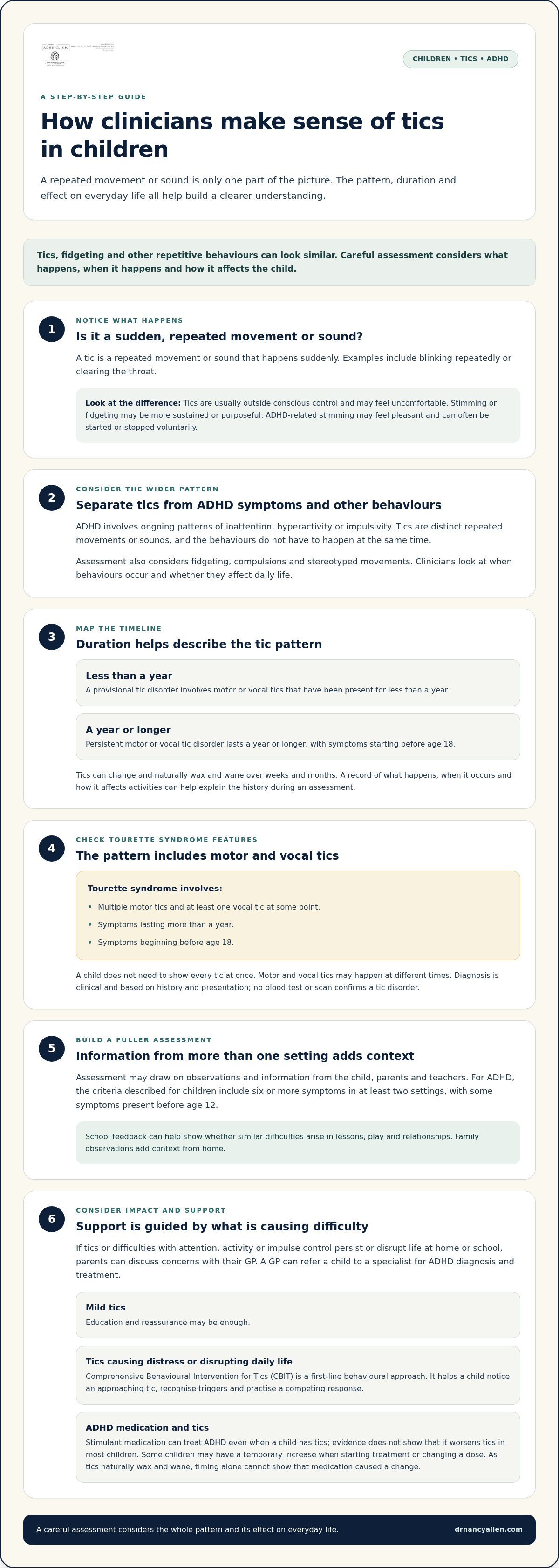
Tics are sudden, repeated movements or sounds, while stimming and fidgeting may be more sustained or purposeful. A child might blink repeatedly, make a sound, tap a pencil or rock while concentrating. ADHD-related stimming may feel pleasant and can often be started or stopped voluntarily; tics can feel uncomfortable and are usually outside conscious control. This distinction can help adults avoid treating every repeated movement as a tic.
Tics and ADHD symptoms
ADHD involves ongoing patterns of inattention, hyperactivity or impulsivity. Tics are distinct movements or sounds that occur repeatedly. A child might interrupt because waiting is difficult, for example, or make a repeated sound as a tic. The behaviours need not happen at the same time, but tics should occur during the course of the child’s ADHD. Assessment also considers fidgeting, compulsions and stereotyped movements before identifying tics.
Stimulant medication and tics
Stimulant medication can treat ADHD even when a child has tics; evidence does not show that it worsens tics in most children. Studies found that methylphenidate did not increase tic frequency compared with children who did not take it. Some children may experience a temporary increase when starting treatment or changing a dose. Because tics naturally wax and wane over weeks and months, timing alone cannot show that medication caused a change.
Treatment when ADHD and tics co-occur
Treatment is guided by which symptoms cause the child the most difficulty. Comprehensive Behavioural Intervention for Tics (CBIT) is a first-line behavioural approach when tics cause distress or interfere with daily life. It helps a child notice an approaching tic, recognise triggers and practise a competing response. Education and reassurance may be enough for mild tics. ADHD treatment can also be considered, with clinicians discussing options such as methylphenidate, clonidine or guanfacine based on the child’s needs.
Tic Disorders and Tourette Syndrome: What is a Tic?
A tic is a repeated movement or sound that happens suddenly, such as blinking or clearing the throat. Diagnosis considers the type of tic, when it began, how long it has been present and its effect on daily life.
In the UK, parents can discuss concerns with their GP, who can refer a child to a specialist for ADHD diagnosis and treatment. Assessment may draw on observations and information from parents, teachers and the child. Seek advice if tics or difficulties with attention, activity or impulse control persist or disrupt life at home or school.
Tic disorder types and durations
Tic disorders are classified partly by whether the child has motor tics, vocal tics, or both, and how long symptoms have lasted. A provisional tic disorder involves motor or vocal tics that have been present for less than a year. Persistent motor or vocal tic disorder lasts a year or longer, and symptoms must have started before age 18.
These time categories help clinicians describe the pattern without assuming every new tic will continue. Tics can change over time, so keeping a record of what happens, when it occurs and how it affects activities can help explain the history during an assessment.
Tourette syndrome diagnostic criteria
Tourette syndrome involves multiple motor tics and at least one vocal tic at some point, with symptoms lasting more than a year and beginning before age 18. The American Psychiatric Association sets out these criteria in its diagnostic framework. Motor tics may include blinking or shoulder movements; vocal tics can include repeated sounds or words.
A child does not need to show every tic at once. Symptoms can change, and motor and vocal tics may occur at different times. Diagnosis is clinical and based on history and presentation; no blood test or scan confirms a tic disorder.
ADHD, or attention deficit hyperactivity disorder, is assessed by considering symptoms and their effect across settings. The criteria described for children include six or more symptoms in at least two settings, with some symptoms present before age 12. Questionnaires from parents, teachers and the young person can contribute, alongside observations and the child’s history.
A clinician also considers whether difficulties such as distractibility, restlessness or acting without thinking are persistent, rather than isolated responses to a particular situation. Feedback from school can show whether similar challenges arise in lessons, play and relationships, while family observations add context from home.
If these patterns affect learning, friendships or family life, discussing them with a GP is a useful starting point. A Child ADHD Assessment can help explore a child’s symptoms and history as part of an individual assessment.
Co-occurrence of ADHD and Tourette syndrome in children
ADHD and tic disorders can occur together, but one diagnosis does not automatically mean the other is present. Rates vary between study groups, so figures are context rather than predictions for an individual child.
How often ADHD and Tourette syndrome co-occur
In a large international cohort of people with tic disorders, 61% of children also had ADHD. Other clinical samples report ADHD in around 50% of people with tic disorders. These estimates describe particular groups, not every child with Tourette syndrome or tics.
Looking from the other direction, about one in five children with ADHD also have Tourette syndrome or a persistent tic disorder. The difference between these estimates reflects which children were included and how researchers defined the conditions. A school observation alone cannot show how common either diagnosis is among children generally.
These figures help explain why an assessment may consider both conditions. A child with Tourette syndrome might also struggle to focus in a lesson; another child with ADHD may have repeated movements or sounds. Seeing one pattern should not lead adults to overlook signs of the other. ADHD and tics in children may affect learning, friendships or routines in different ways.
ADHD with Tourette syndrome or tic disorders
Tourette syndrome is one type of tic disorder, while a persistent tic disorder involves motor tics or vocal tics. ADHD, or attention deficit hyperactivity disorder, is separate. A child could have ADHD alongside Tourette syndrome, another tic disorder, or neither.
For example, a child might have sudden shoulder movements and difficulty waiting their turn. The movements and impulsive behaviour deserve separate consideration, even if they occur on the same school day. Identifying each pattern helps adults understand which support relates to attention, which relates to tics and where the difficulties overlap.
Both patterns can affect the same activity. Repeated movements may attract attention in class, while inattention can make instructions or written work harder to manage. Parents and teachers can note the setting, what the child was doing and the effect on participation. These details are more useful than treating one incident as representative of the overall pattern.
For instance, observations might show that a vocal tic interrupts reading, while distractibility affects several classroom tasks. ADHD and tics in children should be considered as distinct experiences, not bundled together as general restlessness. Sharing examples from home and school can help a clinician understand the child’s needs and discuss suitable support.
Coping with ADHD-related behaviour
Parents and schools can support a child with predictable routines, clear instructions and positive reinforcement. For example, a teacher might offer movement breaks, while parents use a simple reward chart for completing a morning task.
Behavioural therapy and CBIT
Behavioural therapy helps children and families practise responses that make daily routines easier. For children with ADHD younger than six, behaviour therapy, particularly parent training, is recommended before medication is tried. Positive parenting interventions can help parents build warm relationships and clear boundaries. A specific instruction, such as “put your reading book in your bag”, is easier to follow than a general reminder.
Comprehensive Behavioural Intervention for Tics (CBIT) is a behavioural therapy for tic symptoms, not ADHD itself. It teaches a child to notice an approaching tic, identify triggers and practise a competing response. This distinction matters: ADHD-related behaviours and tic disorders may need different interventions, even when both affect the same routine.
Cognitive behavioural therapy (CBT) may help children with ADHD who also need support for anxiety, depression or related difficulties. In CBT, a child can explore how thoughts, feelings and actions connect, then practise strategies for a specific challenge. For example, they might break a daunting homework task into smaller steps.
Support from parents and schools
Consistent routines can make everyday expectations more predictable for a child with ADHD. Parents might use a visual checklist for getting ready, while school staff give the same brief prompts for starting classroom work. Give one clear task at a time, and focus on what the child should do rather than only saying what not to do.
Reward systems, such as a chart marking completed tasks, can encourage progress without turning every mistake into a confrontation. Agree on a realistic target with the child, such as beginning homework after a short break. Recognise effort as well as completion, so feedback is specific and the child knows which action is being praised.
At school, practical adjustments can support attention and task completion. A teacher might move a child’s seat to reduce distractions, offer movement breaks or use a timer to make a task easier to manage. If a pupil’s tics attract attention, calm, matter-of-fact responses can avoid adding pressure or treating movements as deliberate misbehaviour.
Parents and teachers can share observations about which approaches help at home and school. A brief note about a difficult transition, a successful movement break or a useful classroom prompt gives the child’s support network concrete information. These examples can guide conversations with professionals about strategies suited to the child’s attention, behaviour and tic-related needs.
ADHD symptoms in children and young people
ADHD symptoms usually involve inattention, hyperactivity or impulsivity. A young person might lose track of a lesson, struggle to begin independent work or interrupt a conversation. The key is the pattern across everyday situations, not one difficult day. Understanding ADHD and tics in children also means describing attention and movement concerns separately.
How symptoms may appear day to day
Inattention might show up as unfinished written work, forgotten equipment or missed details in instructions. Hyperactivity can involve frequent movement, talking or difficulty settling during a quiet task. Impulsivity may look like interrupting, taking a turn early or acting before considering what might happen. Specific examples help adults explain what they observe without relying only on general labels.
Experiences can vary by setting and activity. A child may concentrate on an interest but find a busy transition or multi-step task difficult. Parents can note what was happening, what support was offered and how the child responded. Teachers can add observations from lessons, group work and break times to build a fuller picture of daily functioning.
Distinguishing ADHD symptoms from tics
Describe repeated movements or sounds separately from attention and activity concerns. For example, record a movement and the situation in which it occurred, then separately note difficulty completing a task. This makes the account clearer than grouping everything under “restlessness”. When describing ADHD and tics in children, careful observations help distinguish experiences without assuming they share one cause.
If a child takes a stimulant, keep separate notes about attention, activity and any motor or vocal tics. Record when changes happen and whether they affect schoolwork, sleep or activities. A clinician can consider this information alongside the child’s history rather than drawing conclusions from one change alone.
When an assessment may help
The diagnostic criteria described for children include six or more ADHD symptoms in at least two settings, with symptoms present before age 12. An assessment considers the child’s history and how difficulties affect daily life. Parent and teacher questionnaires, observations and examples from early childhood can all contribute to understanding the pattern.
Bring practical examples to a GP appointment, such as repeated difficulty following classroom instructions or managing everyday tasks. Note where the difficulty occurs and how it affects learning or relationships. A GP can refer a child to a specialist for diagnosis and treatment when needed.
If attention, hyperactivity or impulsivity difficulties affect your child’s daily life, consider a Child ADHD Assessment to explore their symptoms and history.
Dr Nancy Allen: Adult ADHD Assessment
Dr Nancy Allen’s Adult ADHD Assessment is for adults to discuss their symptoms and history; for a child, the relevant service is her Child ADHD Assessment. An assessment can explore how difficulties affect everyday life and consider appropriate next steps. If tics are also present, include them in the child’s history, as they may need separate consideration.
Dr Nancy Allen provides private consultations online across the UK, where appropriate. Consultations aim to understand each person’s circumstances and discuss options together. With the patient’s consent, care may also involve communication with their NHS GP or other healthcare professionals.
Contact Dr Nancy Allen to discuss whether an assessment may be a useful next step.
Choose a thoughtful next step
If your child experiences ADHD and tics, brief notes about everyday situations can help you explain your concerns. Record what you notice, where it happens and how it affects routines. You can also ask your child what they find difficult and what support feels useful, without making every conversation about symptoms.
This article provides general information and isn’t a substitute for an individual assessment. Speak with your GP or another suitable healthcare professional about your child’s symptoms or treatment. Sharing your observations and questions can help make the conversation more focused.
If you’d like to discuss an assessment, you can contact Dr Nancy Allen. Taking a considered next step can help you find a clearer way forward for your family.
Frequently Asked Questions
Does Behavioural Treatment Work?
Behavioural treatment can help children manage tic symptoms and everyday ADHD-related difficulties. For tics, CBIT includes habit-reversal techniques: noticing the warning signs of a tic and practising a different response. Families can support practice without drawing unwanted attention to the tic. Progress is considered against a practical goal, such as reducing disruption during reading or helping the child feel more comfortable at school.
How Often Do They Co-occur?
ADHD and tic disorders co-occur often enough for clinicians to consider both, but estimates differ between study groups. One estimate is that around 20-30% of people with ADHD symptoms also meet criteria for a tic disorder. This is not an individual prediction. The likelihood for a particular child cannot be inferred from a percentage; assessment depends on their own symptoms, history and day-to-day experiences.
How can ADHD be treated?
ADHD support may combine practical strategies, behavioural therapy and medication, depending on the child’s age, difficulties and needs. Parents can discuss which challenges matter most, such as unfinished schoolwork or difficulty managing transitions, then agree on goals with the clinician. For younger children, parent training can be considered before medication. Treatment choices should be reviewed with an appropriate healthcare professional, not changed independently.
How is ADHD diagnosed?
ADHD diagnosis involves a specialist considering the child’s developmental history, symptoms and their effects in everyday settings. Before an appointment, parents can gather examples from home, while school staff can describe classroom experiences. Note when a difficulty occurs, what task was involved and how it affected the child. A questionnaire may support the assessment, but no single form or observation establishes a diagnosis on its own.
Is It a Tic, a Stim, or Just Fidgeting?
Observe what happens before, during and after the movement, rather than judging from one brief moment. Note whether the child describes an uncomfortable build-up, whether the action seems purposeful and whether it happens during concentration, excitement or stress. For example, a parent might record repeated movements during homework and ask the child how they experience them. These observations can help a clinician distinguish possible explanations.
Is Medication Safe?
Stimulant medicines can be used for ADHD in children who also have tics; evidence does not show worsening in most children. Some may notice a temporary change after starting medication or adjusting a dose, while tic patterns naturally fluctuate. Keep a record of changes and discuss them with the prescribing clinician, including when they began and how they affect daily activities. Don’t alter treatment without clinical advice.
What does ADHD mean in children, and what are the common symptoms?
ADHD means attention deficit hyperactivity disorder, a condition involving persistent difficulties with attention, hyperactivity or impulsivity. A child might regularly lose track of instructions, find waiting difficult or act before considering the outcome. These behaviours alone don’t establish ADHD. The key question is whether a broader pattern affects everyday functioning, such as learning, relationships or routines, and appears in more than one setting.
What are tics, and how do tic disorders present in children?
Tics are repeated movements or sounds, such as facial movements, shoulder jerks or throat noises. A child may have motor tics, vocal tics or both, and the pattern can change over time. Tic disorders are assessed by considering the symptoms’ duration, onset and impact, alongside other possible explanations. If a tic causes pain, distress or difficulty joining in, share those effects with a healthcare professional.



Comments