


Adult ADHD Assessment: A Comprehensive Guide to Seeking Clarity and Support

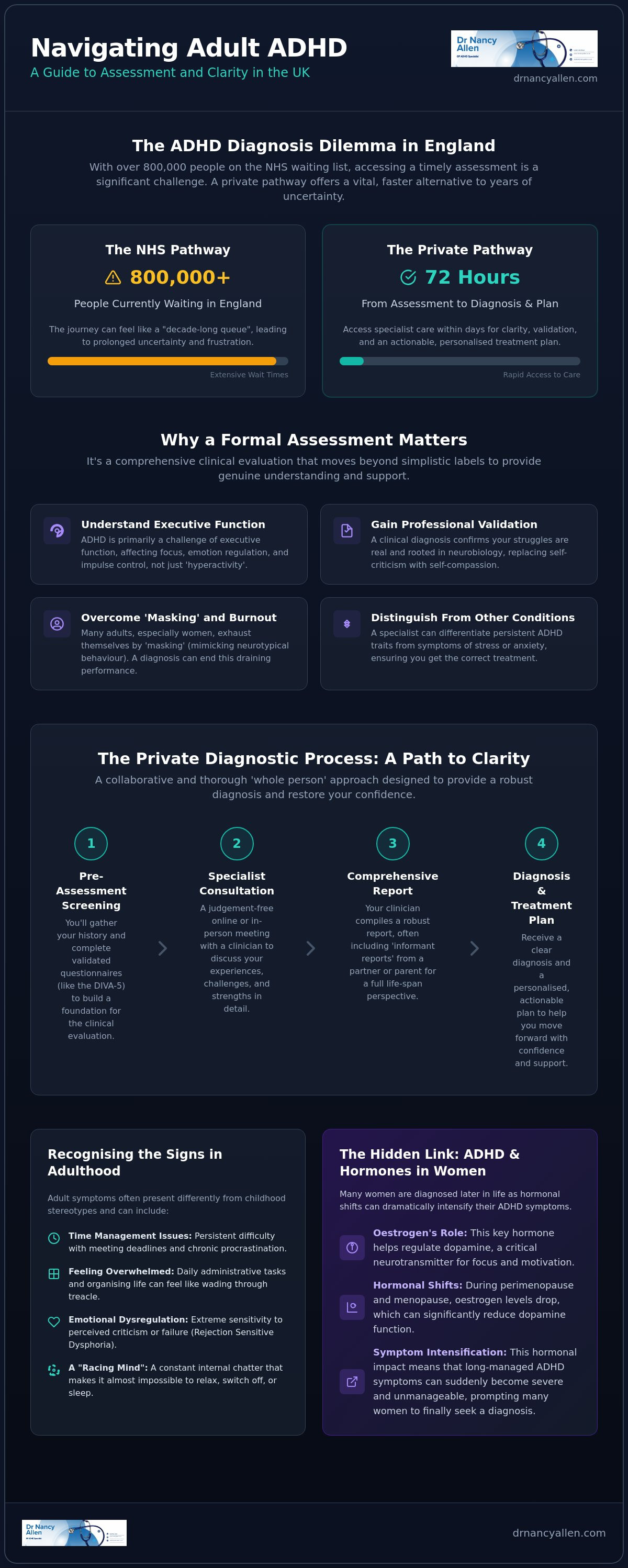
With over 800,000 people in England currently waiting for an NHS ADHD assessment, the journey to understanding your own brain can feel like a decade-long queue that leads nowhere. For years, you might have been told you're simply "anxious" or "unorganised," whilst you're actually navigating a neurodivergent mind in a world designed for neurotypicals. It's exhausting to feel like you're constantly falling behind despite your best efforts. A private adult adhd assessment offers a vital alternative, providing the professional validation you need without the years of painful uncertainty.
You deserve to be heard by a specialist who understands that your struggles are real and rooted in neurobiology, not a lack of willpower. We recognise that a formal diagnosis is often the first step toward self-compassion, offering an explanation rather than an excuse for your life experiences. This guide explores how to access high-quality specialist care within days, ensuring you receive a personalised treatment plan that actually works. We'll walk through the assessment process together, showing you how to gain the clarity and actionable support required to finally move forward with confidence.
Table of Contents
What is an Adult ADHD Assessment and Why Does it Matter?
An adult ADHD assessment is far more than a simple tick-box exercise. It's a comprehensive clinical evaluation designed to identify neurodivergent traits that have likely been present since childhood but may have been obscured by years of coping mechanisms. While many still view ADHD through the narrow lens of childhood hyperactivity, the reality of Adult attention deficit hyperactivity disorder is much more nuanced. It's essentially a challenge of executive function, affecting how you regulate your focus, emotions, and impulses. For many, seeking an assessment is the first step in moving away from a lifetime of self-criticism and toward a place of genuine self-understanding and professional support.
Many adults survive for decades by "masking," the exhausting process of mimicking neurotypical behaviours to fit in or avoid being labelled as "lazy" or "difficult." This constant performance often leads to burnout and a deep-seated sense of being an impostor in your own life. A formal adult adhd assessment strips away these layers, validating your lived experience and replacing the question "why can't I just do it?" with a clear, evidence-based explanation of how your brain is wired.
The Difference Between Screening and a Clinical Diagnosis
It's common to start this journey with an online quiz or a self-report screener. Whilst these tools are helpful for sparking curiosity and identifying potential patterns, they aren't a diagnosis. A formal clinical diagnosis requires a specialist clinician who can look at the "whole person." This involves a detailed review of your history, ensuring that symptoms aren't just temporary reactions to stress but persistent patterns that manifest across different settings, such as both the workplace and your home life. A specialist provides the clinical authority needed to access medication and tailored therapeutic support.
Recognising the Signs in Adulthood
Adult presentations often look different from the restless schoolchild stereotype. You might struggle with chronic procrastination, intense emotional dysregulation, or a persistent "brain fog" that makes simple tasks feel like wading through treacle. Many adults, particularly women, were missed as children because their symptoms were more internalised or they were high achievers who worked twice as hard to keep up. Left untreated, these challenges can take a heavy toll on your career progression, the stability of your relationships, and your overall self-esteem. Common signs include:
Persistent difficulty with time management and meeting deadlines.
Feeling constantly overwhelmed by daily administrative tasks.
Extreme emotional sensitivity to perceived criticism or failure.
A "racing mind" that makes it impossible to relax or sleep.
The Private ADHD Diagnostic Process: What to Expect Whilst Seeking Clarity
Seeking an adult adhd assessment is a significant step, and the process should feel like a partnership rather than a clinical hurdle. We view this journey as a collaborative investigation into your unique brain wiring, conducted in a secure and comfortable environment. Whether you opt for a nationwide online consultation or an in-person appointment, the goal is to provide a space where you feel safe to share your experiences without judgement. This is about uncovering your strengths just as much as identifying your challenges.
To create a truly comprehensive history, we often invite "informant reports" from people who know you well. This might be a parent who remembers your early school years or a partner who sees your current daily challenges. These perspectives help us understand how your traits have manifested across your lifespan, ensuring the final clinical report is robust enough to be shared with your GP for ongoing care. This thoroughness is what distinguishes a professional evaluation from a simple screening tool.
Step 1: The Pre-Assessment Screening
Preparation begins long before the actual meeting. You'll be asked to gather a history of your symptoms from childhood to the present day. We use validated questionnaires, such as the DIVA-5, to help guide our investigation. It's helpful to spend some time organising your thoughts and noting down specific examples of where you feel your executive function falters, such as chronic procrastination or difficulty following complex instructions. This early work ensures our time together is focused and productive.
Step 2: The Clinical Consultation
The heart of the process is a 60-90 minute conversation with a specialist. This isn't just a checklist; it's an empathetic validation of your life journey. We'll discuss your mental and physical health history to ensure a holistic understanding of your well-being. For many women, this includes looking at how life stages affect their symptoms, supported by clinical research into ADHD and Sex Hormones in Females. You'll have the space to explain how neurodivergence impacts your life in a way that data alone cannot capture.
Step 3: The Diagnosis and Treatment Plan
Using the gold-standard DSM-5 or ICD-11 criteria, we'll determine if a diagnosis is appropriate. If it is, we immediately transition to developing a personalised roadmap. This might include medication titration, specialist therapy, or targeted lifestyle adjustments. To provide immediate peace of mind, your full diagnostic report and treatment plan are delivered within 72 hours. An adult adhd assessment with a specialist ensures you aren't just left with a label, but with a clear path forward. If you're ready to begin this journey, you can book a specialist consultation to find the clarity you've been seeking.
The Intersection of ADHD and Hormonal Health Amongst Women
Women's experiences with neurodiversity are often uniquely tied to their endocrine system, a factor frequently overlooked in standard clinical settings. Oestrogen plays a critical role in dopamine regulation; it's the neurotransmitter most closely associated with executive function and reward. When oestrogen levels fluctuate during the menstrual cycle or drop significantly during perimenopause, ADHD symptoms often become much more severe. This biological reality explains why an adult adhd assessment is frequently sought by women in their 40s and 50s who find their lifelong coping strategies are no longer sufficient.
Many women describe a "double burden" where hormonal brain fog overlaps with neurodivergent executive dysfunction. It isn't just about being slightly more forgetful. It's an overwhelming, systemic inability to initiate tasks, regulate emotions, or maintain focus that previously felt manageable, if exhausting. Understanding this intersection is vital for accurate diagnosis, as CDC information on adult ADHD highlights how symptoms can present differently across various life stages and demographics. Seeking a professional adult adhd assessment during midlife can be the key to unlocking a new chapter of self-understanding and relief.
Why Symptoms Often Worsen in Midlife
As oestrogen declines during the menopause transition, the brain's ability to process dopamine effectively diminishes. For a woman with undiagnosed ADHD, this is typically the point where "masking," the intense, internalised effort to appear neurotypical, finally collapses under the weight of biological change. It's essential to distinguish between "menopause brain," which is a transient cognitive shift, and lifelong ADHD traits that have simply been unmasked by falling hormones. A specialist clinician who understands both neurodiversity and hormonal health can provide the clarity needed to identify these distinct but overlapping challenges, ensuring you aren't misdiagnosed with simple age-related decline.
A Holistic Approach to Treatment
Effective support must be as multifaceted as the symptoms themselves. This often involves integrating Hormone Replacement Therapy (HRT) with ADHD-specific management strategies, such as medication or specialised coaching. Personalised care can restore the confidence and quality of life that many women fear they've lost to "personality changes" or cognitive burnout. Treating the hormonal depletion without addressing the underlying neurodivergence, or vice versa, often leads to an incomplete recovery and continued self-criticism. We focus on a unified plan that acknowledges your biology and your brain wiring as a single, interconnected system, allowing you to regain control of your daily life.
Comparing Pathways: Private Assessments vs. NHS Support
Navigating the UK's neurodiversity services requires a clear understanding of the current landscape. Whilst the NHS provides vital care, the system is under unprecedented strain. As of early 2026, over 803,000 people in England were estimated to be waiting for a diagnosis, with many facing delays of between two and eight years. For an adult struggling with executive dysfunction, these years represent more than just a wait; they are a period of continued instability in employment, relationships, and mental health. Choosing a private adult adhd assessment is often a decision to reclaim those lost years and access support when it is most needed.
The 'Right to Choose' pathway exists as a middle ground, allowing patients in England to request an NHS-funded assessment from a private provider. However, even these routes are becoming congested. Major providers often report waits of 8 to 10 months for an initial appointment, with further delays for medication titration. When you require clarity and professional validation to maintain your career or family life, the speed and direct access of a fully private specialist become invaluable.
Wait Times and Access to Specialists
The contrast in timelines is stark. Whilst the NHS route is free at the point of use, the hidden cost is the prolonged impact of untreated symptoms on your well-being. A private adult adhd assessment can typically be arranged within weeks, and in our practice, a diagnosis and treatment plan are provided within 72 hours. This rapid turnaround is essential for those at a breaking point. Procrastination and emotional dysregulation don't pause for a multi-year waiting list; they continue to affect your self-esteem and productivity every day.
Depth of Consultation and Personalisation
Private care offers a level of depth that is difficult to achieve in a stretched public system. You'll benefit from unhurried appointments where your history is explored with the gravity it deserves. This is particularly important for women, as it allows for a clinician with specific expertise in the intersection of ADHD and hormonal health to conduct the review. A robust, private clinical report also provides the necessary evidence for workplace adjustments or Access to Work applications, helping you stay in employment with the right support.
Once you are stabilised on a treatment plan, we can work toward a 'Shared Care Agreement' with your NHS GP. This arrangement allows your local practice to take over the cost of your prescriptions whilst we provide the specialist oversight. Whilst these agreements are at the discretion of the GP, a high-quality, comprehensive assessment report makes the transition much smoother. If you are ready to bypass the waiting lists and start your journey toward clarity, you can book your private ADHD assessment today.
Your Path to Clarity with Dr Nancy Allen
Choosing to undergo an adult adhd assessment is an act of profound self-care. Dr Nancy Allen's philosophy is built upon the belief that clinical expertise must be matched by deep-seated empathy. As a private GP who looks at the "whole person," Dr Allen doesn't simply work through a checklist. She considers your physical health, your lifestyle, and your unique history to ensure that any diagnosis is both accurate and meaningful. This holistic approach ensures that you aren't just given a label, but a comprehensive understanding of how your brain functions within your specific life context.
We recognise that the anxiety of waiting can be as debilitating as the symptoms themselves. That's why efficiency is a cornerstone of our care. Once your consultation is complete, you will receive your full diagnostic report and a personalised treatment plan within 72 hours. This rapid turnaround allows for immediate intervention, helping you start your journey toward restoration without the agony of prolonged uncertainty. Our secure online consultations make this expert care accessible to individuals across the entire UK, providing a comfortable and private setting for your assessment.
A Modern Approach to Neurodiversity
With over 25 years of clinical experience, Dr Allen provides a nuanced perspective that is often missing from standard assessments. She recognises that neurodiversity presents differently in everyone, particularly in high-masking adults who have spent decades trying to fit into neurotypical structures. The focus here is on restoring your confidence and quality of life. Our patient-centric telehealth platform is designed to be intuitive and stress-free, ensuring that the process of seeking help doesn't add to your mental load. From the initial enquiry to the final report, your experience is guided by a steady, compassionate hand.
Next Steps: Embarking on Your Journey
Starting the process is straightforward. When you book your initial consultation, you'll be asked to provide some preliminary information to help us prepare for our time together. This collaborative investigation is the first step toward a life defined by clarity rather than confusion. You don't have to navigate the complexities of neurodivergence alone. Being guided by a seasoned professional who truly hears you provides a sense of security and stability that is often life-changing. If you're ready to find the answers you've been looking for, you can book your adult ADHD assessment with Dr Nancy Allen today.
Reclaiming Your Focus and Future
Gaining clarity on your neurodivergent traits is a transformative act that replaces years of frustration with genuine self-understanding. We have explored how neurodivergence is often unmasked during hormonal shifts and why a clinical evaluation is the vital first step in moving from self-criticism to self-compassion. A private adult adhd assessment offers more than just a label; it provides a professional foundation for restoration and a roadmap for a life that works with your brain, not against it.
Dr Nancy Allen brings over 25 years of specialist clinical experience and a deep understanding of how ADHD intersects with hormonal health to every consultation. You can move from uncertainty to action quickly, as all diagnoses and treatment plans are provided within 72 hours. It's time to stop wondering and start thriving with the expert guidance you deserve. You are not alone in this journey, and the support you need is closer than you think.
Book Your Private Adult ADHD Assessment with Dr Nancy Allen
Frequently Asked Questions
How long does a private adult ADHD assessment take?
The clinical consultation itself typically lasts between 60 and 90 minutes. Whilst the meeting is thorough, the overall timeline is much faster than public routes, where waits often span years. In our practice, you'll receive your formal diagnosis and a personalised treatment plan within 72 hours of your appointment. This rapid turnaround ensures you can access support and begin your journey toward clarity without unnecessary delays or prolonged uncertainty.
Is a private ADHD diagnosis from a GP valid in the UK?
Yes, a diagnosis is valid when conducted by a qualified healthcare professional with specialist expertise in ADHD, as outlined by NICE guidelines. Dr Nancy Allen is a GP with over 25 years of clinical experience and a specific interest in neurodiversity. Her comprehensive reports are robust clinical documents that are recognised for accessing workplace adjustments and can facilitate the transition to ongoing care within the UK healthcare system.
Can I get ADHD medication on the NHS after a private assessment?
It's possible to transfer your medication management to the NHS via a Shared Care Agreement once you are stabilised on your treatment. Whilst these agreements are at the discretion of your NHS GP, providing a high-quality, comprehensive report from your adult adhd assessment significantly increases the likelihood of acceptance. You'll typically need to remain under private specialist review at least once a year to maintain this arrangement and ensure your care remains safe.
What is the difference between ADHD and ADD in adults?
ADD is an older clinical term that is now officially categorised under the broader umbrella of ADHD. Modern diagnostic criteria use the term ADHD "Predominantly Inattentive Presentation" to describe what was previously called ADD. Adults with this presentation often struggle with internalised symptoms like chronic disorganisation, difficulty sustaining attention, and "brain fog," rather than the outward physical hyperactivity or impulsivity often associated with the condition in children.
Will I need to provide school reports for an adult assessment?
School reports are helpful for establishing a childhood history of symptoms, but they aren't strictly mandatory if they're no longer available. We can use other forms of evidence, such as "informant reports" from parents, siblings, or long-term partners who remember your behaviour and challenges as a child. The goal is to build a clear, evidence-based picture of how your neurodivergent traits have persisted from your early years into your adult life.
Can menopause symptoms be mistaken for ADHD?
There is significant overlap between ADHD traits and perimenopause symptoms, particularly regarding memory lapses, emotional dysregulation, and intense "brain fog." Because falling oestrogen levels directly impact dopamine regulation, many women find their lifelong ADHD symptoms only become unmanageable during midlife. A specialist assessment is crucial to distinguish whether these challenges are a new hormonal shift or a lifelong neurodivergent trait that has been unmasked by the menopause transition.
How much does a private ADHD assessment cost in the UK?
Across the UK, the cost of a private adult adhd assessment varies depending on the clinician's seniority and the location of the clinic. Most private providers charge between £500 and £1,200 for the initial diagnostic process. When researching providers, it's important to check whether the fee includes the full clinical report and a follow-up consultation to discuss your treatment plan, as these are vital for your ongoing care and support.
What happens if my assessment shows I don't have ADHD?
If an assessment concludes that you don't meet the criteria for ADHD, the process still provides immense value by ruling out one possibility and providing professional clarity. We use the consultation to explore other potential causes for your struggles, such as anxiety, sleep disorders, or hormonal imbalances. The primary goal is to ensure you feel heard and to provide you with a clear recommendation for the most appropriate next steps for your health.


Comments