


Dating the Wrong Person? The Link to Adult ADHD

Updated: 9 hours ago
If you keep asking, “Why do I keep dating the wrong person and end up getting dumped?”, it’s understandable to feel confused, rejected or as though you’re failing at relationships. Repeated dating disappointments aren’t proof that you’re bad at relationships. The reasons may be more complex than simply choosing the wrong partners.
Adult ADHD can affect how someone experiences the excitement of a new relationship, manages everyday commitments and responds to perceived rejection. Intense early focus may shift; forgetfulness or difficulty planning can lead to misunderstandings. These patterns don’t mean ADHD causes every break-up, or that your struggles are a character flaw. They may be worth exploring if similar difficulties appear across different relationships and other parts of life.
This article looks at the possible connection between ADHD and recurring dating problems. You’ll learn which patterns may be relevant, how an assessment could help you make sense of your experiences, and practical ways to date with greater awareness.
Table of Contents
The Cycle of Dating the Wrong People: Why Do I Keep Dating the Wrong Person and End Up Getting Dumped?
The “wrong person cycle” describes a recurring pattern: attraction feels immediate and consuming, then the relationship becomes uncertain or ends abruptly. If you’re asking, “Why do I keep dating the wrong person and end up getting dumped?”, it can be tempting to conclude that you’re broken or have poor judgement. But recurring relationship difficulties can have more than one explanation, including patterns associated with undiagnosed ADHD or other forms of neurodivergence.
Standard dating advice often assumes you can pace your interest, keep track of plans and feel emotionally steady through uncertainty. Those suggestions may not address the underlying difficulty if attention, impulsivity or emotional regulation are part of the picture. A new connection can also bring novelty and stimulation. For some people with ADHD, this may feel especially compelling, though ADHD doesn’t explain every attraction or break-up.
For a general look at attraction patterns, you can also watch this video:
Recognising the ‘Wrong Person’ Pattern
One clue may be repeatedly prioritising chemistry over compatibility. You might overlook a lack of respect, inconsistent communication or mismatched values because the connection feels powerful. You may also find yourself drawn to emotionally unavailable partners, hoping that patience or care will help them change. Taking on a “saviour” role can give you a strong sense of purpose, but it may leave your own needs unmet. You might worry that you’re “too much” when excited or “not enough” when your attention shifts. Notice these experiences without using them to label yourself.
The Emotional Impact of Getting Dumped Repeatedly
Unexpected endings can make dating feel unsafe. After painful break-ups, rejection fatigue may lead you to withdraw, even if you still want closeness. Grief may also centre on the relationship you imagined: the future, shared routines and potential that disappeared, not only the person. Social rejection can affect emotional wellbeing; Rejection sensitivity is one related concept discussed in connection with ADHD. Seeing peers reach milestones may intensify the sense of being left behind, but relationship timing isn’t a measure of your worth.
Understanding the cycle isn’t about excusing hurtful behaviour or deciding that every difficult relationship points to ADHD. It’s a way to replace self-blame with curiosity. If similar patterns appear across relationships and other parts of life, a professional assessment may help clarify what’s contributing and what support could help.
The ADHD Connection: Dopamine, Hyperfixation, and 'New Relationship Energy'
The early stages of romance can be absorbing: messages bring anticipation, dates offer novelty, and each new discovery gives your attention somewhere compelling to land. ADHD is associated with differences in attention, motivation and reward processing, including the brain’s dopamine system. For some people, the excitement of a new connection may feel especially powerful. This isn’t a simple “dopamine deficiency” explanation, and an intense romance doesn’t by itself indicate ADHD.
That intensity can shape dating choices. The uncertainty of a chase or the unpredictability of an exciting partner may hold your attention, even when the relationship isn’t providing consistency or care. If this keeps happening, asking, “Why do I keep dating the wrong person and end up getting dumped?” can be a useful prompt to look at the pattern rather than blame yourself for having feelings.
Dopamine-Seeking in the Dating World
“Relationship hyperfixation” describes becoming intensely absorbed in a new romantic interest. You might think about them constantly, prioritise contact and share personal details quickly. From the outside, this can resemble lovebombing, but intense focus alone doesn’t establish manipulative intent. Consider how you treat each other, whether you respect boundaries and whether your pace leaves room to get to know the person over time.
This early intensity is sometimes called “new relationship energy” (NRE). It can feel exhilarating, but rapid declarations or constant contact may overwhelm a partner. Someone who is less considerate may also encourage a fast pace for their own reasons. You don’t need to distrust every strong feeling. Instead, notice whether you’re mistaking excitement for compatibility, and pause before making commitments or overlooking behaviour that concerns you.
ADHD in women can be harder to recognise when difficulties are masked or interpreted as personality traits. Some people therefore reach adulthood without understanding how attention, impulsivity or emotional intensity may affect their choices. You can read more about ADHD in women and its signs, including the hormonal connection.
From Hyperfixation to Boredom: The ADHD Relationship Arc
As novelty settles, your attention may shift and the relationship can feel less absorbing. If your interest drops in someone kind and compatible, you may feel guilty: “They’re good to me, so why don’t I feel the same?” A change in excitement doesn’t automatically mean the relationship is wrong or that ADHD is responsible. It can help to distinguish a temporary dip in stimulation from a genuine mismatch, then communicate honestly rather than disappearing or forcing feelings you don’t have.
Moving repeatedly from intense beginnings to self-criticism can leave you believing you’re impossible to please. That’s a conclusion, not a diagnosis. If these patterns affect your wellbeing, a professional adult ADHD assessment may help you explore whether ADHD is relevant and better understand your experience.
Why Relationships Often End Suddenly: Rejection Sensitivity and Executive Dysfunction
A delayed reply, a change in someone’s tone or a cancelled plan can feel especially painful if you’re already worried about being rejected. Some people with ADHD describe this intense response as Rejection Sensitive Dysphoria (RSD). RSD isn’t a formal ADHD diagnosis, but the term can describe emotional pain in response to perceived criticism or rejection. It doesn’t mean every break-up or disagreement is caused by ADHD.
Understanding Rejection Sensitive Dysphoria (RSD)
When a small sign of distance feels like definitive rejection, you might try to prevent further hurt by ending the relationship first. This is sometimes called “pre-emptive dumping”. Others respond by people pleasing or masking their needs, working hard to appear easy-going and agreeable. Keeping that up can become exhausting, and unspoken needs may eventually surface as resentment or conflict.
Sleep can also affect emotional resilience. Difficulty switching off or getting enough rest may leave you with less capacity to manage stress, although sleep problems have many possible causes. Read about why the ADHD brain struggles to sleep and how sleep difficulties may intersect with day-to-day wellbeing.
Emotional dysregulation can make an argument escalate quickly. For example, a disagreement about a forgotten message may soon feel like proof that you’re unwanted, prompting a defensive response before either person has clarified what they meant. Pausing to name the original issue and ask what the other person intended can create space between the trigger and your response.
Executive Dysfunction in Romantic Partnerships
Executive functions help with planning, remembering and following through. When these are difficult, you might forget an important date, lose track of a conversation or struggle to complete a household task you agreed to do. Your partner may interpret this as a lack of care, while you feel frustrated that good intentions don’t reliably become action. The impact is real, even if the behaviour isn’t deliberate.
Time blindness can add to the strain. Losing track of time and arriving late may leave a partner feeling ignored or devalued, even when that wasn’t your intention. Shared routines can be difficult too: staying up later than planned, including through revenge bedtime procrastination, may reduce the time and energy available for connection the next day. Learn more about revenge bedtime procrastination and its possible effects on routines.
If you recognise these patterns, discuss practical supports with your partner, such as shared reminders, clear plans and a calm check-in after conflict. These strategies aren’t a substitute for understanding the underlying cause. If you’re wondering, “Why do I keep dating the wrong person and end up getting dumped?”, a professional adult ADHD assessment may help you explore whether ADHD is relevant to your experiences.
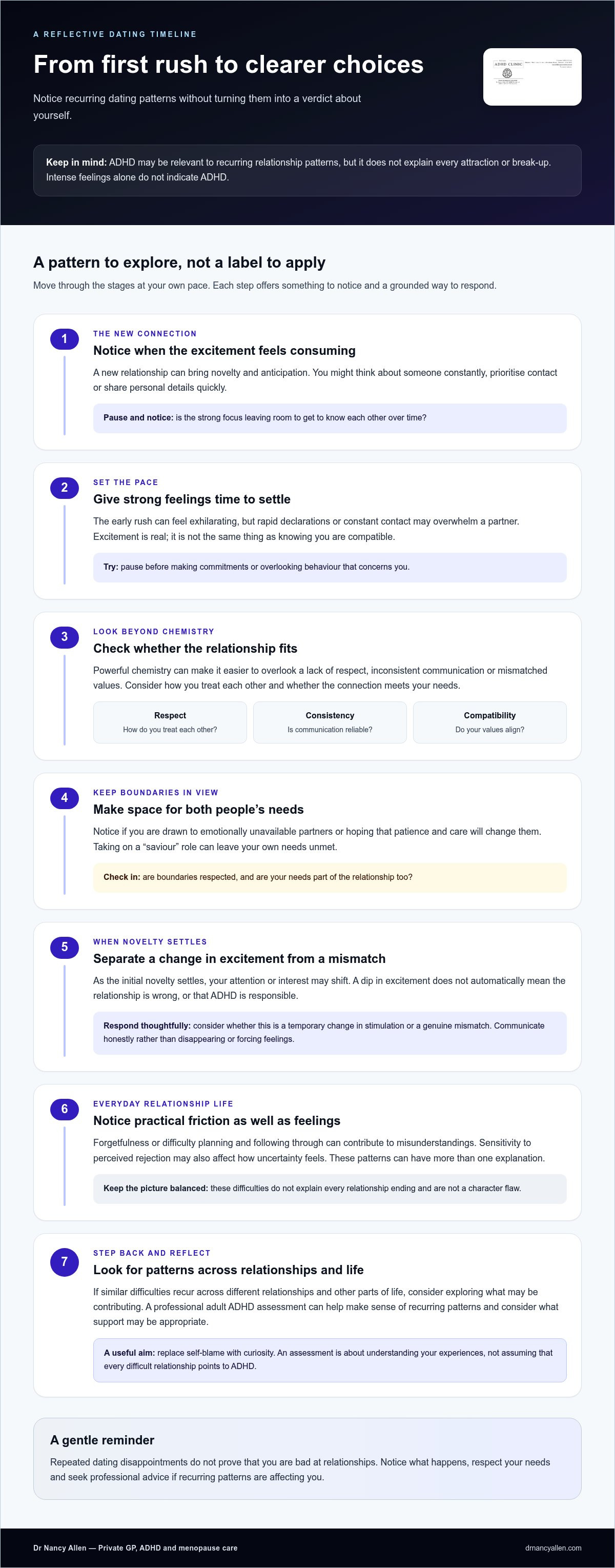
Breaking the Pattern: Moving from Chaos to Conscious Connection
You don’t need to become less enthusiastic or follow rigid dating rules to build a steadier connection. The aim is to notice what’s happening, protect your needs and give attraction time to sit alongside evidence of compatibility. If you’re asking, “Why do I keep dating the wrong person and end up getting dumped?”, a structured approach can help you move from self-criticism to useful observation.
A five-step framework for dating with greater awareness
Notice the spark. Ask what you know about this person beyond the excitement. Do your values, communication styles and expectations seem compatible?
Track your patterns. After dates or conversations, jot down what felt good, what unsettled you and what you needed. Over time, journalling may reveal partner-selection patterns or common break-up triggers.
Check in with yourself. A sudden drop in interest, fatigue, irritability or difficulty concentrating may be a cue to pause and reflect. These experiences have many possible causes; they aren’t proof of a “hyperfixation crash” or ADHD.
Set a pace that feels sustainable. Consider waiting before making significant commitments, including after a third or fourth date. You could also agree with yourself on a contact rhythm that leaves room for sleep, work, friends and time alone.
Communicate one need at a time. You don’t owe someone your full personal history early on. Try a simple explanation, such as, “I enjoy getting to know you, and I do best with plans confirmed clearly.” Notice how they respond to a reasonable boundary.
Slowing down isn’t about suppressing attraction. It gives the first rush of novelty time to settle so you can notice how you feel in different situations, including on ordinary days. Journalling can help you distinguish chemistry from consistent care. Do you feel respected, safe to be yourself and able to raise a concern?
Self-awareness can also mean reframing your worth. ADHD doesn’t make you undeserving of respect, clear communication or boundaries. For a UK-focused discussion of whether ADHD is a disability, explore how this question relates to support and self-understanding.
You shouldn’t have to solve every recurring difficulty by “trying harder”. If similar patterns affect relationships and other parts of life, a clinical explanation may help you understand what’s contributing. Consider an adult ADHD assessment with Dr Nancy Allen to explore how ADHD may affect your life and relationships.
Seeking Professional Clarity: How an ADHD Assessment Changes the Narrative
Dating patterns can offer clues, but they can’t confirm ADHD. A formal adult ADHD assessment can help you explore whether ADHD may be contributing to difficulties with attention, impulsivity or emotional regulation, alongside other possible explanations. If you keep asking, “Why do I keep dating the wrong person and end up getting dumped?”, an assessment may shift the focus from self-blame to understanding what’s happening and what support could help.
The benefits of a clinical diagnosis
A diagnosis isn’t a judgement or a complete explanation for every relationship ending. It can provide a framework for recognising patterns and developing strategies that fit your needs. Instead of thinking, “I’m incapable of making a relationship work”, you may be able to ask more useful questions: What situations make it harder to pause before reacting? What reminders or routines could help me follow through? What boundaries would help me feel secure?
If ADHD is diagnosed, treatment options can be considered in light of your individual circumstances. Medication may be discussed with an appropriate clinician, but it isn’t a guaranteed fix for relationship difficulties. Psychological support may also help some people develop practical ways to manage emotions and communicate. For background on two medicines used in ADHD care, read how lisdexamfetamine differs from methylphenidate. Decisions about medication need to be made with a qualified prescriber; don’t start, stop or change medication based on an article.
For some people, finding a name for long-standing challenges brings relief. It may help replace shame with a clearer understanding of what support to explore, while still recognising that you’re responsible for how you treat partners and yourself.
Your path to supportive care
Dr Nancy Allen specialises in adult ADHD assessments and has over 25 years of clinical experience. Her approach is compassionate and focused on helping people understand how ADHD may affect their lives and relationships. The practice offers secure online consultations to patients across the UK. Its information states that private assessments can provide diagnoses and personalised treatment plans within as little as 72 hours. This is the practice’s stated timeframe, not a promise that every person’s experience or outcome will be identical.
If you’re ready to explore whether ADHD could be part of your experience, book a private ADHD assessment with Dr Nancy Allen. A thoughtful assessment can be a starting point for greater clarity and more informed choices in relationships.
Take the Next Step Towards Relationship Clarity
Repeated break-ups can leave you questioning your judgement and worth. But asking, “Why do I keep dating the wrong person and end up getting dumped?” doesn’t mean you’re failing at relationships. ADHD may be one part of the picture, particularly if patterns around attention, emotional responses or follow-through affect other areas of your life too. A professional assessment can help explore whether ADHD may be relevant and give you a clearer basis for considering what support could help.
Dr Nancy Allen brings over 25 years of clinical experience to adult ADHD assessments. Her private practice offers secure online consultations across the UK, with diagnoses and personalised treatment plans stated to be available within as little as 72 hours. She also specialises in ADHD and hormonal health, which may be relevant for some people.
You don’t have to make sense of every difficult experience alone. Take the first step towards relationship clarity and book your private ADHD assessment with Dr Nancy Allen.
Understanding your needs can help you approach future relationships with greater confidence. Your past doesn’t have to define what comes next.
Frequently Asked Questions
Is it common for people with ADHD to keep dating the 'wrong' people?
Some people with ADHD describe recurring difficulties in dating, but there’s no single pattern that applies to everyone. Novelty, impulsivity, attention differences or sensitivity to rejection may influence how someone experiences relationships, yet ADHD doesn’t determine whom you’ll choose or whether a relationship will last. If you’re asking, “Why do I keep dating the wrong person and end up getting dumped?”, look for patterns across relationships and other areas of life, and consider discussing them with a qualified professional.
Can ADHD medication actually help my love life?
ADHD medication may help manage some ADHD symptoms for some people, but it isn’t a relationship treatment or a guarantee of fewer break-ups. Any potential effect depends on your individual circumstances and should be discussed with an appropriate clinician. Clear communication, pacing, boundaries and practical strategies may also matter. If medication is being considered, a qualified prescriber can explain the options, benefits and risks. Don’t start, stop or change prescribed medication without their guidance.
What is Rejection Sensitive Dysphoria and how does it affect dating?
Rejection Sensitive Dysphoria (RSD) is a term used to describe intense emotional pain in response to perceived criticism or rejection. It isn’t a formal ADHD diagnosis, and people use the term to describe experiences that can have different causes. In dating, a delayed reply or changed plan might feel like definite rejection, prompting distress, people pleasing or ending things pre-emptively. Pausing to check what you know, rather than assume what a partner means, may help.
Why do I lose interest in my partner as soon as the relationship becomes stable?
A drop in excitement as a relationship becomes familiar can have several explanations; it doesn’t automatically mean you have ADHD or that your partner is wrong for you. Novelty may hold attention strongly for some people, and that intensity can change as a relationship settles. Notice whether your interest has shifted broadly or whether specific needs aren’t being met. Give yourself time to reflect, and communicate honestly rather than forcing affection or abruptly withdrawing.
How do I tell a new date that I have ADHD?
You can share your diagnosis when you feel ready; there’s no need to disclose everything on an early date. Start with one relevant detail and a practical request, such as, “I have ADHD, and clear plans help me keep track of dates.” You can share more as trust develops. Notice whether the other person responds respectfully. Your diagnosis may help explain some needs, but it doesn’t define your whole identity or remove the importance of mutual respect.
Can undiagnosed ADHD lead to 'lovebombing' behaviour?
Intense early focus or frequent contact can occur for different reasons, including strong excitement or absorbed attention, but it doesn’t establish that someone has ADHD. Nor does ADHD automatically cause lovebombing, a term often used for overwhelming displays of affection that may be manipulative. Focus on the behaviour and its impact: are boundaries respected, and can you both slow the pace? If you’re concerned, set a clear boundary and seek support from someone you trust.
Why do I feel so much more pain during a break-up than my friends do?
Break-ups affect people differently, and comparing your grief with your friends’ experiences doesn’t make your feelings less valid. Rejection sensitivity, uncertainty, previous experiences and the loss of an imagined future can all contribute to intense distress. ADHD may be one factor for some people, but it isn’t the only possible explanation. Give yourself time, lean on trusted support and speak with a health professional if the pain feels unmanageable or is affecting everyday life.
How long does a private ADHD assessment take with Dr Nancy Allen?
The duration of the assessment appointment itself isn’t specified, so check directly with the practice for details. Dr Nancy Allen’s practice states that diagnoses and personalised treatment plans can be provided within as little as 72 hours. This refers to the stated timeframe for clinical assessment outcomes, not the length of an appointment or a guaranteed timeframe for every individual. The practice offers secure online consultations to patients across the United Kingdom.



Comments