


Doctor Dismissing Symptoms? How to Advocate for Your Care

Updated: 2 days ago
If you’re wondering what to do when a doctor dismisses your symptoms, a useful next step may be a clearer, more focused conversation. Asking for an explanation or follow-up isn’t being difficult. You deserve to understand what has been considered and what happens next.
It’s unsettling to leave an appointment with a symptom still unexplored, especially when you’re unsure how to explain what has changed. You don’t need to arrive with a diagnosis. A clear account of what you’ve noticed, when it began and how it affects you can help bring your concerns into focus.
This guide explains how to prepare for a follow-up, describe unresolved symptoms and ask about assessment, monitoring or another opinion. It also covers how to keep a useful record of the conversation and when not to wait for a routine appointment. If your concerns relate to ADHD or hormonal health, a focused specialist assessment may be one possible next step, without assuming in advance what the cause is.
Table of Contents
When a doctor dismisses your symptoms, what should you do first?
Leaving an appointment without the explanation or next step you hoped for can feel unsettling. Your concern deserves to be heard, but a difference of opinion does not, by itself, explain why the clinician reached their view or establish that an error has occurred. Focus first on what remains unresolved and what action is appropriate now.
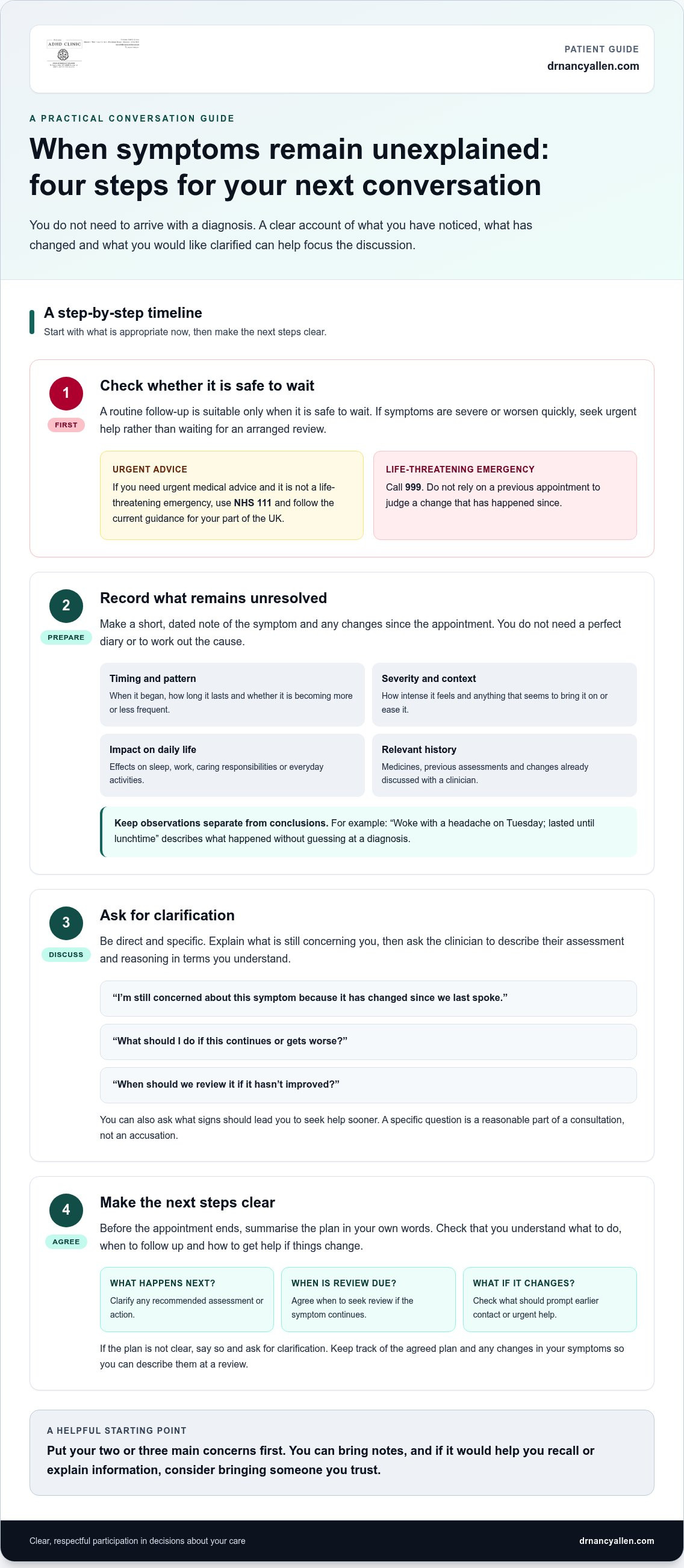
Patient advocacy is clear, respectful participation in decisions about your care. It doesn’t require you to challenge a clinician’s character or arrive with a diagnosis. If you’re deciding what to do when a doctor dismisses your symptoms, use this short sequence:
Check urgency. Don’t wait for a routine review if symptoms are severe or rapidly worsening.
Record your concern. Note which symptom remains unexplained and any changes since the appointment.
Ask for clarification. Invite the clinician to explain their assessment and reasoning in terms you understand.
Agree a plan. Clarify what happens next, when to seek review and what should prompt earlier contact.
This approach can turn a difficult interaction into a practical conversation about care. It also reflects the wider idea of patient advocacy, which includes speaking up for your needs and taking an active part in healthcare decisions.
When symptoms need urgent attention
A routine follow-up is suitable only when it’s safe to wait. If you need urgent medical advice and it isn’t a life-threatening emergency, use NHS 111 and follow the current guidance for your part of the UK. For a life-threatening emergency, call 999. If symptoms become severe or worsen quickly, seek urgent help rather than waiting for an arranged review. Don’t rely on a previous appointment to judge a change that has happened since.
How to respond in the appointment
Be direct and specific. You might say, “I’m still concerned about this symptom because it has changed since we last spoke,” then describe the change as clearly as you can. If you’re unsure what the clinician’s conclusion means, ask what they considered and why they recommend the next step.
Useful questions include: “What should I do if this continues or gets worse?” and “When should we review it if it hasn’t improved?” You can also ask what signs should lead you to seek help sooner. Before the appointment ends, summarise the plan in your own words: what to do, when to follow up and how to get help if things change. If the plan isn’t clear, say so and ask for clarification. A specific question is a reasonable part of a consultation, not an accusation.
How to prepare a clear account of symptoms for your next appointment
A short, organised account can help you explain what has changed without having to remember every detail on the spot. You don’t need to work out the cause. Describe what you’ve noticed, how it affects you and what you hope to clarify. A dated symptom record makes patterns easier to discuss and gives you a practical reference during the appointment.
Before you go, write a brief summary and put your two or three main concerns first. Include relevant medicines, previous assessments and what you’d like help with. If you’re considering what to do when a doctor dismisses your symptoms, this preparation can help keep the conversation centred on the issue that still needs attention.
What to include in a symptom diary
Record observations simply. For each episode or change, note the date, how long it lasted, how often it happens and what was going on at the time. For example, “woke with a headache on Tuesday; lasted until lunchtime” is more useful than guessing at a diagnosis. Your diary doesn’t need to be perfect or cover every day to help you describe a pattern.
Timing and pattern: when the symptom began, how long it lasts and whether it is becoming more or less frequent.
Severity and context: how intense it feels and anything that seems to bring it on or ease it.
Impact: effects on sleep, work, caring responsibilities or everyday activities.
Relevant history: medicines you take, previous assessments and any changes you’ve already discussed with a clinician.
Keep what you directly observed separate from what you suspect it means or have read online. You can bring questions or information you’ve found, but label them as questions rather than conclusions. This keeps the focus on your experience while leaving room for the clinician to consider the details with you. For complex changes in mood, perception or thought patterns—where early signs can be subtle and difficult to articulate—educational guides like pandhealth.com illustrate how clinicians evaluate emerging symptoms. If you’re taking several medicines, a written list can also help you give an accurate account of what you use and when.
How to make the appointment easier to navigate
Prepare one opening sentence that states your main concern and the help you’re seeking. For instance: “The symptom I’d like to focus on is the change in my energy levels, and I’d like to understand what assessment or follow-up is appropriate.” Keep your notes to hand and refer to them if the conversation moves quickly or you lose your train of thought.
If it would help you recall or explain information, consider bringing someone you trust. You can also ask whether your main concerns and the agreed plan can be recorded in the consultation notes. Before the appointment ends, check that you understand the next steps and how they relate to the concerns you raised. If something remains unclear, ask for it to be explained in a different way.
If your concerns relate to ADHD or hormonal health, a focused assessment may help explore your symptoms and history without presuming a particular outcome. Dr Nancy Allen offers specialist ADHD and menopause care, including secure online consultations across the UK.
How to ask for explanations, follow-up or a second opinion
Asking a clinician to explain their reasoning isn’t the same as accusing them of wrongdoing. You can acknowledge their assessment while being clear that you still have questions. A calm, specific request can help you understand what has been considered and what to do if your symptoms persist.
Questions that can clarify the clinical plan
Choose the questions that address your main uncertainty. You might ask:
“What possible explanations have you considered, and what makes one more likely?”
“Why do you recommend waiting or monitoring rather than further investigation now?”
“What change in my symptoms should prompt me to get back in touch?”
“When should we review this, and who should I contact if the plan isn’t helping?”
You don’t need to ask everything at once. Focus on what you need to understand the next step, and check that you know when and how to follow up. If the answer is unclear, say so and ask for it to be put another way.
Choosing a next step
The right route depends on your symptoms, clinical situation and where in the UK you live. Services and processes can differ between England, Scotland, Wales and Northern Ireland, so check current local guidance rather than assuming the same arrangements apply everywhere. This comparison can help you frame what you’re asking for:
When and how to consider another opinion
Requesting another opinion doesn’t mean you’ve decided what the diagnosis is or that the first clinician acted improperly. It can be a way to seek further explanation when uncertainty remains. In cases involving ongoing physical issues like chronic back or nerve pain, specialised providers such as Minimally Invasive Neurosurgery of Texas demonstrate how dedicated spine teams evaluate complex symptoms to determine whether targeted interventions are needed. Processes and access vary, so raise the request with your GP practice or the relevant service and ask what applies locally. Don’t assume that a referral, appointment or particular timescale is guaranteed.
If you’re unsure what to do when a doctor dismisses your symptoms, start by stating what remains unresolved: “I understand the plan, but I’m still concerned because this hasn’t improved. Could we discuss what happens next?” This keeps the conversation focused on your care.
Steps if symptoms remain unexplained or you feel unheard
If the agreed plan hasn’t helped, or your symptoms have changed, contact the relevant GP practice or service again rather than assuming you should simply wait. Compare what was planned with what happened: Was a review arranged? Did you try the recommended next step? Are symptoms persisting, worsening or affecting you differently? A clear account helps the clinician understand why you’re getting back in touch.
Following up when the first plan has not helped
Keep your update factual and focused. Explain what advice you followed, when you followed it, what changed and what remains unresolved. For example: “I tried the approach we discussed, but the symptom is still affecting my sleep and has become more frequent.” Ask when the next review should be and which service or contact route to use if things change before then. Follow the process for the practice or service, as arrangements can vary across the UK.
If you’re unsure what to do when a doctor dismisses your symptoms, distinguish between needing clinical care and wanting to raise a concern about communication. They’re separate actions. A feedback or complaints process won’t assess a new or worsening symptom, so don’t wait for it if you need medical advice.
Routine review: Symptoms are stable, and you’re following an agreed plan. Arrange the review or contact the service as advised.
Prompt clinical advice: Symptoms persist, worsen or new concerns develop. Contact the appropriate health service promptly for advice.
Emergency help: You believe there may be a life-threatening emergency. Call 999. For urgent advice that isn’t life-threatening, use the current urgent-care route for your UK nation. In England, this may include NHS 111; follow official local guidance.
Raising concerns about communication or care
If you want to give feedback or make a complaint, check the relevant practice or service’s current process. Routes differ between services and UK nations, so use the guidance that applies to the care you received rather than relying on a generic process. You can raise what happened while continuing to seek clinical help for symptoms that need attention.
Keep a brief, factual record of appointment and call dates, what was discussed, the advice given and any relevant correspondence. Separate what you directly recall from how the interaction made you feel. This can help you explain your concern clearly if you choose to raise it, without making assumptions about why a decision was made.
If your unresolved concerns relate specifically to ADHD or hormonal health, Dr Nancy Allen provides specialist assessments and care to explore symptoms and discuss personalised options, without assuming a diagnosis. Explore specialist ADHD and menopause care as a possible next step for these concerns.
Finding specialist support when symptoms may relate to ADHD or menopause
Unresolved symptoms can leave you unsure which kind of support to seek. A specialist assessment may be worth considering when your concerns relate to ADHD or peri-menopause and menopause, the areas Dr Nancy Allen focuses on. This is a focused route for exploring those concerns, not a substitute for urgent care or routine medical support for other health needs.
An assessment considers your symptoms and relevant history in context. It may help clarify what further discussion or personalised care options could be appropriate, but it can’t promise a particular diagnosis or outcome. You don’t need to decide the explanation in advance. The aim is to bring your questions and experiences into a focused clinical conversation.
When an ADHD-focused assessment may be relevant
If you have persistent concerns that may relate to adult ADHD, consider how they affect daily life, for example at work, in relationships or when managing everyday tasks. A symptom list alone can’t establish a diagnosis, and similar difficulties may have different explanations. An assessment explores your experiences and history together, helping determine whether ADHD may be relevant and what next steps could be considered.
Before seeking an assessment, note which concerns have been present over time, where they arise and how they affect you. Bring questions about the assessment process and what its findings may mean. Specialist assessment doesn’t replace urgent help for severe or rapidly worsening symptoms, or other care you may need.
When menopause-focused care may be relevant
Changes in your cycle, sleep, mood or other aspects of wellbeing may prompt questions about peri-menopause or menopause. Their timing and context matter, and symptoms can have more than one possible explanation. Specialist menopause care offers a setting to discuss what you’ve noticed, how it affects you and what personalised assessment or care options may be appropriate, without presuming that every symptom is hormonal.
Dr Nancy Allen is a private GP with over 25 years of clinical experience, specialising in ADHD assessments and menopause care. Secure online consultations are available across the UK. If you’re weighing up what to do when a doctor dismisses your symptoms, a focused consultation in these areas may offer another way to explore persistent concerns, while keeping any ongoing or urgent care needs in view.
If your concerns relate to ADHD or hormonal health, you can explore Dr Nancy Allen’s specialist consultations as a possible next step.
Take the next step at your own pace
You don’t need to know the cause of a symptom before asking for further support. Start with the question that matters most to you, and choose a next step that feels manageable. Continuing to seek clarity is a thoughtful part of caring for your health, not a sign that you’re being difficult.
If your concerns relate to ADHD or peri-menopause and menopause, Dr Nancy Allen’s specialist consultations offer a focused setting to discuss your symptoms and explore appropriate care options. With over 25 years of clinical experience and secure online consultations for patients across the UK, Dr Allen provides specialist care in these areas.
Explore Dr Nancy Allen’s specialist consultations to discuss your ADHD or hormonal health concerns. Whatever you decide, your experience deserves careful attention, and you can keep asking for the clarity you need.
Frequently Asked Questions
Is it normal to feel upset when a doctor dismisses your symptoms?
Yes, feeling upset, frustrated or anxious after an appointment where you didn’t feel heard is understandable. You may also feel uncertain about whether to seek help again. Those feelings don’t prove that the clinician acted wrongly, but they may indicate that you need more explanation or support. Give yourself time to reflect, and consider writing down what was said and what you still need clarified before deciding on your next step.
What should I say if my doctor does not take my symptoms seriously?
Be specific about the concern and the effect it’s having. You could say, “I’m worried because this is affecting my ability to manage at work, and I don’t understand what the plan is if it continues.” If you’re wondering what to do when a doctor dismisses your symptoms, ask what the clinician thinks is most likely, what else has been considered and what would change the assessment. Request plain language if medical terms aren’t clear.
Can I ask my GP for a second opinion in the UK?
You can raise the question with your GP, but how another opinion is arranged may depend on your circumstances, the service involved and where in the UK you live. Ask your practice what local options or referral processes apply, and whether your concerns can first be reviewed by another clinician in the service. Don’t assume that a referral, particular specialist or appointment timescale is guaranteed. If symptoms become urgent, seek appropriate care rather than waiting for this discussion.
How do I prepare for another appointment about the same symptoms?
Alongside your notes, take a list of medicines and any relevant letters or test results you already have access to. Write down what you most need from this appointment, such as understanding an earlier result or agreeing what to do if a symptom continues. If you have several concerns, tell the clinician which one you most want to address first. This can help you use the appointment time purposefully without needing to recount every detail.
What should I do if my symptoms get worse after an appointment?
Don’t wait for a routine review if symptoms become severe or deteriorate rapidly. For urgent advice that isn’t life-threatening, use NHS 111 in line with current guidance for your UK nation. Call 999 for a life-threatening emergency. If the change is concerning but not an emergency, contact the relevant health service and explain what is different from the time of your appointment. A previous assessment shouldn’t be treated as a reason to ignore new or worsening symptoms.
Can I change GP practices if I feel unheard?
You can ask to register with a different GP practice, but registration isn’t automatic and arrangements can depend on local practice capacity and rules. Check the current NHS guidance for your nation and contact the practice you’re considering about its registration process. If you need ongoing care, plan how to maintain continuity while any change is being arranged. Changing practice is a personal choice; you can also seek clarification or raise concerns with your current service.
How can I raise a concern about the way a doctor spoke to me?
You can give feedback or make a formal complaint through the process for the practice or service involved. First note the appointment date, what was said as accurately as you can recall, and how the interaction affected your care. Then check the current guidance for that service and nation, as routes differ across the UK. If you still need medical assessment, pursue that separately; a complaint process isn’t a substitute for clinical help.



Comments