


Is ADHD a Disability? Understanding Your Rights and Support in the UK (2026)

Updated: 18 hours ago
With 47% of adults with ADHD reporting they have lost a job due to their condition, the question of legal protection is no longer just a matter of curiosity; it is a necessity for professional survival. You may have spent years feeling "broken" or "lazy" whilst struggling to maintain performance, often fearing that disclosing your neurodivergence could lead to discrimination rather than support. It is a heavy burden to carry, especially when you are navigating a workplace system that feels designed for a different type of brain.
The truth is that your struggles are both real and legally recognised. This article provides clarity on the fundamental question: is adhd a disability? Under the Equality Act 2010, the answer is often a definitive yes. By understanding this legal framework, you can unlock essential workplace protections and access government grants like the Access to Work scheme, which currently offers up to £69,260 in support for the 2025/2026 financial year. We will explore your rights to reasonable adjustments, the nuances of UK benefit systems, and how a private assessment can provide the clinical evidence you need to reclaim your quality of life without the years of waiting often found elsewhere.
Table of Contents
The Legal Status of ADHD under the Equality Act 2010
For many individuals navigating the complexities of neurodivergence, the question of whether their condition carries legal weight is paramount. Under the Equality Act 2010, which governs England, Scotland, and Wales, the answer is clear: ADHD is legally recognised as a disability. This classification isn't just a label; it's a vital protection that ensures individuals aren't unfairly disadvantaged in the workplace or education. It provides a steady hand of support for those who have spent years feeling overlooked or misunderstood by traditional systems.
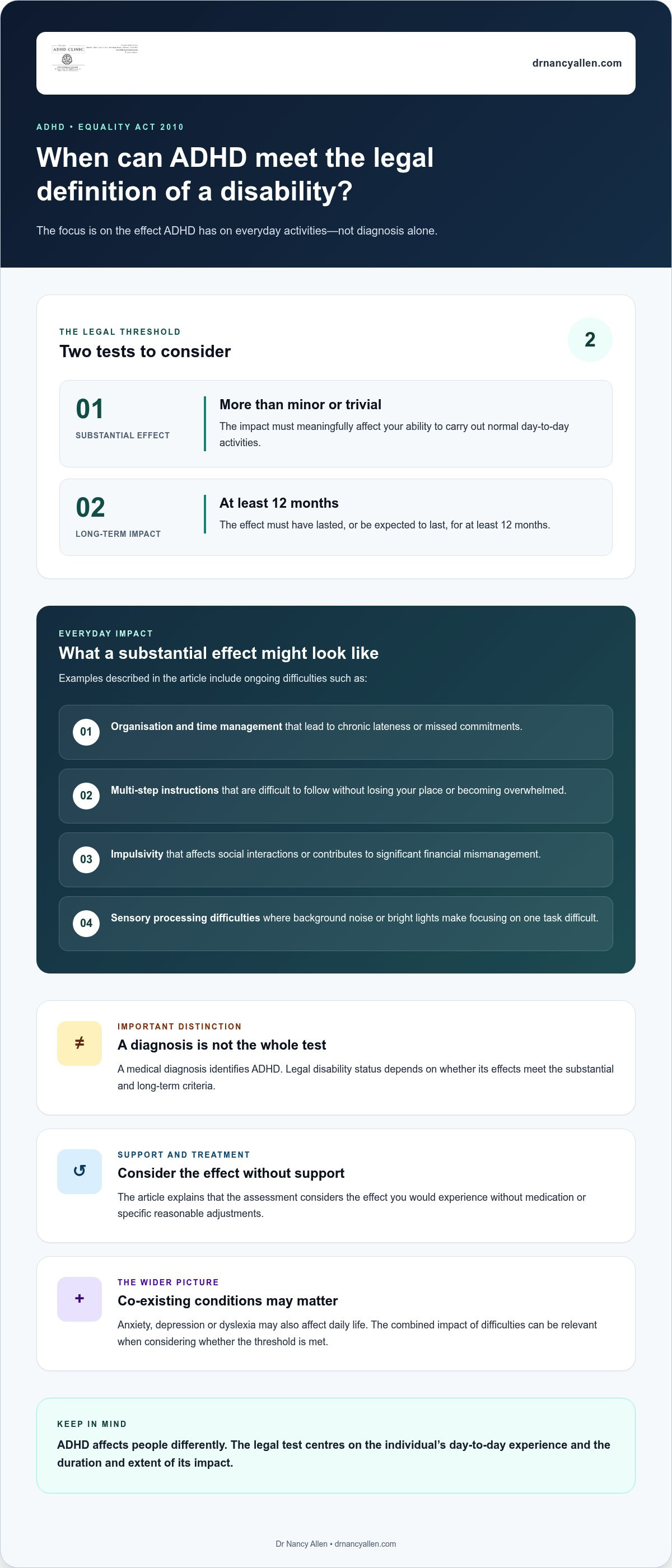
The legal framework focuses heavily on the "effect" of the condition rather than just the medical terminology. To understand the clinical roots of these effects, one can refer to a comprehensive medical and scientific overview of ADHD. However, for the law, the priority is how these symptoms impact your daily life. A medical diagnosis identifies the condition, but legal disability status is established when that condition has a "substantial and long-term adverse effect" on your ability to carry out normal activities. This includes tasks like following complex instructions, keeping to a timetable, or interacting with colleagues in a high-pressure environment.
What Constitutes a 'Mental Impairment'?
The Equality Act uses the term "mental impairment" to categorise conditions like ADHD. While this language might feel clinical, it's the mechanism that grants neurodevelopmental conditions the same legal weight as physical disabilities. Invisible disabilities are often misunderstood by those who cannot see the internal struggle. However, the law treats a challenge with executive function or focus with the same gravity as a mobility issue. Securing a formal diagnosis is the primary way to provide clinical evidence of this impairment. It transforms a personal struggle into a legally protected right, ensuring your needs aren't dismissed as mere personality traits.
ADHD and Co-existing Conditions
It's rare for ADHD to exist in isolation. Many individuals also manage co-existing conditions such as anxiety, depression, or dyslexia. When determining if is adhd a disability in a legal sense, courts and employers must consider the cumulative effect of these challenges. A person might manage their ADHD symptoms reasonably well, but when combined with the weight of clinical depression, the total impact on their daily life may easily meet the disability threshold. Clinical validation helps map these complex profiles, ensuring every facet of your experience is accounted for when you seek support and understanding.
When Does ADHD Meet the Legal Definition of a Disability?
Whilst the legal framework provides a clear answer, applying it to your individual life requires a nuanced look at your daily experiences. To determine if is adhd a disability in your specific case, the Equality Act 2010 sets out two primary hurdles: the substantial test and the long-term rule. A substantial effect is one that's more than minor or trivial. It's the difference between occasionally losing your keys and consistently failing to meet workplace deadlines because your brain cannot prioritise tasks effectively.
The long-term rule requires that the impairment has lasted, or is expected to last, for at least 12 months. Because ADHD is a lifelong neurodevelopmental condition, this criterion is usually met with ease. However, many people mistakenly believe that if their medication helps manage their symptoms, they are no longer disabled. The law disagrees. It assesses you based on your deduced effect, which is how you would function without the support of medication or specific Reasonable Adjustments.
Examples of 'Substantial' Impact
Executive dysfunction manifests in various ways that go beyond simple forgetfulness. You might recognise these patterns in your own life:
Constant difficulty with organisation and time management that leads to chronic lateness or missed commitments.
An inability to follow complex, multi-step instructions without losing your place or becoming overwhelmed.
Impulsivity that affects your social interactions or leads to significant financial mismanagement.
Sensory processing issues where background noise or bright lights make it impossible to focus on a single task.
The 'Hidden' Nature of ADHD Struggles
Many adults become experts at hiding their symptoms to fit in. Masking is the conscious or unconscious suppression of natural ADHD traits to conform to social expectations, a process that frequently leads to extreme exhaustion and significant diagnostic delay. You might spend your entire workday performing the role of a neurotypical employee, only to collapse from mental fatigue the moment you reach home. This emotional toll is a core part of the disabling effect of the condition, even if it isn't visible to your employer or peers.
If you recognise these patterns, a specialist ADHD assessment can provide the clinical evidence required to validate your experience. Gaining this clarity is the first step in confirming that is adhd a disability that entitles you to the support and protections you deserve.
Workplace Rights and Reasonable Adjustments for ADHD
Recognising that is adhd a disability under the Equality Act 2010 provides you with a powerful shield in the professional world. Employers in the UK have a proactive legal duty to ensure that neurodivergent staff are not placed at a substantial disadvantage compared to their neurotypical peers. This duty is triggered as soon as an employer becomes aware, or could reasonably be expected to be aware, of your condition. However, you retain full control over your narrative. You have a right to confidentiality; you decide when, how, and to whom you disclose your diagnosis.
What constitutes a 'reasonable' adjustment depends on the size of your organisation, the cost of the change, and how effective it will be in removing the barrier you face. A global corporation might be expected to provide more extensive support than a small family business, yet the core obligation remains. To initiate this process effectively, a formal specialist report is often the most persuasive tool. Dr Nancy Allen’s 72-hour turnaround for assessments ensures that you can move from a place of uncertainty to a position of legal protection within days, providing your HR department with the clinical evidence they need to implement changes without delay.
Impact-driven and sustainable organisations, such as The Ethical Agency, often lead the way in this regard, building inclusive environments that allow neurodivergent talent to thrive within the digital and creative industries.
Common Reasonable Adjustments for ADHD
Adjustments are rarely about giving an 'advantage'; they are about levelling the playing field so your skills can shine. Small changes to your environment or workflow can have a transformative impact on your productivity and mental well-being. Common examples include:
Environmental changes: Using noise-cancelling headphones to manage auditory distractions, or accessing 'quiet zones' for deep-focus tasks. Some find 'body doubling' (working alongside a colleague) helps maintain focus.
Flexible working: Adjusting start times to accommodate 'sleep inertia', a common ADHD trait where the brain takes longer to reach alertness in the morning. Working from home can also reduce the sensory overwhelm of a busy office.
Task management: Requesting written summaries after meetings, breaking down large projects into micro-deadlines, and having regular check-ins with managers to ensure priorities remain clear.
Access to Work: The UK Government's Best-Kept Secret
When you accept that is adhd a disability in the legal sense, you open the door to government-funded support that many remain unaware of. The Access to Work scheme is a grant designed to cover the costs of practical support that goes beyond 'reasonable' for an employer to provide. For the 2025/2026 financial year, the maximum grant available is £69,260 per person. This funding can be used for specialist ADHD coaching, assistive software, or even a support worker to help with administrative organisation.
Crucially, you do not need your employer's permission to start an application, and the grant is available whether you are employed or self-employed. The process begins with an online application through the Department for Work and Pensions (DWP). Having a clear, professional diagnosis helps an Access to Work assessor understand exactly which barriers you face, ensuring the support package is tailored to your specific clinical profile.
Beyond the Workplace: Education and Daily Life Support
The recognition of ADHD as a protected characteristic extends far beyond the professional arena, touching every stage of life from childhood through to higher education. For students in the UK, the question of whether is adhd a disability is answered by the provision of the Disabled Students’ Allowance (DSA). This support can fund specialist equipment, assistive technology, or mental health mentoring, ensuring that neurodivergent individuals have an equal opportunity to excel in a university environment. Similarly, children are protected under the SEND (Special Educational Needs and Disability) framework, which mandates that schools provide the necessary adjustments to accommodate a child’s unique learning profile.
Outside of education, the legal status of ADHD also plays a vital role in accessing social security. Personal Independence Payment (PIP) and Disability Living Allowance (DLA) for children are designed to help with the extra costs of living with a long-term health condition. These benefits are not awarded based on the diagnosis itself but on the level of support you require for daily living. Securing these rights often requires a detailed clinical assessment that clearly articulates the functional impact of your symptoms on your quality of life.
ADHD and the Menopause Transition
For many women, the midlife transition creates a 'perfect storm' where hormonal shifts and neurodivergence collide. Falling oestrogen levels during perimenopause and menopause directly impact dopamine regulation, often causing a significant spike in ADHD symptoms such as brain fog, forgetfulness, and emotional dysregulation. We frequently see women who managed their symptoms effectively for decades suddenly find that their internal coping mechanisms are no longer sufficient. It is often during this stage that they first realise that is adhd a disability in their context, as the cumulative impact of hormonal changes meets the legal threshold of 'substantial' impact. A combined approach that addresses both neurodivergence and hormonal health is essential for restoring clarity.
Financial Support: PIP and DLA
Navigating the Department for Work and Pensions (DWP) points system can feel like a daunting task. PIP is awarded based on how your ADHD affects your ability to carry out specific daily activities, such as managing your treatments, making financial decisions, or engaging with other people. When completing these applications, it is vital to describe your 'worst days' rather than your best. This provides a realistic picture of the challenges you face when your symptoms are at their most disabling. A comprehensive specialist report serves as the cornerstone of your application, providing the clinical evidence necessary to support your claim for financial assistance.
If you are struggling with the intersection of hormonal changes and neurodivergence, you can book a specialist ADHD and menopause consultation to gain the clinical clarity and support you deserve.
Navigating the Path to Clarity: The Role of a Specialist Diagnosis
A formal diagnosis is far more than a medical label; it is the "golden key" that unlocks the legal protections discussed throughout this guide. Without clinical evidence, the question of whether is adhd a disability remains a personal theory rather than a legal reality. In the eyes of employers, educators, and the DWP, a specialist report provides the necessary proof that your challenges meet the statutory definition of an impairment. It transforms your internal struggle into a recognised condition that demands respect and accommodation.
The current landscape of neurodiversity care in the UK presents a significant challenge. As of 2026, NHS waiting lists for ADHD assessments have stretched to between three and six years in many regions. For a professional struggling to maintain their career or a student facing exams, this delay is often untenable. Private care offers a vital alternative, prioritising speed and empathy without sacrificing clinical rigour. By choosing a specialist path, you bypass the years of uncertainty and move directly toward a personalised treatment plan designed to restore your confidence and quality of life.
Our 72-Hour Diagnostic Process
We recognise that when you reach out for help, you have often already waited too long. Dr Nancy Allen provides a streamlined 72-hour diagnostic process that moves you from your initial secure online consultation to a full, comprehensive report in just three days. This assessment is not a tick-box exercise. Whether for an adult or a child, it involves a deep clinical dive into your history, symptoms, and the specific ways ADHD impacts your daily functioning. The resulting report is crafted to speak directly to HR departments and educational institutions, clearly outlining the adjustments required to help you thrive.
Empowerment Through Validation
Seeking a diagnosis allows you to move past the damaging stigma of 'disability' and begin embracing your neurodivergent strengths. Many of our patients describe a profound sense of relief upon receiving their results; it is the moment they realise they aren't 'lazy' or 'broken', but simply possess a brain that functions differently. Professional clinical insight provides the peace of mind needed to stop masking and start advocating for yourself. For those ready to begin this journey, our Adult ADHD Assessment: A Comprehensive Guide to Seeking Clarity and Support offers a clear roadmap for what to expect during your consultation. Ultimately, confirming that is adhd a disability in your context is the first step toward a life defined by support rather than struggle.
Reclaiming Your Professional and Personal Potential
Understanding the legal framework of the Equality Act 2010 is the foundation for securing the workplace adjustments and financial support you deserve. Whether you are navigating the complexities of perimenopause or seeking clarity for your child, a formal diagnosis provides the clinical validation required to move forward with confidence. We have explored how the question of whether is adhd a disability is answered by the profound impact the condition has on your daily life, rather than just a medical label.
You don't have to wait years for the support you need today. Dr Nancy Allen offers 25 years of clinical experience to guide you through this process with empathy and authority. Through secure online consultations available across the UK, you can receive a comprehensive diagnosis and treatment plan within just 72 hours. This speed ensures you can secure your legal rights and begin your journey toward restoration without further delay.
Take the first step toward clarity and book your private ADHD assessment with Dr Nancy Allen today. Your journey toward a more supported and validated life starts with the right expert guide by your side.
Frequently Asked Questions
Is ADHD considered a disability in the UK for PIP?
ADHD is recognised as a condition that can qualify you for Personal Independence Payment (PIP) if it substantially affects your daily living or mobility. The DWP doesn't grant PIP based on your diagnosis alone; instead, they use a points system to assess how symptoms like executive dysfunction impact specific tasks. Providing a clinical report that details your struggle with focus, organisation, and social interaction is vital for a successful claim.
Do I have to tell my employer I have ADHD?
You aren't legally required to disclose your ADHD to your employer at any stage of your employment. However, if you don't disclose your condition, you won't be entitled to the legal "reasonable adjustments" that can help you thrive in your role. Many professionals choose to share their diagnosis only after they've secured a formal specialist report, as this provides a clear, evidence-based foundation for the conversation with HR.
Can my employer fire me for having ADHD?
An employer cannot legally dismiss you simply because you have ADHD; this would be considered disability discrimination under the Equality Act 2010. If your performance is affected by your symptoms, your employer has a proactive duty to explore reasonable adjustments before taking any disciplinary action. Your legal protections are strongest when your employer is formally aware of your diagnosis and the specific barriers you face in the workplace.
What are the most common reasonable adjustments for ADHD at work?
Common adjustments include noise-cancelling headphones to manage office distractions, flexible start times to accommodate sleep patterns, and receiving all instructions in writing. Other effective changes involve breaking large projects into smaller, manageable milestones and having regular check-ins with your manager. These simple shifts are often highly effective at levelling the playing field for neurodivergent staff.
Does a child with ADHD automatically count as having a disability?
A child with ADHD is considered to have a disability if their condition has a "substantial and long-term" impact on their daily life and learning. This legal recognition ensures they are protected by the SEND framework, allowing parents to request specific classroom support or an Education, Health and Care (EHC) plan. Early clinical validation is the best way to ensure your child receives the necessary accommodations throughout their schooling.
How do I prove my ADHD is a disability to the DWP?
To prove that is adhd a disability in your specific case, you must provide the DWP with clinical evidence of your functional limitations. A comprehensive specialist report is the most effective tool for this, especially when paired with a diary that documents your "worst days." You need to demonstrate how your symptoms affect your ability to manage treatments, make financial decisions, or interact safely with others.
Can I get Access to Work for ADHD if I'm self-employed?
You are fully eligible for the Access to Work scheme if you are self-employed and have a formal ADHD diagnosis. The grant can fund specialist support such as ADHD coaching, organisational software, or even a support worker to help with administrative tasks. This scheme is a vital resource for neurodivergent entrepreneurs who need to bridge the gap between their creative strengths and the demands of running a business, often partnering with specialists like Toptarget Online Marketing Ügynökség to handle high-ROI marketing while they focus on innovation.
Does ADHD count as a disability if I'm on medication?
ADHD still counts as a disability even if your symptoms are successfully managed by medication. UK law applies a "deduced effect" rule, meaning your condition is assessed based on how it would affect you if you were not taking any treatment. This ensures that you don't lose your legal rights or workplace protections simply because you are proactively managing your health with clinical support.



Comments