


Lisdexamphetamine Dosage and Titration: A Complete Guide

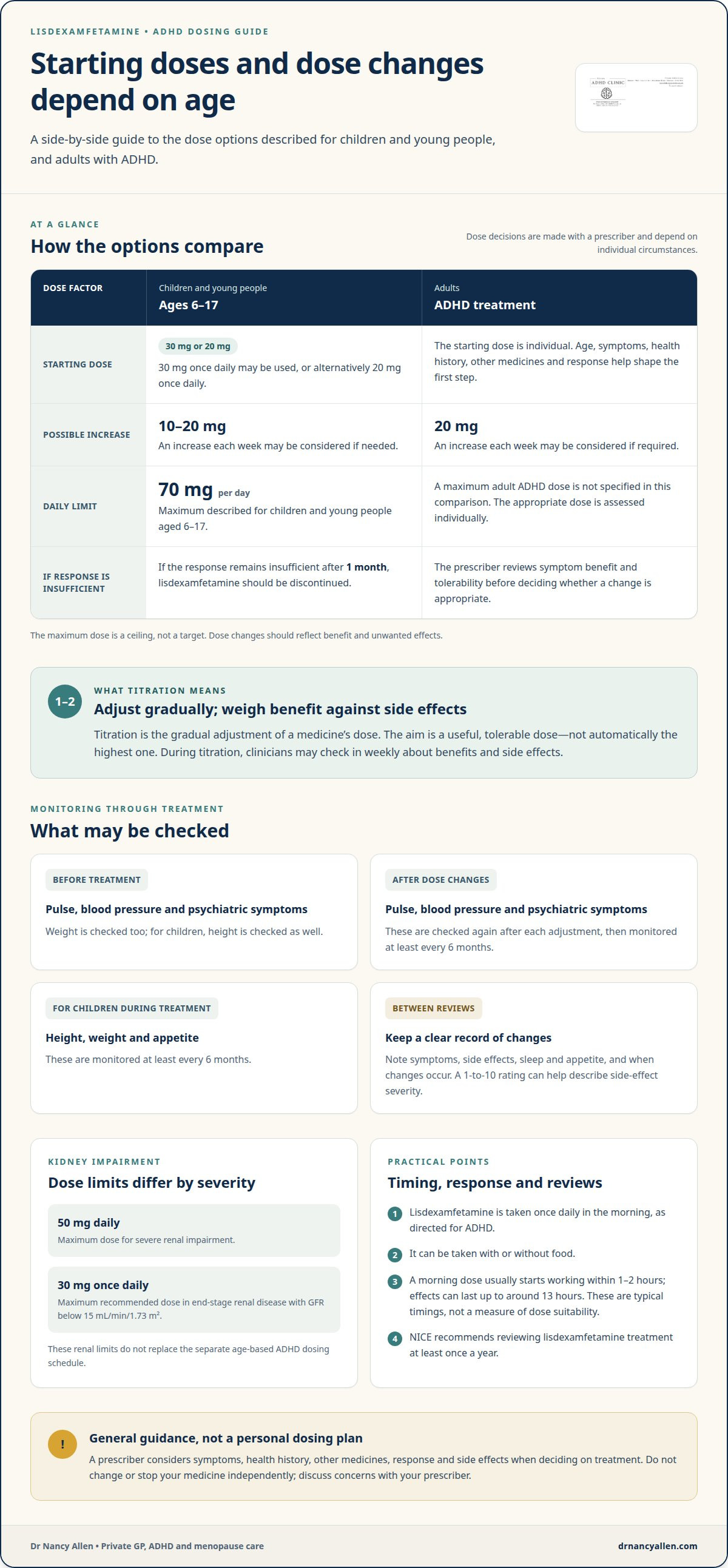
The starting dose of lisdexamfetamine is individual, but age and the reason for treatment shape the options. For ADHD, children aged 6-17 years may start at 30 mg once daily, or alternatively 20 mg once daily; if needed, the dose can be increased by 10-20 mg each week, up to 70 mg per day. In adults with ADHD, increases of 20 mg each week may be used if required. These dosage details for lisdexamfetamine capsules in adults and children, and how best to titrate, are a guide to treatment decisions, not a personal dosing plan.
It’s understandable to want a clear answer about the right dose, how quickly it may change and what to expect along the way. Titration means adjusting a medicine’s dose gradually, so its benefits and any side effects can be considered together. NICE recommends methylphenidate as the first-line pharmacological treatment for children aged 5 years and over and young people with ADHD, so lisdexamfetamine is not automatically the first medicine chosen.
This guide explains how licensed ages and starting doses differ, what clinicians consider when adjusting treatment, and practical points about daily limits, morning use and dosage forms. It also covers monitoring, helping adults, parents and carers understand the process and prepare for a conversation about individual care.
Table of Contents
Maximum daily dose
A starting dose is the amount taken at the beginning of treatment, before any later adjustment. For ADHD, age, symptoms, health history, other medicines and the person’s response help shape that first step. Before treatment, a prescriber also considers possible side effects and checks blood pressure, pulse and weight. For children, height is checked too.
A prescriber can decide on a suitable starting dose based on individual circumstances. If an increase is needed, the dose can rise in 20 mg steps every week. The appropriate next dose depends on symptom benefit and tolerability. For adults, dosage details for lisdexamfetamine capsules and how best to titrate them are general information, not a personal dosing plan.
For children and adolescents aged 6-17 years with ADHD, the starting dose is 30 mg once daily, or alternatively 20 mg once daily. The dose may be increased by 10-20 mg every week if required, up to a maximum of 70 mg per day. If the response remains insufficient after 1 month, lisdexamfetamine should be discontinued.
Titration means gradually adjusting a medicine’s dose to find a suitable balance between benefit and side effects. For adults with ADHD, increases of 20 mg every week may be considered; for children aged 6-17 years, increases of 10-20 mg every week may be considered. The maximum dose is a ceiling, not a target. A prescriber weighs changes against symptoms, adverse effects and relevant health factors.
What dose adjustments are recommended for kidney or liver impairment, or when switching from another ADHD medicine? Severe renal impairment has a maximum lisdexamfetamine dose of 50 mg daily. In end-stage renal disease with a GFR below 15 mL/min/1.73 m2, the maximum recommended dose is 30 mg once daily. Liver impairment and switching from another ADHD medicine require individual clinical consideration of health, current treatment, response and side effects; there is no automatic dose conversion.
With kidney impairment, renal function is important because the stated maximum dose changes according to severity. These renal limits do not replace the separate age-based ADHD dosing schedule. Switching medicines also requires a planned review of the previous medicine and the new treatment. Do not take both doses together unless specifically directed.
For readers considering dosage details for lisdexamfetamine capsules in adults and children, and how best to titrate treatment, age and indication are important starting points. Dosing guidance may differ for adults treated for binge-eating disorder, a different indication from ADHD. The National Institute for Health and Care Excellence recommends reviewing lisdexamfetamine treatment at least once a year. Treatment decisions should reflect benefits and unwanted effects, not simply aim for the maximum.
What is medication titration?
Medication titration is the gradual adjustment of a dose to balance symptom benefits with unwanted effects. With lisdexamfetamine, the prescriber reviews how treatment is working before deciding whether a change is appropriate. The aim is a useful, tolerable dose, not automatically the highest one.
Monitoring means recording changes in symptoms, side effects and relevant physical measures throughout treatment. Before starting lisdexamfetamine, a prescriber checks pulse, blood pressure and psychiatric symptoms. After each dose adjustment, these are checked again, then monitored at least every 6 months. In children, height, weight and appetite also need monitoring at least every 6 months during treatment.
During titration, clinicians may check in weekly about benefits and side effects. A clear record can help make those conversations specific: for example, note changes in concentration, task completion, sleep or appetite, alongside when they occur. Side effects can be rated on a scale from 1 to 10, making it easier to describe their severity and whether it changes after a dose increase. Significant effects that continue after a week may indicate that the dose is too high.
These observations help distinguish a dose that provides too little benefit from one that causes difficult effects. A prescriber considers the pattern over time, rather than judging treatment by one unusually good or difficult day. If benefits are limited, discuss whether to adjust the dose or reconsider the treatment. If side effects are troubling, report them rather than changing or stopping the medicine independently.
Urinary pH describes how acidic or alkaline urine is, and can affect amphetamine levels in the body. Acidifying agents such as ascorbic acid decrease blood levels of amphetamine, while alkalinising agents such as sodium bicarbonate increase them. Discuss medicines and supplements with your prescriber. Do not alter them without advice.
A morning dose of lisdexamfetamine usually starts working within 1-2 hours, and its effects can last up to around 13 hours. These timings describe a typical pattern, not a measure of whether a dose is suitable. During review, consider when benefits begin, how long they seem to last, and whether effects such as appetite changes or sleep difficulties emerge later.
For a clearer discussion, bring a concise record of symptoms and side effects to your next clinical conversation. An individual ADHD assessment can help put symptoms and their impact into context.
Morning administration and food
Morning administration means taking lisdexamfetamine once daily in the morning, as directed for ADHD. It can be taken with or without food, so breakfast does not have to determine when you take it. Following the prescribed morning routine can also make it easier to notice when benefits and side effects occur.
For children aged 6-17 years taking lisdexamfetamine for ADHD, the dose should be taken in the morning. Adults also take it once daily in the morning. If a child’s morning routine changes, the prescription should still guide when the medicine is taken; a parent or carer can discuss practical difficulties with the child’s healthcare professional.
Food is optional when taking a dose, allowing the medicine to fit around different breakfast routines. For example, a person may take the capsule before breakfast or with a meal. This does not mean adjusting the dose according to how much food is eaten. Take the prescribed amount, and tell the prescriber if appetite changes or other effects make meals difficult.
A missed dose is one not taken at the usual time. If you remember in the morning, take it then. If it is already afternoon, skip it and take your usual dose the next morning. This avoids shifting a morning medicine later in the day. Do not take an extra dose to make up for one you missed.
Capsule contents can be mixed into a drink or food only as permitted by the medicine’s instructions. Lisdexamfetamine capsule contents may be mixed with yoghurt, water or orange juice, and the entire mixture should be consumed immediately. Do not prepare it ahead or store it for later. Do not split the contents to create a smaller dose.
These practical details matter whether lisdexamfetamine is prescribed for ADHD or another condition, such as binge eating disorder. The word “syndrome” may appear in information about a condition, but it does not change the medicine’s morning instructions. Take the prescribed dose rather than changing its timing or amount to manage symptoms independently.
Before breakfast: take the prescribed dose in the morning, with or without food.
If a morning dose is remembered later that morning: take it then.
If it is already afternoon: skip it and resume the usual morning dose the next day.
If mixing capsule contents: use yoghurt, water or orange juice, consume the full mixture immediately, and don’t store it.
Tell a healthcare professional about recurring missed doses, appetite changes or difficulties with the morning routine. For a child, a parent or carer can explain how taking the medicine fits around school mornings and meals, so treatment discussions reflect daily life as well as symptoms.
Available oral dosage forms
An oral dosage form is a medicine designed to be taken by mouth. Oral medicines may come in different forms, and the available options can vary by product. The active medicine is the same, but the form affects how a person takes the prescribed dose.
A capsule is a small shell containing medicine, taken whole or opened according to its instructions. Lisdexamfetamine capsules may be swallowed whole, or their contents may be mixed with yoghurt, water or orange juice. Consume the entire mixture immediately rather than storing it. Do not split capsule contents to make a smaller dose.
A chewable tablet is a solid dose that is chewed before swallowing. Vyvanse capsules may be substituted with Vyvanse chewable tablets of the same dosage strength. This does not mean changing forms or strengths independently. A prescriber or pharmacist can clarify how to take a prescribed product, particularly when changing formulation.
An oral solution is a liquid medicine taken by mouth. It may be practical for patients who find capsules or tablets difficult to swallow. The prescribed amount still matters: measure liquid medicine carefully using the method supplied with it, not an ordinary kitchen spoon. Follow the product instructions and prescription.
Difficulty swallowing can make taking a capsule stressful, and anxiety about medicines may add to the challenge. Tell the healthcare professional or pharmacist what is difficult, such as swallowing a whole capsule or managing a liquid dose. They can discuss the available form and its instructions, without relying on guesswork to change the prescribed amount.
These are different forms of lisdexamfetamine, not separate doses to combine. For example, a capsule and a chewable tablet of the same dosage strength are alternatives, not two doses to take together. If your prescription changes from one form to another, follow the new directions and ask about any practical difference in how to take it.
Before taking a dose, use this simple check:
Identify whether the prescription is for a capsule, chewable tablet or oral solution.
Follow the instructions for that specific form, including how to take or measure it.
Keep to the prescribed dose; do not divide capsule contents or combine forms to adjust it.
Ask a pharmacist or prescriber about any unclear direction before changing how the medicine is taken.
For children, parents and carers can help establish a consistent routine by following the directions for the exact product prescribed. If a child cannot swallow a capsule, mention this during a treatment discussion rather than opening or altering doses without guidance. For adults, difficulty swallowing or measuring liquid is also relevant to a medication review. The formulation can be matched to practical needs, while dose decisions remain part of the treatment plan.
Licensed use in children and adults
A licensed age range is the group for whom a medicine is authorised for a particular use. Lisdexamfetamine is used for ADHD in adults and children aged 6 years and older. Its licensed age range does not mean it is automatically the first medicine offered to every person.
For children aged 5 years and over and young people with ADHD, the National Institute for Health and Care Excellence recommends methylphenidate as the first-line pharmacological treatment. Lisdexamfetamine may be considered within an individual treatment plan, taking account of response, side effects and clinical circumstances. Age is one part of that decision, alongside symptoms and health history.
For a child younger than 6 years, a doctor must determine whether lisdexamfetamine is appropriate and decide its use and dose. This is a different situation from the established age range of 6 years and older. Parents and carers can share how symptoms affect daily life, learning and relationships, helping the clinical discussion consider the child’s circumstances.
For children aged 6-17 years with ADHD, treatment starts at 30 mg once daily, or alternatively 20 mg once daily. If needed, the dose can increase by 10-20 mg every week, up to 70 mg per day. Lisdexamfetamine should be discontinued if the response remains insufficient after 1 month.
Growth monitoring means regularly tracking a child’s height, weight and appetite during treatment. Before starting, a prescriber checks blood pressure, pulse and weight, and also checks height in children. During treatment, height, weight and appetite should be monitored at least every 6 months. These measures help clinicians assess how treatment is affecting the child, alongside symptom changes and side effects.
Lisdexamfetamine is also licensed for use in adults with ADHD, though assessment and monitoring remain individual. For adults and children alike, a medicine’s licence describes authorised use, not a guarantee of benefit or a recommendation to use it. Follow the prescribed dose and formulation rather than adjusting them independently.
Practical administration matters too. If a child cannot swallow a capsule, its contents may be mixed with yoghurt, water or orange juice, and the entire mixture consumed immediately. Do not store it or divide it to make a smaller dose. Discuss swallowing difficulties, appetite changes or weight changes with the healthcare professional involved in treatment.
If you’re seeking clarity about ADHD symptoms and whether assessment is appropriate, an individual ADHD assessment can provide a structured starting point for discussing the next steps.
Dr Nancy Allen: Adult ADHD Assessment
Dr Nancy Allen’s Adult ADHD Assessment provides space to explore symptoms, personal history and their impact on daily life. It may be a helpful next step if you’re seeking clarity about possible ADHD or want to discuss how symptoms affect work, relationships or everyday tasks.
An assessment considers your circumstances and supports a discussion about appropriate options. This article can explain general lisdexamfetamine dosing, but it cannot determine whether the medicine is suitable for you or what dose you should take. That requires individual clinical consideration.
If you’re considering an assessment, contact Dr Nancy Allen to discuss the next step.
Take your next step with confidence
Understanding lisdexamfetamine capsule doses for adults and children, and how treatment is titrated, can help you have a more informed conversation about ADHD care. Consider what you need from that conversation: clarity about symptoms, an assessment or a review of treatment options. A clinician can consider your history and circumstances alongside the questions you bring.
Dr Nancy Allen offers Adult ADHD Assessment and Child ADHD Assessment, as well as Peri-menopause & Menopause Specialist Care. An online article cannot determine whether you have ADHD or recommend a personal dose, but it can help you identify what you’d like to discuss.
If you’re ready to explore an assessment or discuss your situation, contact Dr Nancy Allen. A thoughtful conversation can be a constructive starting point.
Frequently Asked Questions
How is your initial dose of ADHD medication determined?
The initial dose is selected by considering age, symptoms, health history, other medicines, and likely benefits and risks. For lisdexamfetamine, a prescriber also considers kidney function and checks relevant physical measures before treatment. For example, a child’s height is checked alongside weight, while symptoms and daily functioning help show what treatment needs to address. These factors guide the starting plan rather than a dose chosen by age alone.
How long does lisdexamfetamine take to work?
Lisdexamfetamine usually starts working within 1-2 hours after a dose. During treatment review, noting when changes become noticeable can help describe its effect across the day. For example, record whether attention or task completion changes during the morning, and whether benefits remain useful later. This information helps a prescriber assess the overall pattern; one isolated day does not provide the full picture of treatment response.
How long will I need to take it?
How long you take lisdexamfetamine depends on its ongoing benefits, side effects and your treatment goals. NICE recommends reviewing lisdexamfetamine treatment at least once a year. A review is an opportunity to discuss changes in symptoms and daily functioning, and whether the current plan remains appropriate. Do not stop or alter prescribed treatment without discussing it with the clinician responsible for your care.
How should lisdexamfetamine be titrated, and at what intervals, in adults and children?
Titration adjusts the dose in planned steps, with benefits and side effects reviewed before another change. In adults with ADHD, increases of 20 mg every week can be used if required. For children aged 6-17 years, increases of 10-20 mg every week can be used if required. Don’t increase the dose yourself. Share changes in symptoms or unwanted effects with the prescriber before the next planned adjustment.
What dose increments and available capsule strengths are used for lisdexamfetamine titration in the UK?
For adults with ADHD, dose increases can be 20 mg every week if required; for children aged 6-17 years, increases can be 10-20 mg every week. The prescribed capsule strength should match the written directions, and capsule contents must not be split to create a smaller dose. Ask a pharmacist to explain a dispensing label if the strength or directions are unclear, rather than combining or altering doses.
How should lisdexamfetamine be taken, including timing, with or without food, and missed doses?
Take lisdexamfetamine once daily in the morning, with or without food. If you remember a missed dose during the morning, take it then. If it is already afternoon, skip it and resume your usual dose the next morning. Do not take an extra dose to make up for the missed one. If you miss doses repeatedly, discuss your routine with your prescriber or pharmacist.
What baseline checks and ongoing monitoring are needed when starting or increasing lisdexamfetamine?
Before starting, a prescriber checks blood pressure, pulse and weight, and checks height in children. Pulse, blood pressure and psychiatric symptoms are monitored before treatment, after each dose adjustment, and at least every 6 months thereafter. For children, height, weight and appetite also need monitoring at least every 6 months. Keep scheduled reviews and report relevant changes between appointments, particularly after a dose change.
What are the common and serious side effects of lisdexamfetamine, and what symptoms need urgent medical attention?
Side effects can affect whether a dose remains suitable, so report new or troublesome effects to the prescriber, especially after a dose increase. The symptoms and their severity guide the clinical review. For severe or sudden symptoms, seek urgent medical advice; call 999 for an immediate emergency or contact NHS 111 for urgent help that is not life-threatening. Don’t change the dose independently while waiting for advice.



Comments