


Methylphenidate vs Guanfacine: Comparing ADHD Medications

Updated: 3 hours ago
The non-stimulant option isn’t automatically the gentler or more suitable choice. If you’re comparing methylphenidate vs guanfecine (usually spelt guanfacine), you may want a clear answer, particularly if you’re weighing possible side effects, concerns about dependence or conflicting advice online. Neither medicine is right for everyone.
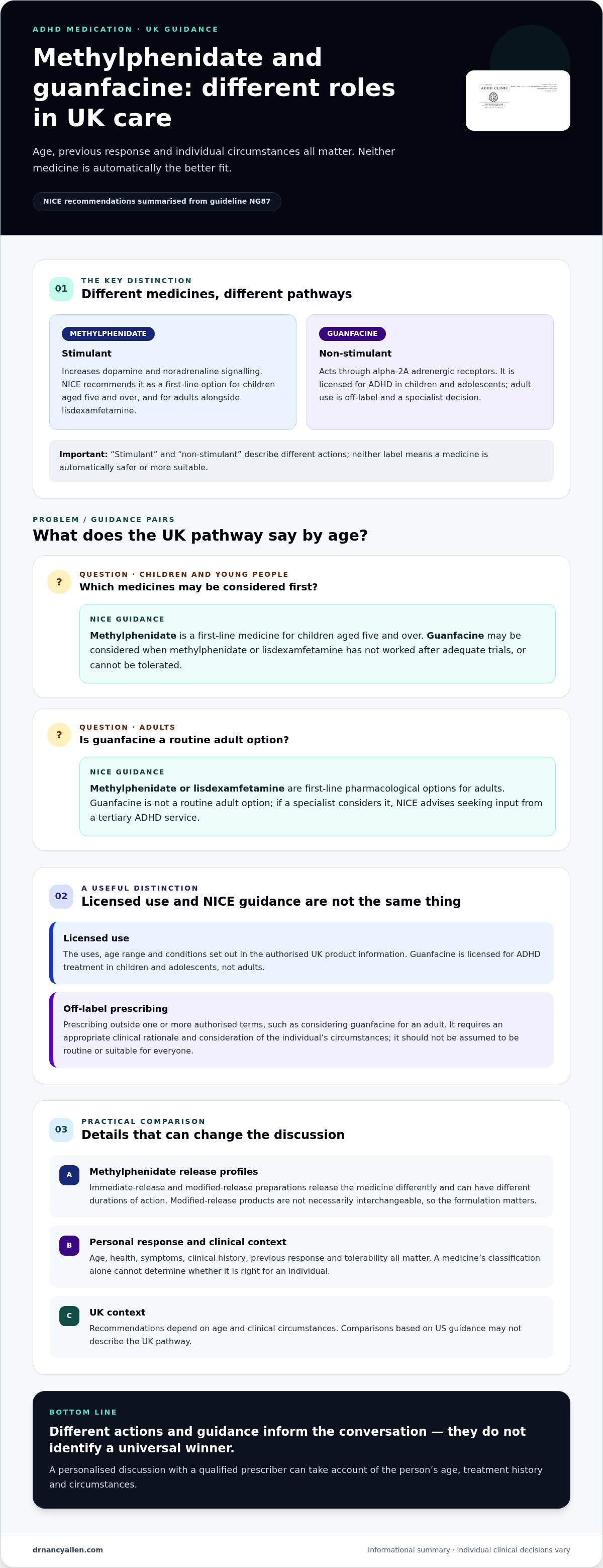
Both medicines are used in ADHD care, but they work differently and have different roles. UK guidance matters: NICE recommends methylphenidate as a first-line medicine for children and young people aged five and over, and lists it alongside lisdexamfetamine as a first-line option for adults. Guanfacine is licensed for children and adolescents; use in adults is off-label and a specialist decision. This article explains how the medicines differ, their typical effects and side effects, and how UK prescribing guidance can shape the discussion. Rather than looking for a universal winner, consider what may fit your individual clinical needs. An ADHD assessment and a personalised conversation with a qualified prescriber can help you understand the options.
Table of Contents
Methylphenidate vs guanfacine: what is the essential difference?
Methylphenidate is a stimulant medicine, whilst guanfacine is a non-stimulant. They act on the brain in different ways and have different prescribing contexts in the UK. Neither label means a medicine is automatically safer or better. Suitability depends on a person’s age, health, symptoms and clinical history. The comparison is sometimes searched as “methylphenidate vs guanfecine”, although guanfacine is the correct spelling.
Broadly, stimulants influence brain signalling involving dopamine and noradrenaline. Guanfacine acts on alpha-2A adrenergic receptors instead. This difference helps explain why a prescriber may consider the medicines in different circumstances, but it cannot determine which is right for an individual.
For a closer look at one methylphenidate formulation, this video discusses Concerta and its use in adult ADHD:
How does methylphenidate work?
Methylphenidate affects the availability of dopamine and noradrenaline, chemical messengers involved in attention and other brain functions. Responses vary between people. The medicine comes in immediate-release and modified-release forms, which release it differently and can therefore have different durations of action. Modified-release products aren’t necessarily interchangeable, so the formulation matters. Read more about methylphenidate release ratios to understand why the proportions released at different times are relevant.
How does guanfacine work?
Guanfacine stimulates alpha-2A adrenergic receptors, which are part of the brain’s noradrenaline system. Rather than acting like a stimulant, it influences signalling through this receptor pathway. This is a useful distinction, but not a complete explanation of brain chemistry or a guarantee of a particular effect. Guanfacine is also used for ADHD; for a broader overview, explore how non-stimulant ADHD medication works.
In short, methylphenidate increases dopamine and noradrenaline signalling, whilst guanfacine works through alpha-2A receptors. Their different actions inform clinical discussion, not an automatic treatment choice. A comparison can help you understand the terminology and prepare questions, but medication decisions need to take account of your circumstances and UK prescribing guidance.
What does UK guidance say about methylphenidate and guanfacine?
UK recommendations depend on age and clinical circumstances, so US comparisons may not describe the pathway followed here. NICE guideline NG87 recommends methylphenidate as a first-line medicine for children aged five and over, and recommends methylphenidate or lisdexamfetamine as first-line pharmacological options for adults with ADHD. For children and young people, NICE says guanfacine may be considered when methylphenidate or lisdexamfetamine hasn’t worked after adequate trials or can’t be tolerated.
In UK guidance, methylphenidate is a first-line option for children aged five and over and for adults, whilst guanfacine has a role for some children and young people and is not a routine adult treatment. This summarises NICE recommendations; it doesn’t predict what a particular person will be prescribed. Previous response, tolerability, health history and other clinical factors matter too.
How can recommendations differ for children and adults?
NICE’s recommendations are age-specific. For adults, the first-line choices are methylphenidate or lisdexamfetamine; guanfacine is not a routine adult option. If a specialist is considering guanfacine for an adult, NICE advises seeking input from a tertiary ADHD service. Recommendations for children and young people shouldn’t simply be applied to adults, or vice versa.
UK product information also sets the authorised age range for guanfacine: it is licensed for ADHD treatment in children and adolescents, not adults. A medicine’s licence and NICE recommendations are related but distinct. Guidance describes a recommended clinical pathway, whilst the licence defines authorised use. A clinician will consider both alongside the person’s needs.
What do licensed use and off-label prescribing mean?
Licensed use means prescribing a medicine within the uses, age range and conditions described in its authorised UK product information. Off-label prescribing means a clinician prescribes outside one or more of those terms, such as when considering guanfacine for an adult. It isn’t the same as an unlicensed medicine, but requires an appropriate clinical rationale and a decision that takes the individual’s circumstances into account. Off-label use shouldn’t be assumed to be routine or suitable for everyone.
This distinction can help make sense of different advice online. A medicine’s use in another country or discussion in research doesn’t establish its place in UK guidance. For example, research into combined stimulant and guanfacine administration explores treatment approaches, but it doesn’t replace NICE recommendations or determine what is appropriate for an individual.
When comparing methylphenidate vs guanfecine, focus on how age, previous treatment response and personal health affect the options, rather than treating one medicine as universally preferable. A careful ADHD assessment and personalised treatment discussion can put UK guidance into context without presuming a particular prescription.
Methylphenidate vs guanfacine: side effects, duration, and practical differences
Side effects can affect how manageable a medicine feels in everyday life, but a list can’t predict an individual response. When comparing methylphenidate vs guanfecine, consider the formulation, timing and your routine as well as possible effects. Neither medicine is universally safer or more effective; the balance of benefits and unwanted effects is personal and should be reviewed with a prescriber.
What side effects should readers understand?
With methylphenidate, appetite changes or difficulty sleeping may affect meals and evening routines. Headache, nausea and anxiety are also reported. Guanfacine may cause sleepiness or tiredness, which can affect concentration and daily activities; dizziness is another possible effect. These are common themes, not a complete list, and experiencing one doesn’t automatically mean treatment will be unsuitable.
Product information also describes less common but potentially serious adverse effects. Read the patient information leaflet supplied with your medicine, and speak to your prescriber about any new, severe or worrying symptom. Don’t change or stop a prescribed medicine based on a comparison article. Your clinician can advise on appropriate next steps and whether your treatment needs review.
Why do duration and daily routines vary?
Immediate-release methylphenidate usually acts for a shorter period than modified-release versions. The research information for this article gives typical ranges of around three to four hours for immediate-release and eight to twelve hours for some extended-release formulations, but these aren’t promises. The specific product and individual response matter. Release profiles differ too. The MHRA advises prescribing modified-release methylphenidate by brand because products may not have equivalent release characteristics.
Guanfacine’s schedule depends on the prescribed product and the clinician’s instructions. Extended-release guanfacine is generally taken once daily, but that doesn’t mean every formulation or treatment plan follows the same schedule. Discuss when a medicine is taken, how its effects fit around work, school, meals or sleep, and how it feels over time. Don’t assume a standard schedule will suit everyone.
Keep a brief record of dose timing as prescribed, any perceived benefit, side effects and changes to sleep or appetite. This can make follow-up conversations more specific. If you’re also comparing stimulant options, formulation and duration are relevant when considering lisdexamfetamine and methylphenidate, but expected duration or a side-effect list alone can’t determine which treatment is appropriate for you.
How should you weigh the options with your prescriber?
A comparison can help you prepare, but choosing or changing ADHD medication is a clinical decision, not a simple choice between two product types. If you’re searching “methylphenidate vs guanfecine”, focus the discussion on what you need support with, what you’ve tried before and what matters in your day-to-day life.
What information is useful to bring to a medication discussion?
Before your appointment, make a few notes. You don’t need a perfect record; clear examples from everyday life can make the conversation more focused.
Symptoms and priorities: Note which difficulties have the greatest impact, such as sustaining attention at work, managing tasks or keeping up with routines. Describe what you hope might improve.
Previous treatment: List any ADHD medicines you’ve taken, how they affected you and any unwanted effects. Include how long you took them if you remember.
Health and other medicines: Share relevant medical conditions, health changes and all medicines or supplements you use. These details help your prescriber consider the whole picture.
Practical preferences: Think about how treatment might fit around sleep, meals, study, work or caring responsibilities. Ask which formulation is being discussed and how its schedule may affect your routine.
Monitoring and follow-up: Ask what will be reviewed, how to report side effects or concerns, and when your progress will be discussed again.
You don’t need to arrive with a preferred medicine. A clear account of what matters to you gives the prescriber a better basis for weighing potential benefits, risks and practical considerations together.
If you’re seeking clarity about ADHD symptoms and treatment options, a personalised ADHD assessment can place medication discussions in the context of your individual needs. An assessment doesn’t guarantee a particular diagnosis or prescription; it provides a structured basis for clinical discussion.
What should you do if treatment is not working well?
Tell your prescribing clinician if you’re getting limited benefit, experiencing unwanted effects or finding treatment difficult to fit into daily life. Be specific: note what has changed, when you notice it and how it affects you. Don’t stop, start or alter a prescribed medicine without clinical advice.
A review may consider several possibilities, including the dose, formulation, original diagnosis, coexisting needs or a different treatment approach. The right next step depends on your history and response, so online accounts or another person’s experience can’t determine what should happen in your case. Monitoring and follow-up are part of prescribing. Agree with your clinician what will be checked and how to raise concerns between reviews.
These conversations can take time, particularly when you’re balancing concerns about side effects with the hope of meaningful support. Bringing notes and questions can help you take part with confidence, whilst leaving the prescribing decision to a clinician who understands your circumstances. For adults exploring telepsychiatry and ongoing medication management, services like New Age Psychiatry demonstrate how structured, remote follow-up can support individualised psychiatric care.
How can an ADHD assessment support an informed treatment plan?
Reading about methylphenidate and guanfacine can help you decide what to ask, but a comparison cannot diagnose ADHD or identify the right treatment for you. Medication decisions depend on more than drug class: symptoms, personal and health history, previous treatment experiences and day-to-day needs all contribute to the clinical picture.
A personalised assessment brings those details together. It explores how difficulties have developed, how they affect daily life and whether other factors may be relevant. This context matters because people can experience similar challenges for different reasons, and treatment planning should reflect the individual rather than a medicine comparison alone.
What can a personalised ADHD assessment clarify?
An assessment can explore the nature and history of your symptoms, their impact across areas such as work, study or relationships, and the support you may need. For adults, an adult ADHD assessment guide can help you understand what an assessment may involve. The findings can inform a considered discussion of options, but they don’t guarantee a diagnosis, prescription or particular outcome.
Dr Nancy Allen is a private GP with more than 25 years of clinical experience, offering ADHD assessments and personalised care through secure online consultations across the UK. The aim is to understand your circumstances and discuss appropriate next steps, not to select a medicine on the basis of its name or category alone. Dr Allen provides private ADHD assessments for adults and children.
What is a sensible next step?
Before seeking clinical advice, write down what you’re experiencing and what you’d like to understand. You might note when difficulties arise, how they affect your routine, any previous assessments or treatments, and what concerns you about possible medication. Include questions about expected benefits, potential unwanted effects and how progress would be reviewed. A short list can make it easier to discuss what matters, especially if you feel unsure where to begin.
If you’re weighing up methylphenidate vs guanfecine, bring that comparison into the conversation as a starting point, not as a request for a particular prescription. A clinician can consider your history and priorities alongside relevant guidance, explain the reasoning behind a treatment plan and discuss follow-up. You can ask for clear explanations and share what matters to you.
Seeking support doesn’t commit you to a particular treatment. A private ADHD assessment with Dr Nancy Allen offers a structured opportunity to explore your symptoms and discuss individualised care, including through secure online consultation. If you’re ready, explore an assessment and begin a considered conversation about your needs.
Take your questions into a personalised conversation
The question of methylphenidate vs guanfecine can be a useful starting point, but you don’t need to reach a decision before seeking advice. Focus instead on what you hope to understand or change, and what concerns you most. A thoughtful clinical conversation can make space for your questions and consider your circumstances without assuming that one treatment is right for everyone.
It may help to write down the situations where you’d value more support, alongside any questions about assessment or possible next steps. Bring these notes at your own pace. An assessment is an opportunity to explore your experiences and discuss care; it doesn’t commit you to medication or guarantee a particular outcome.
If you’re ready to explore your options, book a personalised ADHD assessment with Dr Nancy Allen. It’s a practical first step towards clearer, individualised guidance. You deserve to feel heard as you consider what support may be right for you.
Frequently Asked Questions
Is methylphenidate stronger than guanfacine?
“Stronger” isn’t a direct or useful comparison between medicines from different drug classes. Their effects, prescribed doses and intended roles differ, and a higher dose doesn’t necessarily mean better symptom control. In the methylphenidate vs guanfecine discussion, what matters is whether a treatment helps with the person’s priorities and how well they tolerate it. A prescriber can assess response over time rather than judging strength from dose or online accounts.
Can guanfacine be used by adults with ADHD in the UK?
Guanfacine is licensed in the UK for ADHD in children and adolescents, not adults. NICE doesn’t recommend it as a routine adult treatment; if a specialist is considering it for an adult, NICE advises seeking tertiary ADHD service input. Such adult prescribing would be off-label and requires an individual clinical rationale. Licensing, guidance and a prescriber’s decision are distinct, so this information can’t establish whether guanfacine is appropriate for a particular person.
Is guanfacine a stimulant like methylphenidate?
No. Methylphenidate is a stimulant, while guanfacine is a non-stimulant medicine. In plain terms, they influence different signalling pathways in the brain, so guanfacine isn’t simply a milder version of methylphenidate. “Non-stimulant” describes its drug class, not a guarantee that it has fewer side effects or is suitable for everyone. A prescriber considers the medicine’s profile alongside the person’s health and treatment history.
How quickly do methylphenidate and guanfacine work?
There isn’t one reliable timetable that applies to everyone. Methylphenidate’s effects and duration depend partly on whether the prescribed product is immediate- or modified-release, and personal response varies. Guanfacine’s effects may develop differently, and its prescribed formulation and schedule matter. A prescriber can explain what to look for and when to review progress. Follow the prescribed instructions rather than judging treatment by another person’s timeline.
What are the main side effects of methylphenidate and guanfacine?
Methylphenidate can be associated with reduced appetite, difficulty sleeping, headache, nausea or anxiety. Guanfacine may cause sleepiness, tiredness, dizziness, dry mouth or constipation, and can affect blood pressure. These are possible effects, not a prediction of what you’ll experience, and the list isn’t exhaustive. Read the patient leaflet supplied with your medicine and tell your prescriber about new or worrying symptoms, particularly if they affect daily activities.
Can methylphenidate and guanfacine be taken together?
A clinician may consider using medicines together in some circumstances, but this requires an individual prescribing decision and appropriate monitoring. Research on combined treatment doesn’t show that the combination is right for every person, nor does it replace UK clinical guidance. Your prescriber needs to consider your treatment history, health and other medicines. Don’t combine ADHD medicines, including medicines prescribed at different times, unless your clinician has specifically advised you to do so.
What happens if ADHD medication causes unwanted side effects?
Contact the prescribing clinician and describe what you’re experiencing, when it occurs and how it affects you. They can assess whether it may relate to the medicine and discuss an appropriate review. Don’t stop, start or change the dose or timing without clinical advice, as the safest next step depends on your situation. If symptoms feel severe or urgent, seek prompt medical help rather than waiting for a routine follow-up.



Comments