


Are You Single Because of ADHD? How Diagnosis Helps

Updated: 18 hours ago
What if being single isn’t proof that you’re difficult to love? If you’ve found yourself asking, “Am I single because of my ADHD ?”, it may be after missed messages, plans that slipped your mind or emotions that felt hard to steady. Those experiences can hurt, especially when they leave you feeling rejected or misunderstood.
ADHD-related traits such as inattention, impulsivity or difficulty regulating emotions can sometimes add friction to dating and relationships. But they don’t explain every setback, define your worth or determine whether you’ll find a supportive partner. Understanding the difference can help you look at recurring difficulties with compassion rather than shame.
This article explores how ADHD may shape dating, what it can’t explain on its own, and practical ways to communicate your needs and manage common points of tension. It also considers when an ADHD assessment or other professional support may be worth exploring, particularly if similar challenges affect several areas of your life. A diagnosis cannot promise to change your relationship status, but greater clarity may help you make choices that feel right for you.
Table of Contents
Am I single because of my ADHD? Start with a compassionate, balanced answer
How ADHD traits may shape dating and relationship experiences
ADHD and relationship difficulties: what the diagnosis can and cannot explain
Practical ways to make dating and relationships more manageable with ADHD
When to seek ADHD support and what a next step could look like
Am I single because of my ADHD? Start with a compassionate, balanced answer
If you’re asking, “Am I single because of my ADHD ?”, it may follow a painful dating experience or reflect a pattern you’re trying to understand. The question is valid whether or not you have an ADHD diagnosis, and whether or not you want a relationship. Being single doesn’t automatically mean there’s a problem to solve.
ADHD may contribute to some dating experiences, but it can’t explain singleness by itself. Relationships are shaped by compatibility, opportunity, personal preferences, circumstances and past experiences, as well as how two people relate to one another. A possible influence is not a definitive cause, and it isn’t a verdict on your capacity to connect.
For another perspective on how ADHD can affect relationships, watch this video:
Can ADHD affect dating without defining who you are?
It can, for some people. ADHD-related experiences may influence communication, organisation or emotional responses, but they don’t look the same in everyone and may vary from one relationship to another. A behaviour that causes friction in one situation might barely feature in another, depending on the people involved and the support or routines available.
These are possible influences, not universal features or moral failings. Forgetting something, for instance, doesn’t by itself establish why it happened or show how much you care. The overview of Adult attention deficit hyperactivity disorder discusses adult experiences, including interpersonal relationships, but a general description can’t tell you whether ADHD applies to you.
Why being single is not evidence that something is wrong with you
Relationship status is not a measure of personal worth, health or diagnostic status. You might be single because you haven’t met someone compatible, because dating isn’t a current priority, or because circumstances have limited opportunities. If you feel lonely or rejected, that pain deserves care, but neither feeling is proof that you have ADHD.
It may be more useful to ask whether there are persistent patterns you want help understanding across different parts of life, rather than treating singleness as evidence. If you’re weighing up broader questions about attention, organisation or day-to-day functioning, the adult ADHD assessment guide explains what seeking an assessment can involve. An assessment may offer clarity about relevant concerns, but it can’t determine your relationship future.
How ADHD traits may shape dating and relationship experiences
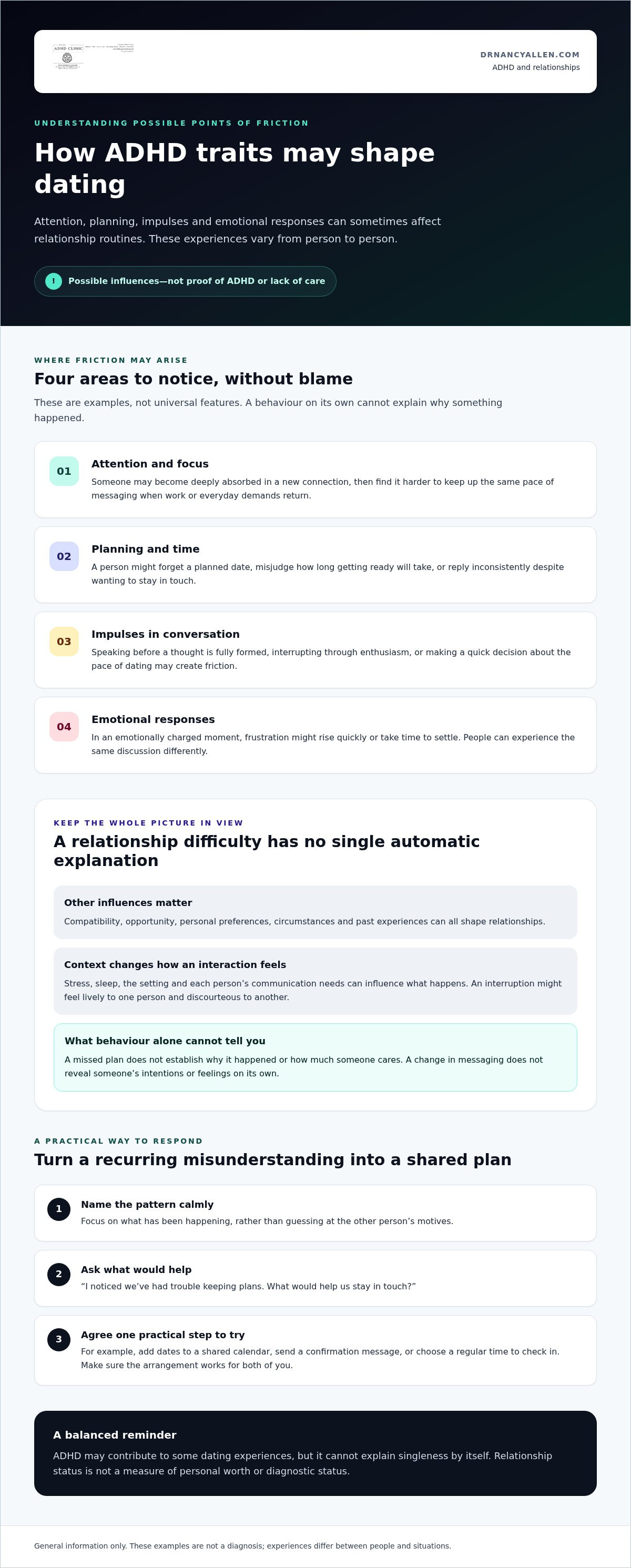
Dating involves keeping track of plans, sharing attention and responding to changing emotions. For some people with ADHD, differences in attention, planning, impulse control or emotional regulation may affect these interactions. The effect depends on the person and situation: ADHD traits can affect relationship routines differently for each person.
For example, someone may become deeply absorbed in a new connection, then find it harder to sustain the same pace of messaging once work or everyday demands return. CHADD describes how ADHD can complicate romance, including changes in focus as a relationship develops. A change in messaging may prompt questions, but it doesn’t reveal someone’s intentions or feelings on its own.
Can inattention or time-management difficulties cause dating misunderstandings?
They can sometimes contribute. A person might forget a planned date, misjudge how long getting ready will take, or reply inconsistently despite wanting to stay in touch. The other person may feel overlooked, while the person who missed the plan may feel embarrassed or misunderstood. Behaviour alone can’t establish whether someone cares, or why a commitment was missed.
Rather than guessing, try a calm, direct conversation: “I noticed we’ve had trouble keeping plans. What would help us stay in touch?” Then agree on one practical step to test, such as adding dates to a shared calendar, sending a confirmation message or choosing a regular time to check in. Make sure the arrangement works for both of you.
How can impulsivity or emotional intensity affect connection?
Speaking before a thought is fully formed, interrupting through enthusiasm, or making a quick decision about the pace of dating may create friction for some people. In an emotionally charged moment, frustration might also rise quickly or take time to settle. These examples are not proof of ADHD, and familiar phrases such as “rejection sensitivity” shouldn’t be treated as a diagnosis by themselves.
Stress, sleep, the setting and each person’s communication needs can all shape an interaction. The same interruption might feel lively to one person and discourteous to another; an intense discussion might feel connecting to one partner and overwhelming to the other. Asking what each person experienced can offer more insight than assigning blame.
Some people may also mask difficulties or work hard to meet others’ expectations, which can make their experiences less visible. The guide to ADHD in women explores signs and masking in more detail. If attention, planning or emotional regulation concerns persist across several parts of life, information about a private adult ADHD assessment may help you understand one route to greater clarity. An assessment cannot guarantee a particular dating outcome.
ADHD and relationship difficulties: what the diagnosis can and cannot explain
A diagnosis can help explain why certain patterns keep recurring, but it doesn’t mean someone is unable to build or sustain a healthy relationship. ADHD may offer one way to understand difficulties with attention, planning or responding in the moment. It doesn’t remove personal agency, define someone’s character or tell the whole story of a relationship.
It can help to separate a possible contributing factor from a complete explanation. For example, repeatedly missing commitments might relate to longstanding organisational difficulties, but it could also reflect stress, competing responsibilities, unclear expectations or a mismatch in how two people communicate. More than one factor may be involved, and both people’s needs and circumstances matter.
Is every dating problem a sign of ADHD?
No. An isolated behaviour, difficult relationship or period of conflict can’t establish ADHD. Forgetfulness, distraction or a strong emotional reaction may happen for many reasons, and a reader can’t reliably identify a diagnosis from examples alone. Stress, mental health, communication habits and life circumstances may all be relevant. A clinician can consider the broader picture rather than treating one explanation as certain.
Relationship conflict by itself isn’t evidence of ADHD. Nor does a diagnosis automatically explain every disagreement. It may be more useful to ask whether a difficulty is persistent, appears in more than one part of life and has a longer history, while remaining open to other explanations.
When might an ADHD assessment help make sense of recurring patterns?
An assessment may be worth considering if concerns have been present over time and affect areas beyond dating, such as work, study, daily organisation or relationships with friends and family. A clinician considers the person’s history and how difficulties affect everyday functioning; a single dating setback is not enough to determine whether ADHD is present.
Preparing a few examples can help make the discussion clearer. You might note when a pattern began, where it tends to appear, what helps, and what questions you want answered. The aim is to explore evidence and support needs, not to assign blame to you or a partner. Understanding a pattern can create room for more informed choices, but it can’t guarantee a particular relationship outcome.
If an assessment confirms ADHD, you may also want to consider what support is relevant to you, whether that involves practical coping strategies, therapy, or neurofeedback training from providers such as Neurobics to help regulate focus and mental wellbeing. The guide to ADHD rights and support in the UK offers a starting point for thinking about wider support. Any next step should reflect your individual circumstances, rather than the assumption that a diagnosis alone will resolve relationship difficulties.
Practical ways to make dating and relationships more manageable with ADHD
There’s no single strategy that works for everyone. Treat practical changes as experiments: try one, discuss whether it helps, and adjust together. The aim isn’t to eliminate every misunderstanding or make one person responsible for managing everything. It’s to find shared ways of communicating that respect both people’s needs. For individuals and partners who want guided support in navigating these dynamics, Mindbender Counseling provides individual and couples counselling focused on understanding interpersonal patterns and fostering healthier communication.
How can you explain ADHD-related needs to someone you are dating?
You can describe a specific need and its practical effect without apologising for who you are. For example: “I can lose track of messages when I’m concentrating. A direct follow-up helps me notice that you’re waiting for a reply.” You don’t have to share more than feels safe or disclose everything at once. Choose what to say based on the trust and context you have.
Make it a conversation, not a set of instructions. Ask what helps the other person feel considered, too. You could agree what “keeping in touch” means to each of you, or decide how much notice you both need if plans change. Clear expectations can reduce guesswork, but they should feel workable for both sides.
What can help after a misunderstanding or missed plan?
Start by recognising the impact before explaining the reason. “I’m sorry I missed our plan. I can see that left you waiting” acknowledges their experience without turning the moment into a judgement about your character. Then, if it feels useful, explain what happened and discuss how to handle a similar situation next time.
A practical arrangement might be a calendar invitation, a reminder, or a brief confirmation on the day. Choose it together and check whether it actually helps. A routine should support both people, not become a test that one person must pass to prove they care.
During a tense conversation, consider pausing if either of you feels too overwhelmed to listen. You might say, “I want to understand this properly. Can we take a break and come back to it later?” Agree when you’ll revisit the topic, then return to it once emotions have settled. A pause is different from ignoring the issue.
Repair includes taking responsibility for the effect of an action and trying a realistic change. Shame and self-blame rarely offer a useful plan. If you’re asking, “Am I single because of my ADHD ?”, remember that strategies can help you understand and address recurring friction, but they can’t guarantee a relationship outcome.
If broader, persistent concerns are prompting you to seek clarity, a private adult ADHD assessment with Dr Nancy Allen is one option to consider. An assessment may help you understand your experiences and consider personalised next steps; it isn’t a substitute for shared communication or a promise of a particular dating result.
When to seek ADHD support and what a next step could look like
You don’t need to pursue an assessment simply because you’re single. It may be worth seeking professional advice if concerns about attention, organisation, impulsivity or emotional regulation are persistent, cause difficulty in everyday life and show up in more than dating. You might notice similar challenges at work, in study, at home or in friendships. The decision is yours, and you can seek clarity even if you’re unsure whether ADHD is the explanation.
If you’ve been asking, “Am I single because of my ADHD ?”, try widening the question: are there recurring experiences across different parts of life that you’d like to understand better? An assessment may help explore those experiences and possible support options. It can’t determine why you’re single or guarantee a particular relationship outcome.
What should you prepare before discussing ADHD concerns with a clinician?
You don’t need to arrive with a complete account. Brief notes can help you explain what you’ve noticed and how it affects day-to-day life. Consider recording:
Examples of recurring difficulties at home, work, study or in relationships.
How long you’ve noticed these patterns, including anything you remember from earlier life.
What tends to make things easier or harder, and what you’d like help understanding.
Questions you want to ask, plus any relevant background information you already have.
Online checklists may help you put concerns into words, but they can’t confirm a diagnosis. A clinician needs to consider your history and circumstances rather than relying on a score or one relationship experience.
How can an ADHD assessment support understanding beyond dating?
An assessment explores symptoms, personal history and how difficulties affect different areas of life. It can help build a clearer picture of your individual needs and whether ADHD may be relevant. The purpose is understanding, not assigning blame to you or someone you’ve dated. A diagnosis, if given, is not a measure of your worth and does not define your ability to form a supportive relationship.
Dr Nancy Allen offers private adult ADHD assessments and secure online consultations for patients across the UK. An assessment can be one way to explore your experiences and consider possible next steps. Take time to think about what you hope to understand before deciding whether it feels right for you.
Move towards greater clarity, at your own pace
If you’ve wondered, “Am I single because of my ADHD ?”, remember that ADHD may shape some relationship experiences, but it cannot explain your relationship status on its own. Compatibility, circumstances and personal preferences matter too. Difficulties with communication or consistency can be explored without turning them into a judgement about your worth.
Practical adjustments, such as agreeing expectations or trying reminders together, may ease recurring friction. If similar concerns persist across different parts of life, an assessment could help you understand your experiences and consider possible support. It won’t promise a partner or determine your relationship future.
Dr Nancy Allen has more than 25 years of clinical experience and offers secure online consultations to patients across the UK. An assessment can help you explore persistent concerns and consider personalised next steps, but it cannot promise a particular relationship outcome. You can take things one step at a time. Greater understanding can help you make choices that feel more informed, whether or not a relationship is your goal.
Frequently Asked Questions
Can ADHD make it harder to find or keep a relationship?
ADHD can contribute to challenges in dating or relationships for some people, but it doesn’t make a healthy, lasting relationship impossible. Differences in attention, planning or emotional regulation may affect shared routines or communication, while compatibility, circumstances and both people’s needs also matter. If a particular pattern is causing difficulty, discussing it together and trying practical adjustments may help. There’s no single relationship outcome that applies to everyone with ADHD.
Is being single a sign that I have ADHD?
No. Being single isn’t a sign of ADHD, and relationship status can’t establish a diagnosis. People are single for many reasons, including personal preference, timing, opportunity and compatibility. If you’re concerned about attention, organisation or impulsivity, consider whether these are persistent experiences across different areas of life, not just dating. A qualified clinician can explore your history and circumstances; an isolated experience or online checklist can’t confirm ADHD.
Can ADHD affect communication when dating?
It can affect communication for some people. Someone might lose track of a message, interrupt without intending to, or find it difficult to respond during an emotionally intense conversation. These behaviours don’t reveal a person’s feelings or intentions by themselves. Try explaining a specific need clearly, asking what helps the other person feel heard, and agreeing expectations for replies or plans. Both people’s communication preferences deserve consideration.
How can I tell whether relationship problems are related to ADHD?
You can’t reliably tell from a relationship problem alone. Consider whether similar difficulties have been recurring over time in other settings, such as work, study, home life or friendships. Also keep in mind that stress, communication habits and circumstances may contribute. Writing down examples and their impact can help you discuss the wider pattern with a clinician, who can consider your history rather than drawing conclusions from one behaviour.
Can ADHD be treated so I can have a successful relationship?
Support for ADHD may help a person understand and manage difficulties that affect everyday life, but it can’t guarantee a successful relationship. The right approach depends on individual needs and should be discussed with a suitably qualified clinician. Relationship success also involves compatibility, communication and the choices of both people. If ADHD is affecting several areas of your life, an assessment can help clarify whether it may be relevant and what support options to consider.
Should I tell someone I am dating that I have ADHD?
That’s a personal choice. You can decide what to share, when, and how much, based on your comfort and the trust in the relationship. If you choose to talk about it, focus on practical information: for example, what helps you remember plans or communicate clearly. You don’t have to disclose everything at once or present a diagnosis as an apology. A respectful conversation should leave room for the other person’s needs too.
Can an ADHD assessment explain why I am single?
An ADHD assessment may help explore persistent symptoms, personal history and support needs, but it can’t determine why you’re single or predict your relationship future. If you’re asking, “Am I single because of my ADHD ?”, an assessment may offer insight into patterns that affect more than dating. Dr Nancy Allen offers private ADHD assessments and secure online consultations across the UK. Consider an assessment for broader concerns, not as a promise of finding a partner.
If persistent ADHD-related concerns affect several areas of your life, contact Dr Nancy Allen to explore a private assessment and personalised support options.



Comments