


Understanding Methylphenidate Ratios in ADHD Medication

Imagine it's 2:00 PM and you're midway through a vital task when the mental fog suddenly rolls back in. You took your medication this morning, yet the focus that felt so solid at 10:00 AM has vanished. This midday crash is a common experience for many managing ADHD; it often stems from a misunderstanding about how different brands deliver their active ingredients. It's a vital distinction to make because not all methylphenidate medications have the same ratio of short to long acting in the same capsule. Whilst they share the same active ingredient, the way they release into your system varies significantly between brands like Concerta XL, Equasym XL, and Medikinet XL.
It's incredibly disheartening when your treatment feels like a rollercoaster rather than a steady hand. You deserve a daily routine that feels stable and predictable, without the anxiety of symptoms returning at the wrong moment. In this guide, you'll discover how these specific release profiles affect your symptom control and why certain brands aren't interchangeable. We'll also provide the clinical insight needed to discuss these nuances with your specialist, helping you achieve a personalised treatment plan that supports your life from the morning rush until you wind down for the evening.
Table of Contents
Beyond the Label: What Are Modified-Release Methylphenidate Medications?
The Release Profile: Understanding the Ratio of Short to Long-Acting Components
Comparing Major UK Brands: Concerta XL, Medikinet XL, and Equasym XL
The Clinical Impact: How Release Ratios Affect Your ADHD Symptom Control
Personalising Your Treatment: Finding the Right Medication Ratio
Beyond the Label: What Are Modified-Release Methylphenidate Medications?
Methylphenidate remains the cornerstone of ADHD treatment in the UK, serving as the primary stimulant used to support neurodivergent brains. It functions by regulating neurotransmitters that govern attention and impulse control. For many years, the only option was Immediate Release (IR) medication, which enters the bloodstream quickly and exits just as fast. This often led to a "yo-yo" effect where symptoms returned every few hours. Today, we primarily use Modified Release (MR) formulations. These act as a sophisticated delivery vehicle, using intricate capsule technology to release the drug slowly. This steady delivery is vital for executive function support; it provides the reliable baseline needed to manage complex schedules. It's essential to recognise that not all methylphenidate medications have the same ratio of shot to long acting in the same capsule, meaning the brand your pharmacist dispenses can fundamentally change your experience of the day.
The Evolution of ADHD Treatment
The journey of ADHD care has moved from the logistical challenge of multiple daily doses to the streamlined convenience of once-a-day medication. Modern capsules are engineered to mimic the effect of taking several small doses at precise intervals. This allows for a smoother experience that supports the pre-frontal cortex throughout the working day. This brain region is responsible for organising thoughts, managing time, and initiating tasks. When medication levels remain stable, it's much easier to stay on track whilst navigating the demands of a busy life. Instead of experiencing the sharp peaks and troughs of IR tablets, MR formulations aim to provide a "plateau" of focus that mirrors the natural rhythm of your daily routine.
Why One Size Does Not Fit All
Clinical experience shows that every patient responds to medication differently. Every brain is unique. Some individuals metabolise the active ingredient very quickly, whilst others find it lingers in their system for much longer. This variation is why the specific engineering of a capsule matters so much. Not all methylphenidate medications have the same ratio of shot to long acting in the same capsule, and these subtle differences can define whether a treatment is successful or frustrating. Pharmacokinetics is the study of how the body moves medication through its system; it helps us understand why brand-specific release profiles are so influential. Achieving stable symptom control isn't merely about finding the right milligram dose. It's about identifying the specific ratio that aligns with your body's unique metabolic rate and your personal daily requirements.
The Release Profile: Understanding the Ratio of Short to Long-Acting Components
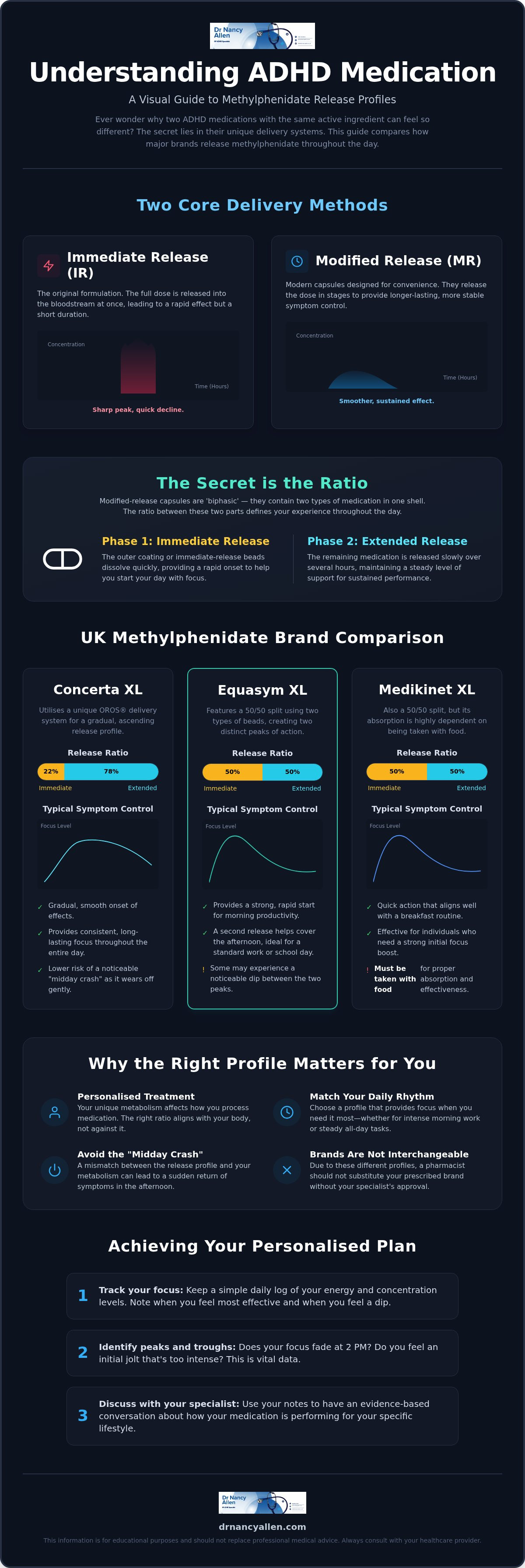
Modified-release capsules are often described as 'biphasic,' meaning they release the active ingredient in two distinct stages. The first stage is the Immediate Release (IR) portion, designed to help you engage with your morning tasks quickly. The second is the Extended Release (ER) portion, which maintains focus as the day progresses. It's this specific balance that dictates how you feel at 11:00 AM versus 4:00 PM. Research into extended-release methylphenidate shows that these delivery systems are engineered to manage the way the drug is absorbed, preventing the sharp spikes associated with older tablet forms.
The ratio determines the 'peak' concentration in your blood. A higher initial percentage creates a sharper peak early on, whilst a lower initial percentage leads to a more gradual rise. If your work requires intense focus at 9:00 AM, a 50:50 split might be your best ally. If you need your medication to last until your evening commute, a different profile is likely more suitable. Not all methylphenidate medications have the same ratio of shot to long acting in the same capsule, and this variation is exactly why one brand might feel like a steady support whilst another feels like a sudden jolt followed by a slump.
The 50:50 Split: A Balanced Approach
Medikinet XL and Equasym XL utilise a balanced 50:50 ratio. This means half the dose is released immediately, providing a robust start to the day. This profile is often favoured by those who need significant support during the morning rush or school hours. It's vital to remember that Medikinet XL requires a meal to ensure the second half releases correctly. Without food, the medication can release too quickly, leading to an early crash and leaving you unsupported by lunchtime.
The 22:78 Split: The "Slow and Steady" Curve
Concerta XL and its bioequivalents, such as Xaggitin and Delmosart, use a 22:78 split. Only 22% is released initially, with the remaining 78% delivered gradually. This is achieved through OROS technology, a laser-drilled shell that uses osmotic pressure to push the medication out slowly. It's designed for a twelve-hour day, offering a smoother curve with a less intense 'kick' in the morning. If you feel your current medication isn't matching your daily rhythm, you might benefit from a specialist ADHD assessment to review your personalised treatment plan.
Comparing Major UK Brands: Concerta XL, Medikinet XL, and Equasym XL
Whilst several medications share the active ingredient methylphenidate hydrochloride, the "shell" or delivery mechanism is what truly differentiates them. It is common for pharmacists to offer an alternative brand during supply shortages; however, this can lead to unexpected changes in symptom control. Not all methylphenidate medications have the same ratio of shot to long acting in the same capsule, and switching brands can disrupt the careful balance achieved during titration. Consulting the NHS guidance on methylphenidate formulations confirms that these products are not always clinically interchangeable.
Concerta XL and its Bioequivalents
Concerta XL is perhaps the most well-known brand. It has several bioequivalents in the UK, including Xaggitin XL, Delmosart, Matoride XL, and Xenidate XL. These medications all follow the 22:78 release pattern. This means they provide a small initial dose followed by a much larger, gradual release. Because this profile is designed to last for roughly 12 hours, it is often favoured for individuals who require support across a full working day or a long school day. If you are taking one of these, your capsule likely has a hard, non-digestible shell that you might notice after it has passed through your system.
Medikinet XL vs Equasym XL
Medikinet XL and Equasym XL are often grouped together, yet they serve different needs. Medikinet XL utilise a 50:50 ratio, providing a very strong morning start. Crucially, Medikinet XL must be taken with a substantial breakfast. Without food, the "modified" part of the release can fail, causing the entire dose to enter your system at once. Equasym XL uses a 30:70 ratio, offering a middle ground for those who find Concerta too weak in the morning but Medikinet too intense. Both of these brands typically last for about 8 hours, which is shorter than the Concerta family.
The Importance of Brand-Specific Prescribing
Dr Nancy Allen advocates for prescribing by brand name rather than the generic "methylphenidate MR." This ensures consistency. If your prescription is generic, the pharmacy can provide any brand they have in stock, which might inadvertently change your ratio and trigger a medication crash. Maintaining the same brand is a key part of prioritising your quality of life. If you are currently struggling with inconsistent focus, a thorough Adult ADHD Assessment can help clarify whether a change in medication ratio is necessary to better support your daily routine.
The Clinical Impact: How Release Ratios Affect Your ADHD Symptom Control
The "rebound effect" is more than just a gradual return of symptoms; it's often a sharp, jarring transition that can leave you feeling irritable, overwhelmed, and mentally exhausted. This sudden shift happens because not all methylphenidate medications have the same ratio of shot to long acting in the same capsule. If the release curve drops too steeply, your brain struggles to adjust to the sudden reduction in dopamine support. This creates "peaks and troughs" in your focus, where you might feel highly productive for four hours only to face a significant emotional and cognitive slump in the afternoon.
This volatility doesn't just affect your work; it impacts your relationships and your ability to manage evening responsibilities. When the medication wears off too abruptly, emotional regulation often suffers. You might find yourself snapping at loved ones or feeling a sense of deep "brain fog" that makes simple decisions, like what to cook for dinner, feel impossible. Identifying the right ratio is about smoothing out these transitions to ensure your executive function remains stable until you are actually ready to rest.
The Morning Rush vs The Evening Wind-down
Choosing a ratio depends heavily on when you need your focus to be most resilient. If your primary challenges occur during the morning rush, a 50:50 split provides that necessary early boost. However, if you find your symptoms return just as you need to manage evening chores or childcare, that same ratio might leave you unsupported. Some patients benefit from a small immediate-release "top-up" dose in the late afternoon to bridge the gap between their morning capsule and bedtime. Managing these transitions effectively is a key part of addressing ADHD and sleep, as a poorly timed medication crash can lead to a "tired but wired" state that makes it difficult to switch off at night.
ADHD, Menopause, and Medication Efficacy
For women, the intersection of neurodiversity and hormonal health adds another layer of complexity. Oestrogen plays a fundamental role in dopamine regulation; as levels decline during perimenopause and menopause, ADHD symptoms often intensify. You may discover that a medication ratio that worked perfectly for years suddenly feels inadequate or wears off much faster than it used to. This isn't a failure of the medication, but rather a shift in your internal chemistry. A holistic approach that considers both HRT and a reviewed ADHD medication ratio is often the most effective way to restore your confidence and clarity. If you're struggling to maintain focus during this transitional life stage, you can enquire about a specialist menopause and ADHD consultation to explore a more personalised treatment plan.
Personalising Your Treatment: Finding the Right Medication Ratio
Titration is often misunderstood as a simple search for the highest dose you can tolerate without side effects. In reality, it's a sophisticated process of fine-tuning that requires a deep understanding of your body's unique rhythm. Every brain is different. Because not all methylphenidate medications have the same ratio of shot to long acting in the same capsule, finding your ideal milligram dose is only the first step. You also need to ensure the release profile aligns with your metabolic rate and your daily schedule. This personalised approach is what transforms a medication from a temporary fix into a reliable tool for long-term clarity.
To support this process, you should track your symptoms with precision. Note down exactly when you feel your focus peaking and when you notice the first signs of a "rebound." This data allows your specialist to see the full picture of your day. It helps determine if you need a higher dose or if a different brand's ratio would provide a smoother experience. Private specialist care offers the time and space needed for this level of detail, ensuring your treatment is never rushed or standardised. Finding the right ratio is a journey, but it's one that leads to a restoration of confidence in your own abilities.
The Titration Journey with Dr Nancy Allen
Dr Nancy Allen provides a supportive environment where your experience is validated and your treatment is tailored to your specific needs. Whilst the practice offers a 72-hour turnaround for diagnoses, the subsequent titration phase is unhurried and collaborative. We consider factors like your work hours, your evening responsibilities, and even hormonal health to choose the initial release profile. This dedication to evidence-based, empathetic care ensures that your medication supports your holistic well-being rather than just suppressing symptoms. You are an active partner in this process, and your feedback is the most important data we have.
Next Steps for Your ADHD Management
Your path toward better symptom control begins with awareness. Take a moment to review your current prescription bottle and note the specific brand name rather than just the generic ingredient. If you are experiencing peaks and troughs in your attention, start a simple diary to track these fluctuations over a week. This preparation is vital for a meaningful follow-up consultation where you can discuss ratio changes with clarity. You don't have to settle for a medication rollercoaster when a simple change in delivery technology could provide the stability you deserve. To discuss your specific medication profile and achieve the focus you need, you can Book a private ADHD consultation today.
Finding Your Path to Sustained Mental Clarity
Achieving stable focus isn't about trial and error; it's about understanding the sophisticated technology behind your treatment. You now know that not all methylphenidate medications have the same ratio of shot to long acting in the same capsule, and this distinction is often the missing piece in avoiding the exhausting "midday crash." Whether you require a robust morning boost or a steady, twelve-hour curve, your medication should be a reliable tool that supports your unique daily rhythm.
If you're struggling with inconsistent symptom control or find your needs shifting during hormonal changes like perimenopause, expert guidance can help fine-tune your approach. Dr Nancy Allen provides empathetic, specialist care for both adults and children, with a focus on evidence-based treatment plans. With a 72-hour turnaround for diagnosis and treatment planning, we prioritise your quality of life and your need for immediate support.
You don't have to navigate these clinical complexities alone. Book a private ADHD assessment with Dr Nancy Allen to begin your journey toward a more predictable and productive routine. With 25 years of clinical experience, we're here to help you rediscover your confidence and achieve the lasting clarity you deserve.
Frequently Asked Questions
Is Concerta XL the same as Medikinet XL?
Concerta XL and Medikinet XL are fundamentally different in their delivery systems. Concerta XL utilises a 22:78 ratio, providing a gradual release designed to last up to 12 hours. Medikinet XL, however, uses a 50:50 ratio, offering a much stronger initial dose that typically lasts about 8 hours. Because not all methylphenidate medications have the same ratio of shot to long acting in the same capsule, these two brands are not medically interchangeable.
What happens if my pharmacist gives me a different brand of methylphenidate?
If your brand is switched, you might notice your symptoms returning earlier or feeling more intense at different times of the day. Whilst the active ingredient remains methylphenidate, the release profile varies between manufacturers. This is why Dr Nancy Allen advocates for brand-specific prescribing. Switching can disrupt the stability achieved during titration, potentially leading to a medication crash if the new ratio doesn't align with your metabolic needs.
Why does my ADHD medication only seem to last 6 hours instead of 12?
This often happens if you are on a brand with a shorter release window, such as Medikinet XL or Equasym XL, which are designed for an 8-hour workday. Additionally, your body might metabolise the medication faster than average. It's a reminder that not all methylphenidate medications have the same ratio of shot to long acting in the same capsule; finding the right brand for your metabolic rate is essential for sustained focus.
Do I need to eat food with my methylphenidate for the ratio to work?
Food intake is critical for certain brands, particularly Medikinet XL. This medication requires a substantial breakfast to ensure the modified-release portion of the capsule functions correctly. Without food, the medication can release too quickly into your system, causing a sharp peak followed by an early slump. Other brands, like Concerta XL, are less dependent on food, but consistency in your morning routine always helps maintain a predictable response to your treatment.
Can I switch between Lisdexamphetamine and Methylphenidate easily?
Switching between these two medications is not a direct swap; it requires a supervised titration process with a specialist. Lisdexamfetamine is a prodrug that the body converts into an active stimulant, offering a very smooth release. Methylphenidate acts more directly on the brain's dopamine transporters. Because their mechanisms and durations differ significantly, your clinician must carefully monitor the transition to ensure your symptoms remain well-managed throughout the change.
What is a "rebound effect" and how is it related to medication ratios?
The rebound effect is the sudden return or intensification of ADHD symptoms as medication leaves your system. This often manifests as irritability, fatigue, or a total loss of focus. It's directly related to the medication's release curve. If the ratio of immediate to extended release isn't suited to your metabolism, the drop-off can feel too abrupt. Choosing a brand with a smoother, more gradual release profile can often help mitigate this distressing evening crash.
Why do some methylphenidate capsules have different coloured beads inside?
The different coloured beads are a visual representation of the biphasic release system. Typically, one set of beads is designed for immediate release to provide your morning focus, whilst the other set has a special coating that dissolves slowly for an afternoon boost. This intricate engineering is why capsules should never be crushed or chewed; doing so destroys the carefully balanced ratio and releases the entire dose at once, which can be dangerous.


Comments