


Grieving the Past: Processing Your Late ADHD Diagnosis

Updated: 2 days ago
Receiving an ADHD diagnosis in adulthood is often celebrated as a "lightbulb moment," yet for many, that light only serves to illuminate the shadows of a life that might have been. It is a complex paradox; you finally have the answers you've spent a lifetime seeking, but those answers bring a heavy, unexpected sense of loss. You aren't just learning about a neurodevelopmental condition. You are grieving the past-processing the emotional grief of who you could've been if you've been diagnosed decades earlier. This isn't a sign of ungratefulness. It is a necessary, clinical response to the exhaustion of masking and the frustration of being told to "just try harder" by those who missed the signs.
We recognise that the anger you feel toward teachers, parents, or doctors isn't just about the missed diagnosis, but about the unnecessary difficulty of the decades that followed. In this guide, we'll explore how to validate this profound sense of an unlived life as a real and vital part of your healing journey. You will discover practical ways to reframe your personal history and find a compassionate path forward that honours your past struggles while restoring your confidence. By acknowledging the gravity of your experience, we can move from the "what ifs" toward a future built on clarity and expert insight.
Table of Contents
The Unseen Bereavement: Understanding Grief After a Late Diagnosis
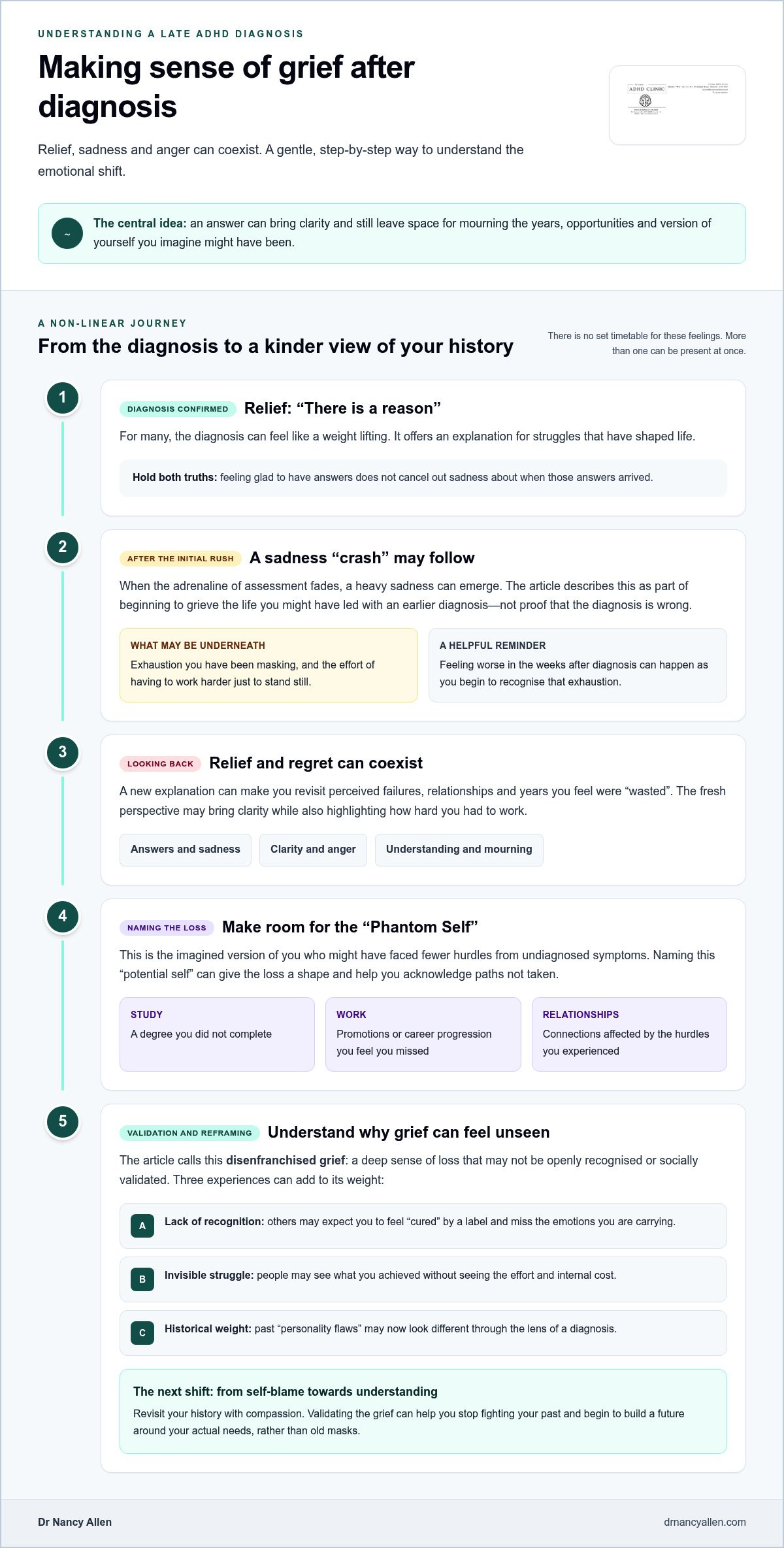
The moment a clinician confirms your diagnosis, a profound shift occurs. For many, the immediate sensation is one of immense weight being lifted; finally, there is a reason for the struggles that have defined your life. However, once the initial adrenaline of the assessment fades, it's common to experience a sudden, heavy "crash" of sadness. This isn't a sign that the diagnosis was wrong. Instead, it's the beginning of a vital clinical process: grieving the past-processing the emotional grief of who you could've been if you've been diagnosed decades earlier. You aren't just mourning a lost opportunity; you're mourning an entire version of yourself that never had the chance to exist without the burden of undiagnosed symptoms.
This emotional response is often directed at the systems that failed you. It's natural to feel a sharp sting of anger towards teachers who labelled you "lazy," or doctors who overlooked your symptoms for years. A deeper Understanding Adult ADHD reveals that these missed signs carry a high cost, often leading to decades of unnecessary self-criticism and exhaustion. Acknowledging this anger is the first step toward moving into a healthier, more integrated future.
Why Relief and Regret Coexist
It feels contradictory to feel both happy for the answers and devastated by the timing. This paradox exists because your brain is busy rewriting your entire personal history in real time. Every perceived failure, every broken relationship, and every "wasted" year is being viewed through a new lens. Whilst this provides clarity, it also forces you to confront the reality of how much harder you had to work just to stand still. If you feel "worse" in the weeks following your diagnosis, remember that this is often a sign of the healing process beginning. You're finally allowing yourself to feel the exhaustion you've been masking for half a lifetime.
The Role of Disenfranchised Grief
Society understands how to support someone who has lost a loved one or a job, but it lacks the rituals to honour the loss of a "potential self." This is known as disenfranchised grief; it's a deep sense of loss that isn't openly recognised or socially validated. Because there is no funeral for the life you might have led, the pain can feel isolating. When you are grieving the past-processing the emotional grief of who you could've been if you've been diagnosed decades earlier, you are navigating a path that is both clinical and deeply personal. Common reasons this grief feels so heavy include:
Lack of recognition: Friends or family may expect you to be "cured" now that you have a label, overlooking the emotional backlog you're carrying.
Invisible struggle: Others only see the version of you that succeeded despite the ADHD, not the internal cost of that success.
Historical weight: The sudden realisation that your past "personality flaws" were actually symptoms of a manageable condition.
Validating this experience as a legitimate form of bereavement is essential for your long-term well-being. It allows you to stop fighting your history and start building a future based on your actual needs rather than your past masks.
The "Phantom Self": Mourning the Person You Could Have Been
When you receive a late diagnosis, you aren't just meeting your neurodivergent self; you're also introduced to the "Phantom Self." This is the version of you that might have existed without the constant friction of undiagnosed symptoms. It is the person who finished university with ease, maintained steady career progression, or nurtured relationships without the invisible hurdles of impulsivity and distraction. Grieving the past-processing the emotional grief of who you could've been if you've been diagnosed decades earlier involves acknowledging that this phantom version isn't just a fantasy. It represents the genuine potential you felt within yourself but could never quite grasp.
Naming this version of yourself can be a powerful tool in your healing journey. By giving this "phantom" a space in your mind, you allow yourself to mourn the lost milestones and the paths not taken. Whether it's the degree you didn't complete or the promotions you missed, these aren't just simple regrets. Naming this experience is a vital part of grieving the past-processing the emotional grief of who you could've been if you've been diagnosed decades earlier, as it gives your loss a tangible shape and allows you to move through it rather than around it.
Re-evaluating Your Personal History
For decades, you likely internalised your struggles as moral failings. You might have been called lazy, scattered, or told you weren't living up to your potential by those who didn't understand your brain's unique wiring. Viewing your past through a neuro-inclusive lens transforms these labels; "laziness" is revealed as executive dysfunction, and a "lack of willpower" is recognised as a dopamine deficiency. This fundamental shift allows you to replace decades of shame with clinical clarity. Viewing your history through this empathetic framework acts as a transformative bridge between your past struggles and your future potential.
The Weight of Masking and Exhaustion
Masking is the exhausting process of mimicking neurotypical behaviours to fit into a world not designed for you. For many, it has been a lifelong survival strategy that comes at a high cost. You aren't just tired; you're experiencing the cumulative effect of decades spent suppressing your natural impulses and forcing your brain to work in ways that feel unnatural. This deep, systemic exhaustion underscores why a compassionate, unhurried adult adhd assessment is so vital. It isn't just a clinical tick-box exercise; it is often the first time a person is truly seen without their mask. If you are ready to begin this process of restoration, Dr Nancy Allen offers specialist ADHD support that prioritises your unique human journey and provides the clarity you deserve.
Regret vs. Relief: Navigating the Emotional Paradox of Clarity
The journey following a late diagnosis rarely follows a linear path. While you might expect a straightforward progression toward healing, the reality is often a cyclical experience of relief, anger, mourning, and eventual acceptance. One day you may feel empowered by your new-found clarity; the next, you are submerged in the weight of grieving the past-processing the emotional grief of who you could've been if you've been diagnosed decades earlier. This emotional paradox is a standard clinical response to a major identity shift. It is not a sign of regression, but rather your mind's way of integrating a lifetime of misunderstood experiences into a coherent new narrative.
The "Anger Phase" is frequently the most jarring part of this process. You might find yourself directed toward specific individuals, such as parents who missed the signs or doctors who dismissed your concerns as mere anxiety. This anger is often entirely justified. It represents a healthy boundary-setting exercise where you acknowledge that your past struggles weren't your fault. By validating this frustration rather than suppressing it, you create the necessary space for genuine mourning to begin.
The ADHD and Menopause Overlap
For many women, the catalyst for a late diagnosis is the onset of perimenopause or menopause. During this transition, declining oestrogen levels directly impact dopamine production, which can significantly worsen ADHD symptoms that were previously managed through sheer effort and masking. This hormonal shift often "unmasks" the condition, leading to a crisis of identity in midlife. It is during this time that the sense of loss feels most acute, as the strategies you relied on for decades suddenly fail. Managing menopause symptoms alongside specialist ADHD support is essential for restoring your quality of life. Understanding this intersection helps you realise that your recent "decline" isn't a personal failure, but a biological reality that deserves expert clinical care.
Handling the "What If" Questions
When your mind spirals into loops of "what if I had been diagnosed at seven, or seventeen?", it's easy to feel anchored to a version of the past you cannot change. These questions are a natural part of grieving the past-processing the emotional grief of who you could've been if you've been diagnosed decades earlier. To manage these thoughts, focus on grounding yourself in the present whilst acknowledging the validity of your past struggle. Clinical validation is a powerful tool here; it provides the evidence-based proof needed to silence the imposter syndrome that often fuels regret. By accepting that your brain simply works differently, you can stop asking "what if" and start asking "what now," using your new-found clarity to build a life that truly fits your neurodivergent needs.
Practical Steps to Organise Your Healing and Reframe Your History
Moving from the initial shock of a diagnosis toward genuine restoration requires a structured approach. It isn't enough to simply know you have ADHD; you must actively process the emotional backlog of a lifetime. This starts with viewing self-compassion as a clinical tool rather than a soft sentiment. When you practice self-compassion, you're effectively lowering the physiological stress associated with decades of perceived failure. It's a way of signalling to your nervous system that the "threat" of being "wrong" or "lazy" is finally over. This shift is vital when grieving the past-processing the emotional grief of who you could've been if you've been diagnosed decades earlier, as it provides the safety needed to look back without flinching.
One practical method for bridging the gap between your current clarity and your past confusion is writing a letter to your younger self. You don't need to worry about it being a literary masterpiece. Simply acknowledge the specific difficulties that child or young adult faced without support. When communicating your diagnosis to loved ones, focus on explaining that your current grief isn't a rejection of the life you've built together. It's a necessary mourning for the unnecessary struggle you endured. Clear, evidence-based communication helps others understand that your "new" behaviours aren't a change in personality, but a restoration of your authentic self. For those navigating complex family dynamics alongside a new diagnosis, practitioners like Michelle McMillan offer personalised therapy strategies designed to support women and families through periods of emotional transition.
Reframing Your Narrative
To move forward, you must systematically dismantle the old, critical stories you've told yourself. You can follow these three steps to re-evaluate your history:
Step 1: Identify a specific "failure." Choose a moment from your past that still carries a sting of shame, such as a lost job, a forgotten deadline, or a strained relationship.
Step 2: Apply the "ADHD Lens." Instead of seeing it as a lack of care, recognise the specific executive dysfunction at play, such as poor working memory or time blindness.
Step 3: Replace self-criticism with facts. Reframe the event as: "I didn't fail because I was lazy; I struggled because I was navigating a neurotypical system with an unsupported ADHD brain."
Building a Neuro-Inclusive Future
Healing isn't just about managing symptoms; it's about the restoration of confidence. Once you've processed the weight of the past, you can begin to set boundaries that honour your brain's actual needs. This might mean changing how you organise your workspace or being honest about your capacity for certain tasks. Grieving the past-processing the emotional grief of who you could've been if you've been diagnosed decades earlier eventually leads to a place where you can advocate for yourself with clarity. Seeking specialist support is a key part of this transition. If you're ready to bridge the gap between your past struggles and a more confident future, you can book a specialist ADHD consultation to begin your journey of restoration.
Moving Forward: How Professional Support Bridges the Past and Future
A formal ADHD assessment is far more than a clinical requirement; it serves as the essential foundation for the emotional work of reconstruction. Without this evidence-based clarity, the mind often remains trapped in a cycle of self-doubt and historical shame. By obtaining a definitive diagnosis, you transform your past from a series of inexplicable failures into a logical sequence of events. This clarity is the catalyst for grieving the past-processing the emotional grief of who you could've been if you've been diagnosed decades earlier. It provides the structure needed to stop searching for answers and start building a future based on clinical facts rather than self-criticism.
Dr Nancy Allen’s approach prioritises the human element of this journey, recognising that you are more than a collection of symptoms. With over 25 years of clinical experience, Dr Allen understands that an adult ADHD assessment requires an unhurried, empathetic environment where your personal narrative is heard and respected. Through secure online consultations available nationally, you can access this specialist care from a space where you feel most comfortable. This accessibility ensures that the transition from confusion to clarity is handled with the gravity and professional dedication your experience deserves.
The Power of Empathetic Validation
Being heard by a specialist who understands the unique intersection of ADHD and hormonal health, such as the changes during menopause, is a vital part of the healing process. A "tick-box" diagnosis often fails to address the emotional backlog of a late diagnosis, whereas a compassionate assessment validates the depth of your struggle. This professional validation is often the most effective tool for silencing the internal critic that has whispered "not good enough" for decades. It allows you to accept that your brain’s wiring was the primary hurdle, not a lack of character or effort.
Your Path to Clarity and Support
A late ADHD diagnosis is a profound turning point that requires more than just clinical management; it demands the space to honour your unique history. By recognising that your past struggles were the result of neurodivergence rather than personal failure, you can begin to dismantle decades of internalised shame. This process of grieving the past-processing the emotional grief of who you could've been if you've been diagnosed decades earlier is a vital step toward reclaiming your identity. It allows you to move beyond the weight of the "Phantom Self" and start building a life that truly accommodates your brain's wiring.
Finding a path forward is possible with the right specialist guidance. Dr Nancy Allen offers unhurried, compassionate consultations that prioritise your quality of life, focusing on the complex intersection of ADHD and hormonal health. With over 25 years of clinical experience, Dr Allen provides evidence-based treatment plans that bridge the gap between your past struggles and a clearer future. You don't have to navigate this transition alone. Book a private Adult ADHD Assessment with Dr Nancy Allen to find the clarity you deserve. Your journey of restoration begins with a single step toward validation and support.
Frequently Asked Questions
Is it normal to feel depressed after an ADHD diagnosis?
Experiencing a period of low mood or a "crash" is a standard part of the diagnostic journey for many adults. This often stems from the sudden realisation of how much effort you've exerted just to function over the years. It's a clinical response to the exhaustion of masking. This sadness is usually a form of mourning for the years of unsupported struggle rather than clinical depression, though professional guidance is essential to distinguish between the two.
How long does the grief of a late diagnosis typically last?
There is no fixed timeline for processing this loss, as grief is a non-linear experience that varies for every individual. Some people find clarity within months, whilst others may navigate identity shifts for a year or more. The duration often depends on the depth of the "Phantom Self" you are mourning. Working through a structured treatment plan can help move you from the initial shock toward a place of restoration and confidence.
Why am I so angry at my parents/teachers after being diagnosed as an adult?
This anger is a justified response to the systemic failure of those who missed your neurodivergent traits during your formative years. You are grieving the past-processing the emotional grief of who you could've been if you've been diagnosed decades earlier. It is natural to feel frustrated that your academic or social difficulties were mislabelled as character flaws. Recognising this anger as a valid boundary-setting exercise is a healthy part of your recovery.
Can menopause make it feel like I am only just "getting" ADHD now?
The decline in oestrogen during menopause directly reduces dopamine levels, which often causes previously managed ADHD symptoms to become overwhelming. This hormonal shift can "unmask" neurodivergence that you had successfully hidden for decades. Many women only seek an assessment during midlife because the strategies they relied on for years suddenly stop working. Specialist care that addresses both hormonal health and ADHD is vital for regaining control and clarity.
What is the "Phantom Self" in the context of neurodiversity?
The "Phantom Self" is the idealised version of who you might have been if you had received support and medication in childhood. It represents a life without the invisible hurdles of executive dysfunction. Mourning this version of yourself is a necessary step in accepting your authentic, neurodivergent reality. By acknowledging this phantom, you can stop comparing your current achievements to an impossible standard and begin to value your actual resilience and strength.
How can I stop ruminating on the years I lost before my diagnosis?
Cognitive reframing is an effective clinical tool to help move your focus from the "what ifs" to the present moment. Instead of seeing lost years as a failure, try to view them as a testament to your incredible strength in surviving without support. Grounding techniques and self-compassion exercises allow you to honour your past struggle without being consumed by it. Professional validation often provides the final piece of evidence needed to silence these repetitive thoughts.
Should I tell my employer about my late ADHD diagnosis?
Deciding to disclose your diagnosis is a personal choice that depends on your workplace culture and your need for reasonable adjustments. In the UK, ADHD is recognised as a disability under the Equality Act 2010, which may grant you legal protections and support. If you feel comfortable, sharing this information can lead to a more neuro-inclusive environment. However, many individuals choose to process their diagnosis privately before making any formal workplace declarations.
How does a private ADHD assessment help with the grieving process?
A private assessment provides the unhurried, compassionate space necessary to validate your lifetime of experiences. Unlike a standard "tick-box" exercise, a specialist consultation allows you to be heard and understood by an expert who recognises the emotional weight of a late diagnosis. This formal clarity acts as the foundation for grieving the past-processing the emotional grief of who you could've been if you've been diagnosed decades earlier, turning confusion into a manageable clinical narrative. Once diagnosed, you can learn more about Collins Psychology and their structured therapy programmes that help adults navigate this transition and build a more confident future.



Comments